Coloradia velda
Velda pinemoth
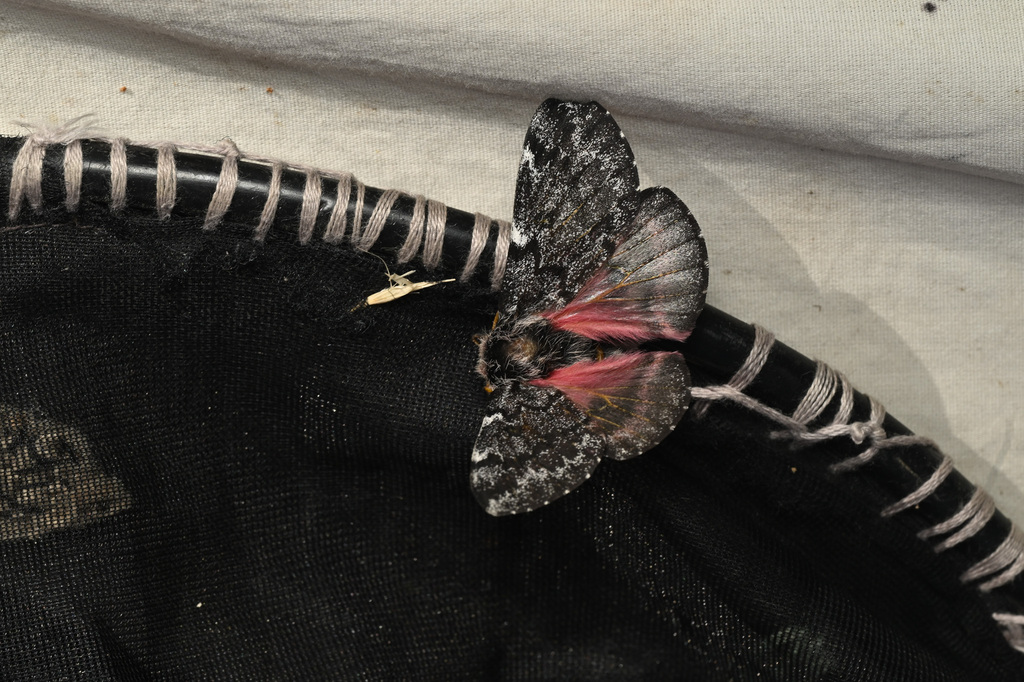
(c) Trevor Van Loon, some rights reserved (CC BY) · licence
Family: Saturniidae · Class: Insecta · Order: Lepidoptera
Coloradia velda (Velda pinemoth) is a California animal in the Saturniidae family.
The Velda pinemoth (Coloradia velda) is a medium-sized moth in the family Saturniidae, endemic to the San Bernardino Mountains of California. Adults exhibit typical saturniid characteristics with a robust body and broad wings spanning approximately 60-80 mm (2.4-3.1 inches). The forewings display a mottled pattern of browns and grays with distinct eyespots, while the hindwings are typically lighter with similar markings. Males are generally smaller than females and possess more feathery antennae for detecting female pheromones. The caterpillars are large and cylindrical, reaching lengths of 75-100 mm (3.0-3.9 inches) when mature, with a green to brown coloration and rows of prominent spines along their body segments. Coloradia velda occurs exclusively in the San Bernardino Mountains of San Bernardino County, California. This represents one of the most geographically restricted distributions among North American saturniid moths. The species' range is constrained by the distribution of its obligate host plant and suitable montane habitat within this mountain system. Historical records suggest the moth was once more widely distributed within appropriate habitat zones of the San Bernardino Mountains. The species inhabits montane forests and woodlands where pinyon pine (Pinus monophylla) occurs, typically at elevations between 1,200 and 2,400 meters (4,000-8,000 feet). These areas are characterized by semi-arid conditions with hot, dry summers and cold winters. The moth requires mature pinyon pine stands for successful reproduction, as larvae depend entirely on this host plant for nutrition. Suitable habitat includes both pure pinyon stands and mixed coniferous forests where pinyon pine is a significant component. Velda pinemoth larvae are specialist herbivores that feed exclusively on pinyon pine needles and developing shoots. Females deposit eggs on pinyon pine branches during late summer or early fall, and larvae typically emerge the following spring. Development takes one to two years to complete, with caterpillars overwintering in diapause. Pupation occurs in the soil beneath host trees, with adults emerging during summer months. Adults do not feed, relying on energy reserves accumulated during the larval stage. Mating typically occurs shortly after emergence, with males using pheromone detection to locate females. The conservation status of Coloradia velda remains poorly documented, with no federal or state listing designations currently assigned. However, the species' extremely limited geographic range and dependence on a single host plant species suggest potential vulnerability to habitat loss and environmental changes. Threats may include forest management practices, wildfire, climate change impacts on pinyon pine distribution, and urban development pressure in the San Bernardino Mountains. The moth's restricted range makes it particularly susceptible to localized disturbances that could affect pinyon pine populations. Additional research is needed to determine current population status and assess conservation needs for this geographically restricted endemic species.
Classification
Class: Insecta · Order: Lepidoptera · Family: Saturniidae
Frequently asked questions
How is Coloradia velda classified?
Coloradia velda belongs to class Insecta, order Lepidoptera, family Saturniidae.
What family does Coloradia velda belong to?
Coloradia velda is in the Saturniidae family.
What is Coloradia velda?
The Velda pinemoth (Coloradia velda) is a medium-sized moth in the family Saturniidae, endemic to the San Bernardino Mountains of California.
Is Coloradia velda found in California?
Yes. Coloradia velda is recorded in California in The California Species Project's catalogue.
Related species
Other California species in the same genus, family, or bioregion.
Data from The California Species Project — 14,000+ California species with verified data from CNPS, CDFW, USFWS, and more.