Coluber constrictor
North American Racer
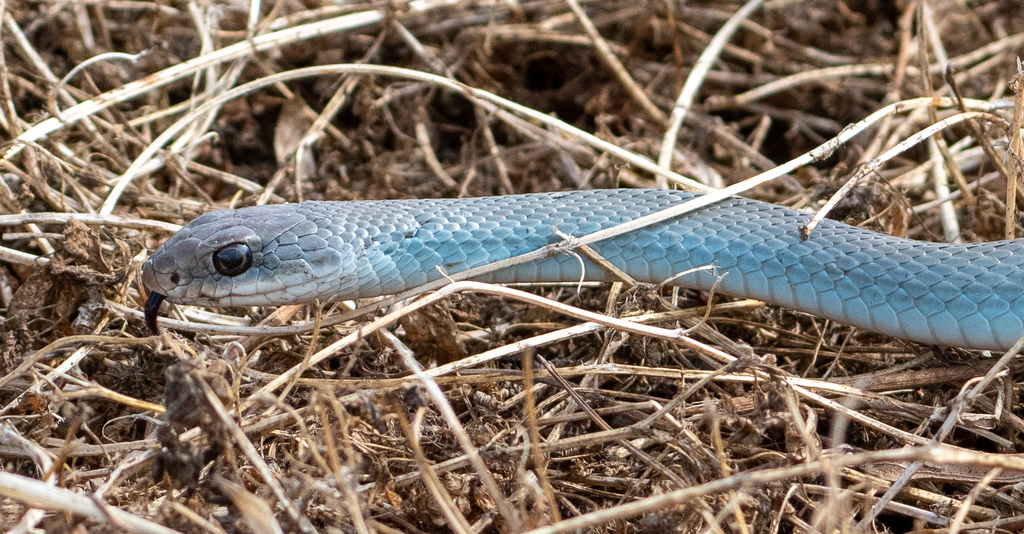
(c) Jonathan Eisen, some rights reserved (CC BY) · licence
Family: Colubridae · Class: Reptilia · Order: Squamata
Coluber constrictor (North American Racer) is a California animal in the Colubridae family.
The North American Racer is a large, slender snake species with adults typically measuring 0.9 to 1.5 meters (3 to 5 feet) in total length, though some individuals may reach 1.8 meters (6 feet). Adults display uniform coloration ranging from blue-black, brown, olive, or gray dorsally, with lighter ventral surfaces that are typically cream, white, or pale yellow. Juveniles exhibit a distinctly different pattern, displaying gray or brown ground color with dark brown or reddish-brown blotches along the back and sides, which fade as the snake matures. The species has smooth scales arranged in 17 rows at midbody, large eyes relative to head size, and a divided anal scale. In California, the North American Racer occurs primarily in the northern and central regions of the state, extending south through the Central Valley and into southern California. The species is found from sea level to elevations of approximately 2,100 meters (7,000 feet) in mountainous areas. Historically, racers were more widespread throughout suitable habitat, but urban development and habitat conversion have reduced their range in some areas, particularly in the Central Valley and coastal regions. North American Racers inhabit diverse habitats including grasslands, oak woodlands, chaparral, riparian corridors, agricultural areas, and open forests. They prefer areas with open ground for hunting combined with nearby cover such as rock piles, brush, or fallen logs for shelter. The species demonstrates strong habitat adaptability, utilizing both natural and modified landscapes, though they require adequate prey populations and refugia for thermoregulation and escape from predators. Racers are diurnal, fast-moving predators that actively hunt rather than ambush prey. Their diet consists primarily of small mammals, birds, eggs, lizards, frogs, and insects, with prey selection varying by season and availability. Adults are excellent climbers and swimmers. Mating occurs in spring, typically from April through June. Females lay clutches of 3 to 30 eggs in loose soil, rotting logs, or similar substrate during summer months. Eggs incubate for 45 to 65 days, with hatchlings emerging from late summer through early fall. Young racers may fall prey to various predators including birds of prey, larger snakes, and mammals, while adults have fewer natural predators due to their size and speed. The North American Racer is not federally or state listed in California and maintains relatively stable populations across much of its range. However, local populations face pressure from habitat loss due to agricultural conversion, urban development, and fragmentation of natural areas. Road mortality represents a significant threat in developed regions. The species benefits from habitat conservation efforts that preserve large blocks of grassland and woodland habitats with connectivity corridors between suitable areas.
Classification
Class: Reptilia · Order: Squamata · Family: Colubridae
Frequently asked questions
How is Coluber constrictor classified?
Coluber constrictor belongs to class Reptilia, order Squamata, family Colubridae.
What family does Coluber constrictor belong to?
Coluber constrictor is in the Colubridae family.
What is Coluber constrictor?
The North American Racer is a large, slender snake species with adults typically measuring 0.9 to 1.5 meters (3 to 5 feet) in total length, though some individuals may reach 1.8 meters (6 feet).
Is Coluber constrictor found in California?
Yes. Coluber constrictor is recorded in California in The California Species Project's catalogue.
Related species
Other California species in the same genus, family, or bioregion.
Data from The California Species Project — 14,000+ California species with verified data from CNPS, CDFW, USFWS, and more.