Coluber taeniatus
Striped Whipsnake
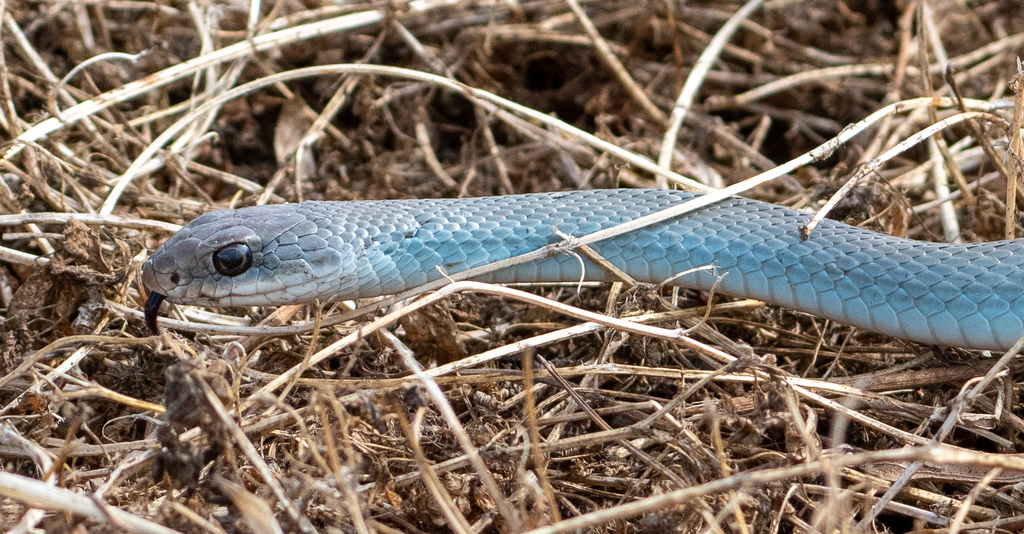
(c) Jonathan Eisen, some rights reserved (CC BY) · licence
Family: Colubridae · Class: Reptilia · Order: Squamata
Coluber taeniatus (Striped Whipsnake) is a California animal in the Colubridae family.
The striped whipsnake is a large, slender colubrid snake that reaches lengths of 0.9 to 1.8 meters (3 to 6 feet), with exceptional individuals occasionally exceeding 2 meters (6.5 feet). The body is elongated and cylindrical with a relatively small head distinct from the neck. Dorsal coloration varies from cream to light yellow or pale gray, marked by four distinct dark longitudinal stripes running the length of the body. The central pair of stripes is typically darker and more prominent than the lateral stripes. The ventral surface is white to pale yellow. Juveniles display similar patterns but with more contrasting coloration. Historically, striped whipsnakes occurred throughout much of California's interior regions, from the Central Valley to the Mojave Desert and extending into the Transverse and Peninsular Ranges. Current distribution includes portions of the San Joaquin Valley, southern Sierra Nevada foothills, Tehachapi Mountains, and scattered locations in the Mojave Desert. The species ranges from near sea level to elevations of approximately 2,440 meters (8,000 feet), though it is most common below 1,525 meters (5,000 feet). Striped whipsnakes inhabit a variety of arid and semi-arid environments including chaparral, oak woodland, pinyon-juniper woodland, and desert scrub communities. They show particular affinity for areas with rock outcrops, canyon walls, and boulder fields that provide shelter and basking sites. The species also utilizes riparian corridors and agricultural edges where prey is abundant. Ground cover typically consists of scattered shrubs with open areas for thermoregulation. This diurnal species is highly active and fast-moving, capable of sustained speeds up to 11 kilometers per hour (7 miles per hour) when pursuing prey or escaping threats. Striped whipsnakes are primarily lizard specialists, consuming fence lizards, whiptails, skinks, and small snakes. They also take small mammals, birds, and insects. Mating occurs in spring following emergence from winter dormancy. Females deposit 3 to 12 leathery eggs in underground burrows or beneath rocks during late spring or early summer. Eggs incubate for 65 to 80 days, with hatchlings emerging in late summer measuring 25 to 30 centimeters (10 to 12 inches). The striped whipsnake is not federally or state listed, though populations have declined in some areas due to habitat conversion and fragmentation. Agricultural development in the Central Valley has eliminated suitable habitat across extensive portions of the historical range. Urban expansion in foothill regions continues to reduce available habitat. Road mortality poses a significant threat, particularly during the active season when individuals cross roadways while hunting. Climate change may affect the species through altered precipitation patterns and increased temperatures in desert habitats. Current population trends vary regionally, with stable populations in protected areas but continued declines in developed landscapes.
Classification
Class: Reptilia · Order: Squamata · Family: Colubridae
Frequently asked questions
How is Coluber taeniatus classified?
Coluber taeniatus belongs to class Reptilia, order Squamata, family Colubridae.
What family does Coluber taeniatus belong to?
Coluber taeniatus is in the Colubridae family.
What is Coluber taeniatus?
The striped whipsnake is a large, slender colubrid snake that reaches lengths of 0.9 to 1.8 meters (3 to 6 feet), with exceptional individuals occasionally exceeding 2 meters (6.5 feet).
Is Coluber taeniatus found in California?
Yes. Coluber taeniatus is recorded in California in The California Species Project's catalogue.
Related species
Other California species in the same genus, family, or bioregion.
Data from The California Species Project — 14,000+ California species with verified data from CNPS, CDFW, USFWS, and more.