Columbina inca
Inca Dove
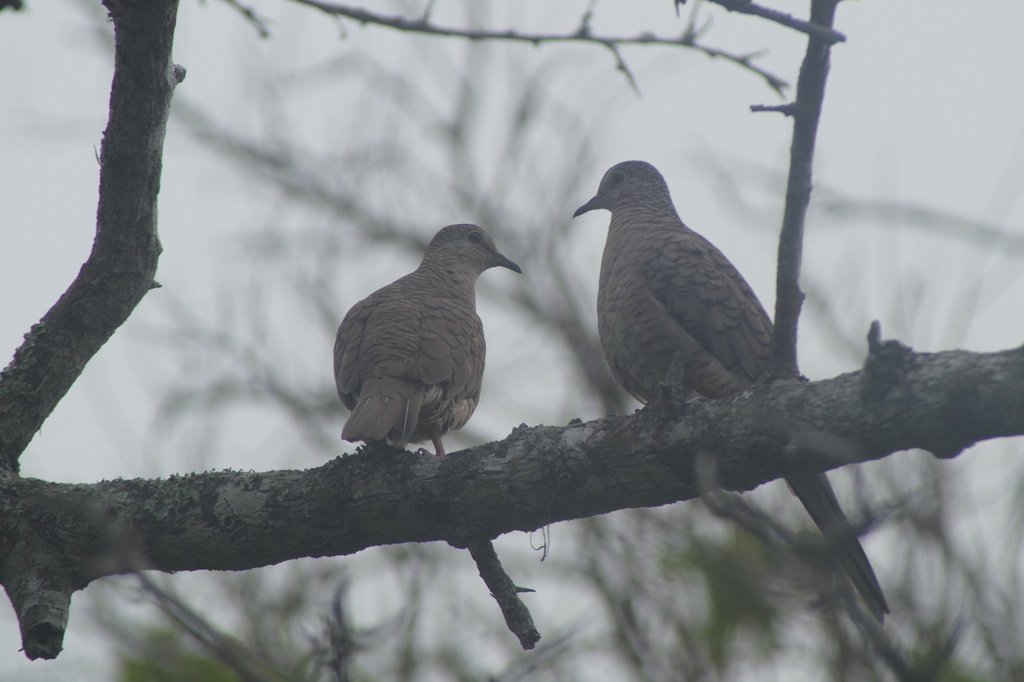
(c) Carlos Domínguez-Rodríguez, some rights reserved (CC BY) · licence
Family: Columbidae · Class: Aves · Order: Columbiformes
Columbina inca (Inca Dove) is a California animal in the Columbidae family.
The Inca Dove is a small, compact dove measuring 16.5 to 23 centimeters (6.5 to 9.0 inches) in length with a wingspan of 28 to 32 centimeters (11 to 12.6 inches). Adults weigh 30 to 58 grams (1.1 to 2.0 ounces). The species displays distinctive scaled plumage, with dark-edged feathers creating a scalloped pattern across the pale gray-brown upperparts and whitish underparts. The long, square-tipped tail is edged with white outer feathers that become conspicuous in flight. Males and females appear similar, though males may show slightly more pronounced scaling and darker coloration during breeding season. Juveniles display less distinct scaling and buffer overall coloration. Historically, Inca Doves ranged from the southwestern United States through Central America to Costa Rica. In California, the species was first documented as a vagrant in the 1980s, with scattered records primarily from the Imperial Valley and desert regions of Riverside and San Bernardino counties. Most California occurrences represent overshoots from expanding Arizona populations, though the species has not established permanent breeding populations in the state. The core breeding range extends from Arizona, New Mexico, and Texas southward through Mexico. Inca Doves inhabit arid and semi-arid environments, showing strong association with human-modified landscapes. They occur in desert towns, urban parks, agricultural areas, and suburban neighborhoods with scattered trees and shrubs. The species typically occupies elevations from sea level to 1,500 meters (4,900 feet), preferring areas with open ground for foraging and nearby trees or structures for nesting and roosting. In their core range, they frequent areas with mesquite, palo verde, and introduced shade trees. Inca Doves are highly social, often gathering in flocks of 20 to 100 individuals, particularly during non-breeding periods. They forage primarily on the ground, consuming small seeds from grasses, forbs, and shrubs, with a particular preference for seeds smaller than 4 millimeters. Their diet includes seeds from Bermuda grass, pigweed, and various annual plants. Breeding occurs year-round in suitable climates, with peak activity from March through October. Pairs construct flimsy platform nests of twigs, grass, and rootlets, typically 1 to 8 meters above ground in shrubs, trees, or on human structures. Females lay two white eggs per clutch, with incubation lasting 12 to 14 days. Both parents share incubation and feeding duties, and pairs may produce multiple broods annually. The Inca Dove is not federally or state-listed as threatened or endangered. The species has actually expanded its range northward over the past century, likely facilitated by habitat modification, irrigation, and climate change. Populations appear stable to increasing throughout most of their range. In California, the species remains a rare vagrant, with fewer than 50 documented records as of 2024. The species benefits from urban development that provides water sources, food, and nesting sites, though excessive pesticide use and habitat homogenization may pose localized threats.
Classification
Class: Aves · Order: Columbiformes · Family: Columbidae
Frequently asked questions
How is Columbina inca classified?
Columbina inca belongs to class Aves, order Columbiformes, family Columbidae.
What family does Columbina inca belong to?
Columbina inca is in the Columbidae family.
What is Columbina inca?
The Inca Dove is a small, compact dove measuring 16.5 to 23 centimeters (6.5 to 9.0 inches) in length with a wingspan of 28 to 32 centimeters (11 to 12.6 inches).
Is Columbina inca found in California?
Yes. Columbina inca is recorded in California in The California Species Project's catalogue.
Related species
Other California species in the same genus, family, or bioregion.
Data from The California Species Project — 14,000+ California species with verified data from CNPS, CDFW, USFWS, and more.