Columbina talpacoti
Ruddy Ground-Dove
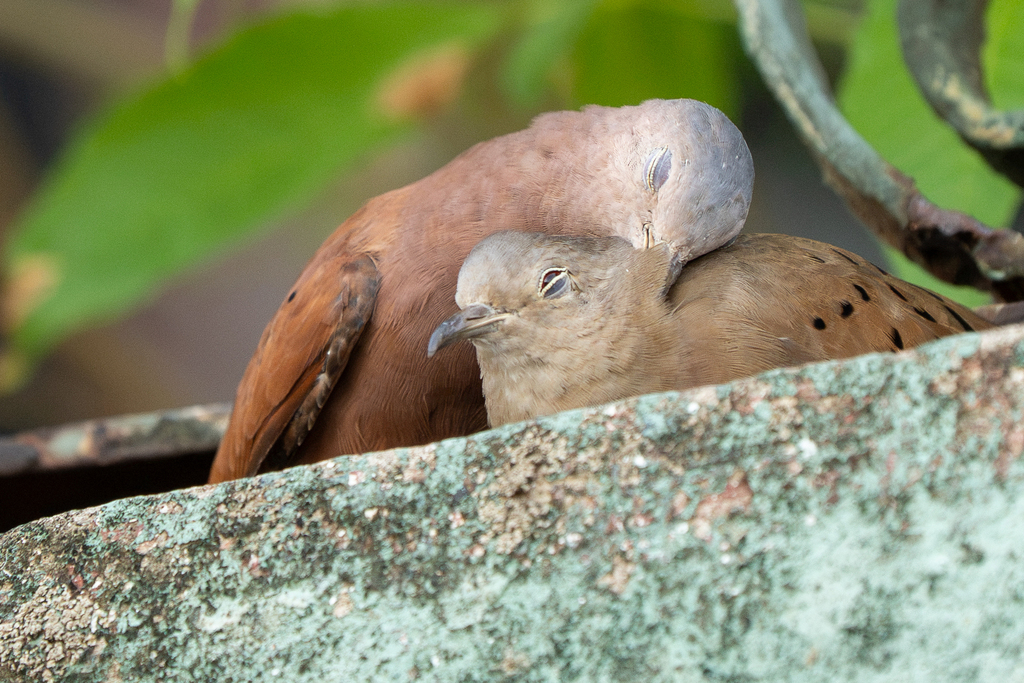
(c) Anthony Batista, some rights reserved (CC BY) · licence
Family: Columbidae · Class: Aves · Order: Columbiformes
Columbina talpacoti (Ruddy Ground-Dove) is a California animal in the Columbidae family.
The Ruddy Ground-Dove is a small, compact dove measuring 15-18 cm (5.9-7.1 inches) in length with a wingspan of 22-28 cm (8.7-11.0 inches). Males display distinctive rufous-cinnamon plumage on the head, neck, and underparts, with darker brown wings marked by small black spots on the wing coverts. The back and rump are grayish-brown with a rufous wash. Females are generally duller, showing more grayish-brown tones throughout with less pronounced rufous coloration. Both sexes have dark eyes, orange-red to reddish legs, and a straight, dark bill. In flight, the wings reveal bright chestnut underwing coverts that contrast sharply with darker flight feathers. Historically, the Ruddy Ground-Dove's range extends from extreme southern Texas through Mexico, Central America, and much of South America. In the United States, the species is primarily resident in the Rio Grande Valley of Texas. California records are extremely rare and typically represent vagrant individuals far outside the species' normal range. Most California sightings have occurred in southern counties, particularly along the coast and in desert areas near the Mexican border. The species inhabits open and semi-open areas including agricultural fields, pastures, scrublands, and woodland edges. Ruddy Ground-Doves prefer areas with scattered trees or shrubs for roosting and nesting, combined with open ground for foraging. They are commonly found in cultivated areas, ranch lands, and human-modified habitats. Elevation ranges from sea level to approximately 1,500 meters (4,900 feet) in most of their range. Ruddy Ground-Doves are primarily granivorous, feeding on small seeds collected from the ground surface. Their diet consists mainly of grass seeds, weed seeds, and occasionally small insects. They forage by walking methodically across open ground, picking seeds from soil and leaf litter. The species is often observed in pairs or small flocks, particularly outside the breeding season. Nesting occurs in low shrubs or trees, typically 1-3 meters above ground. The female constructs a simple platform nest of twigs and places 2 white eggs. Breeding can occur year-round in tropical portions of their range, with peak activity during wet seasons when food resources are most abundant. The Ruddy Ground-Dove is not federally or state listed in California, as it is not considered part of the state's regular avifauna. The species has no established breeding population in California and appears only as a casual vagrant. According to eBird data, fewer than 20 records exist for California as of December 2025. The species is considered stable throughout most of its natural range in Latin America, though populations may face localized pressures from habitat conversion and agricultural intensification. Climate change could potentially influence the northern extent of the species' range, though any range expansion into California would likely remain limited to extreme southern border areas.
Classification
Class: Aves · Order: Columbiformes · Family: Columbidae
Frequently asked questions
How is Columbina talpacoti classified?
Columbina talpacoti belongs to class Aves, order Columbiformes, family Columbidae.
What family does Columbina talpacoti belong to?
Columbina talpacoti is in the Columbidae family.
What is Columbina talpacoti?
The Ruddy Ground-Dove is a small, compact dove measuring 15-18 cm (5.9-7.1 inches) in length with a wingspan of 22-28 cm (8.7-11.0 inches).
Is Columbina talpacoti found in California?
Yes. Columbina talpacoti is recorded in California in The California Species Project's catalogue.
Related species
Other California species in the same genus, family, or bioregion.
Data from The California Species Project — 14,000+ California species with verified data from CNPS, CDFW, USFWS, and more.