Conophorus fenestratus
Cone-snout Bee Fly
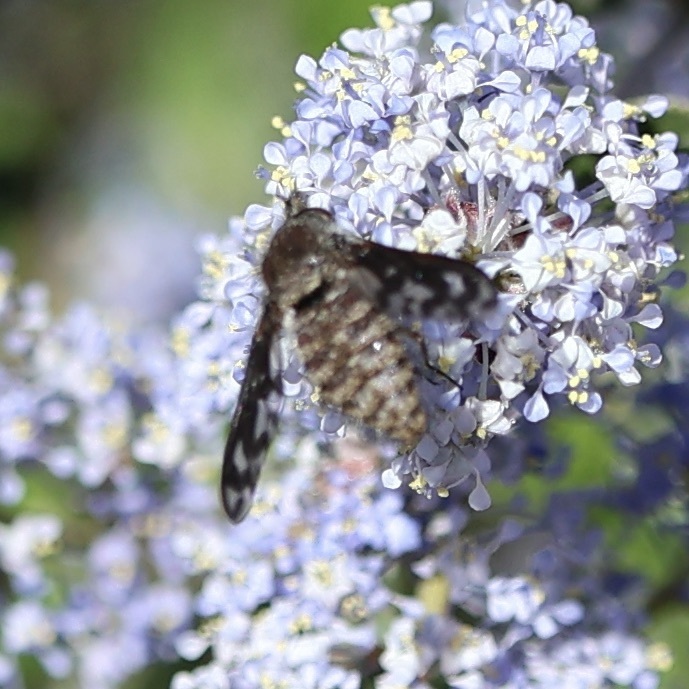
no rights reserved · CC0
Family: Bombyliidae · Class: Insecta · Order: Diptera
Conophorus fenestratus (Cone-snout Bee Fly) is a California animal in the Bombyliidae family.
The cone-snout bee fly (Conophorus fenestratus) is a distinctive member of the family Bombyliidae, characterized by its all-black coloration and conical snout-like proboscis. This dipteran species belongs to the subfamily Bombyliinae and tribe Conophorini. Adults are relatively small to medium-sized flies with dark wings and a robust, hairy body typical of bee flies. The species can be distinguished from related bee flies by its uniform black appearance, lacking the striped patterns seen in some congeners like C. cristatus. Conophorus fenestratus occurs in California, with documented populations in coastal and inland regions. According to biological surveys, the species has been recorded in areas including the Ballona Wetlands and surrounding coastal communities of Los Angeles County (Mattoni 1991). The species appears to have associations with sandy habitats, particularly sand dune ecosystems where it has been specifically documented as a characteristic species. The species inhabits coastal and near-coastal environments, with a particular affinity for sand dune communities. Research indicates that C. fenestratus shows strong habitat specificity, being most abundant in sand dune environments where it maintains higher population densities compared to other habitat types (Mattoni 1991). The species has been documented in association with native plant communities typical of California's coastal scrub and dune systems, including areas where restoration activities are ongoing. As a member of the Bombyliidae, cone-snout bee flies are important pollinators and nectar feeders as adults. Bee flies typically hover near flowers while feeding, using their elongated proboscis to access nectar from deep corolla tubes. Many bombyliid species are effective pollinators due to their hairy bodies which readily collect and transfer pollen between flowers. The larvae of most bee fly species are parasitoids or predators of other insects, though specific host relationships for C. fenestratus have not been well documented in the available literature. Like many specialized coastal species in California, C. fenestratus faces potential conservation challenges from habitat loss and fragmentation of coastal dune systems. Historical surveys suggest the species was more widespread in coastal areas that have since undergone significant urban development. The species is not currently listed under federal or state endangered species acts, and specific population trend data are not available. However, the documented association with sand dune habitats, which have experienced substantial reduction throughout California's coast, suggests that monitoring of populations may be warranted. Conservation of remaining coastal dune systems and ongoing habitat restoration efforts, such as those at LAX and other coastal sites, may benefit this species and other dune-associated invertebrates. Detailed ecological studies of this species remain limited, and additional research on its specific host plant relationships, life cycle requirements, and population status would enhance understanding of its conservation needs.
Classification
Class: Insecta · Order: Diptera · Family: Bombyliidae
Frequently asked questions
How is Conophorus fenestratus classified?
Conophorus fenestratus belongs to class Insecta, order Diptera, family Bombyliidae.
What family does Conophorus fenestratus belong to?
Conophorus fenestratus is in the Bombyliidae family.
What is Conophorus fenestratus?
The cone-snout bee fly (Conophorus fenestratus) is a distinctive member of the family Bombyliidae, characterized by its all-black coloration and conical snout-like proboscis.
Is Conophorus fenestratus found in California?
Yes. Conophorus fenestratus is recorded in California in The California Species Project's catalogue.
Related species
Other California species in the same genus, family, or bioregion.
Data from The California Species Project — 14,000+ California species with verified data from CNPS, CDFW, USFWS, and more.