Contia longicaudae
Forest Sharp-Tailed Snake
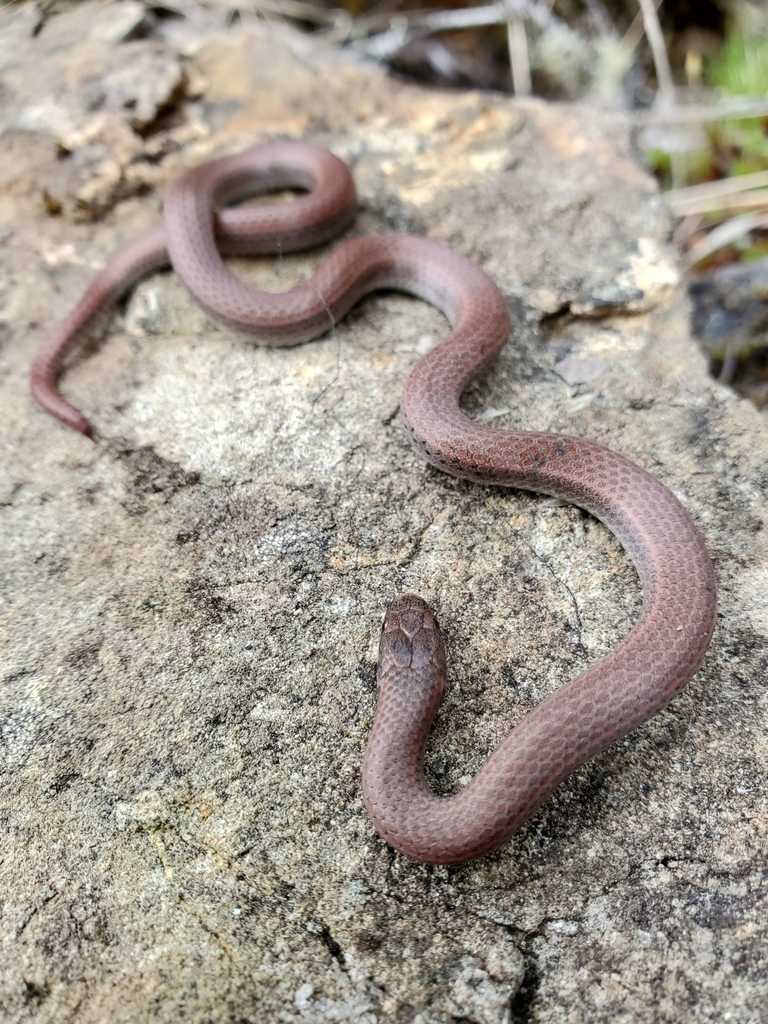
no rights reserved · CC0
Family: Colubridae · Class: Reptilia · Order: Squamata
Contia longicaudae (Forest Sharp-Tailed Snake) is a California animal in the Colubridae family.
The Forest Sharp-tailed Snake (Contia longicaudae) is a small, secretive colubrid snake endemic to the Pacific Northwest. Adults typically measure 200 to 400 mm (8 to 16 inches) in total length, with females generally larger than males. The species exhibits a slender build with a relatively long tail comprising approximately 25-30% of total body length. The dorsal coloration ranges from reddish-brown to gray-brown, often with a slight reddish tinge. The ventral surface is cream to pale yellow with a row of dark spots along each side of the belly scales. A distinctive pale collar or band often encircles the neck, though this feature may be faint or absent in some individuals. The scales are smooth and arranged in 15 dorsal rows at midbody. Historically, the Forest Sharp-tailed Snake occurred in humid coniferous forests from southwestern British Columbia south through western Washington and Oregon to northwestern California. In California, the species is documented from Humboldt, Del Norte, and potentially Mendocino counties. The current distribution appears fragmented, with many historical localities no longer supporting populations. Recent surveys suggest the species may have experienced significant range contraction, particularly at the southern extent of its distribution. The species inhabits mature coniferous forests dominated by Douglas-fir, western hemlock, and redwood. Forest Sharp-tailed Snakes are typically found in areas with dense canopy cover, abundant woody debris, and thick duff layers. They occur from sea level to elevations of approximately 1,200 meters (3,900 feet). The species shows strong preference for microhabitats with high moisture retention, including areas beneath logs, bark, leaf litter, and talus slopes within forested settings. These snakes are fossorial, spending most of their time underground or beneath surface cover objects. Forest Sharp-tailed Snakes are specialized predators that feed almost exclusively on slugs, particularly species in the genus Ariolimax and other terrestrial gastropods. Their feeding behavior involves seizing slugs and swallowing them whole, often consuming prey items nearly as large as the snake's head. Reproduction occurs through oviposition, with females laying clutches of 2 to 8 eggs during summer months. Eggs are deposited in moist soil or decaying organic matter. Hatchlings emerge in late summer or early fall, measuring approximately 80-100 mm (3-4 inches) in total length. The species is primarily nocturnal and exhibits reduced activity during dry periods. While not federally listed, the Forest Sharp-tailed Snake faces significant conservation challenges. Primary threats include habitat loss from logging, urban development, and forest management practices that reduce canopy cover and eliminate woody debris. Climate change may further impact the species through altered precipitation patterns and increased temperatures that affect soil moisture levels. The species' specialized diet and habitat requirements make it particularly vulnerable to environmental changes. Current population trends are poorly understood due to the secretive nature of the species and limited recent survey efforts.
Classification
Class: Reptilia · Order: Squamata · Family: Colubridae
Frequently asked questions
How is Contia longicaudae classified?
Contia longicaudae belongs to class Reptilia, order Squamata, family Colubridae.
What family does Contia longicaudae belong to?
Contia longicaudae is in the Colubridae family.
What is Contia longicaudae?
The Forest Sharp-tailed Snake (Contia longicaudae) is a small, secretive colubrid snake endemic to the Pacific Northwest.
Is Contia longicaudae found in California?
Yes. Contia longicaudae is recorded in California in The California Species Project's catalogue.
Related species
Other California species in the same genus, family, or bioregion.
Data from The California Species Project — 14,000+ California species with verified data from CNPS, CDFW, USFWS, and more.