Contopus cooperi
Olive-sided Flycatcher
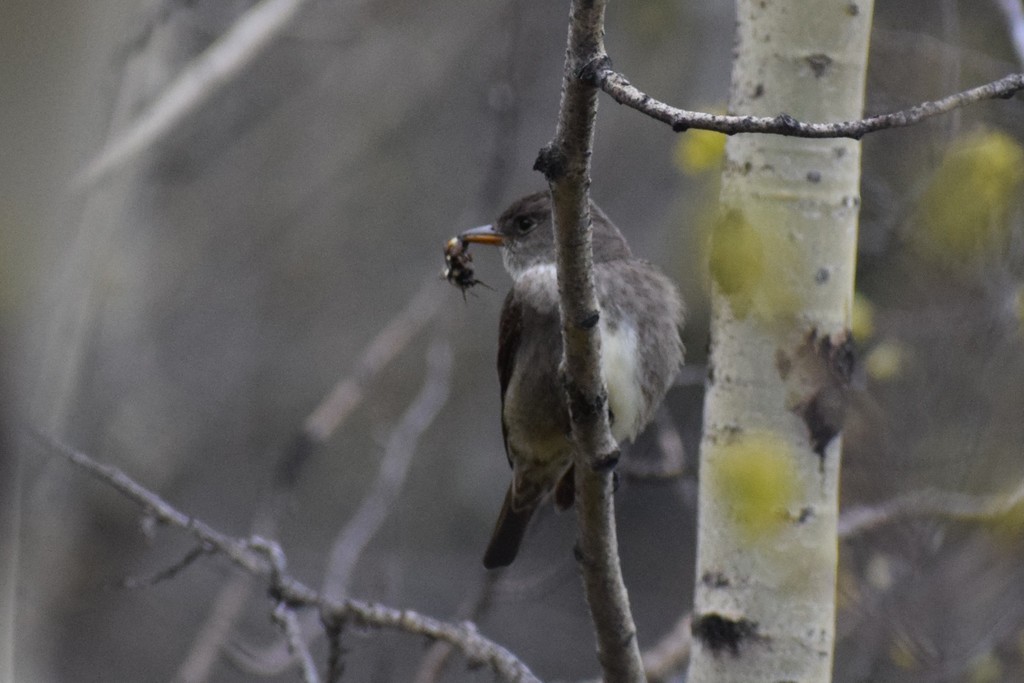
(c) Syd Cannings, some rights reserved (CC BY) · licence
Family: Tyrannidae · Class: Aves · Order: Passeriformes
Conservation status: G4 S3
Contopus cooperi (Olive-sided Flycatcher) is a California animal in the Tyrannidae family.
The Olive-sided Flycatcher is a medium-sized passerine bird measuring 18 to 20 cm (7.1 to 7.9 inches) in length with a wingspan of 33 to 36 cm (13 to 14 inches). Adults weigh 30 to 35 grams. The species displays a distinctive three-toned appearance with dark olive-brown upperparts, white underparts, and prominent dark olive-brown flanks that create a characteristic vest-like pattern. The head is proportionally large with a broad, flat bill typical of aerial insectivores. White tufts of feathers on the lower back are often visible in flight or when the bird is agitated. The tail is relatively short and slightly notched. The Olive-sided Flycatcher breeds across boreal and montane forests of North America, from Alaska south through the western United States to Central America. In California, the species occurs primarily in the Sierra Nevada, Cascade Range, and higher elevations of the Coast Ranges. Breeding populations are found from Siskiyou County south to Kern County, with scattered populations in the San Bernardino and San Gabriel Mountains. The species winters in South America, primarily in the Andes from Colombia to Peru. Breeding habitat consists of mature coniferous and mixed forests with openings, typically at elevations between 1,200 and 2,800 meters (3,900 to 9,200 feet) in California. The species shows strong preference for forest edges, burned areas with standing snags, and areas with tall dead trees or prominent perches overlooking clearings. Common associated tree species include Douglas fir, ponderosa pine, lodgepole pine, and red fir. Nest sites are typically placed on horizontal branches of conifers, 4 to 15 meters above ground. Olive-sided Flycatchers are aerial insectivores that hunt from prominent perches, making long sallying flights to capture flying insects including beetles, flies, bees, wasps, and flying ants. The species is territorial during breeding season, with males defending territories of 2 to 10 hectares through aggressive displays and vocalizations. The distinctive song consists of a loud, whistled "quick-three-beers" phrase. Breeding occurs from May through August, with females constructing cup-shaped nests of twigs, rootlets, and lichens. Clutch size ranges from 2 to 4 eggs, with an incubation period of 14 to 17 days. The Olive-sided Flycatcher has experienced significant population declines across its range, with North American Breeding Bird Survey data indicating a 78% decline since 1970. In California, the species is ranked S3, indicating vulnerability to extirpation. Primary threats include loss of mature forest habitat through logging, fire suppression leading to changes in forest structure, and potential impacts from climate change affecting insect prey availability. The species is considered a Bird of Conservation Concern by the U.S. Fish and Wildlife Service as of December 2025, though it lacks federal listing protection.
Classification
Class: Aves · Order: Passeriformes · Family: Tyrannidae
Conservation status
G4 S3
Frequently asked questions
How is Contopus cooperi classified?
Contopus cooperi belongs to class Aves, order Passeriformes, family Tyrannidae.
What family does Contopus cooperi belong to?
Contopus cooperi is in the Tyrannidae family.
Is Contopus cooperi protected or of conservation concern?
Contopus cooperi carries the following status: G4 S3.
What is Contopus cooperi?
The Olive-sided Flycatcher is a medium-sized passerine bird measuring 18 to 20 cm (7.1 to 7.9 inches) in length with a wingspan of 33 to 36 cm (13 to 14 inches).
Is Contopus cooperi found in California?
Yes. Contopus cooperi is recorded in California in The California Species Project's catalogue.
Related species
Other California species in the same genus, family, or bioregion.
Data from The California Species Project — 14,000+ California species with verified data from CNPS, CDFW, USFWS, and more.