Contopus pertinax
Greater Pewee
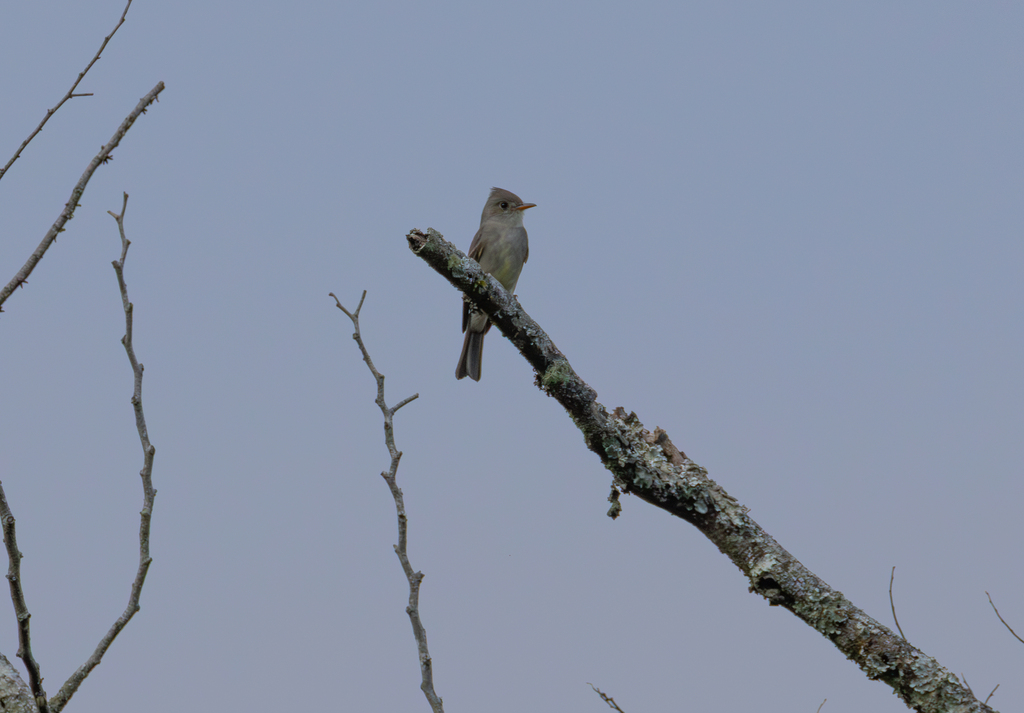
(c) Kevin Brix, some rights reserved (CC BY-SA) · licence
Family: Tyrannidae · Class: Aves · Order: Passeriformes
Contopus pertinax (Greater Pewee) is a California animal in the Tyrannidae family.
The Greater Pewee is a medium-sized flycatcher measuring 18 to 20 cm (7.1 to 7.9 inches) in length with a wingspan of approximately 32 cm (12.6 inches). Adults display olive-gray to brownish-gray upperparts and pale gray underparts with a subtle yellowish wash on the belly. The species exhibits a prominent crest that can be raised or lowered, distinguishing it from similar flycatchers. The bill is relatively long and broad with an orange-yellow lower mandible, while the upper mandible remains dark. Wing bars are typically indistinct or absent, and the tail appears slightly notched. In California, the Greater Pewee occurs primarily as a rare vagrant, with most documented records from fall and winter months along the coast and in southern regions. The species breeds in montane coniferous forests from Arizona and New Mexico southward through Mexico to Nicaragua. During migration and winter, individuals may appear in riparian woodlands, oak forests, and mixed woodland habitats at various elevations. The Greater Pewee inhabits pine-oak forests, mixed coniferous woodlands, and canyon bottoms with dense tree cover. In its breeding range, the species typically occurs at elevations between 1,500 and 3,000 meters (4,900 to 9,800 feet), favoring areas with tall trees for nesting and open spaces for foraging. When occurring as vagrants in California, birds are often found in coastal scrub, riparian corridors, and urban parks with mature trees. This flycatcher employs typical tyrannid foraging behavior, sallying from exposed perches to capture flying insects before returning to the same or nearby perch. The diet consists primarily of flying insects including flies, beetles, moths, and flying ants. Greater Pewees are known for their distinctive vocalizations, including a clear, whistled "ho-say maria" call that distinguishes them from other pewees. During the breeding season, which occurs from May through July in their primary range, pairs construct cup-shaped nests of plant fibers, bark, and lichens placed on horizontal branches of conifers. Females typically lay 3 to 4 cream-colored eggs with brown spotting. The Greater Pewee is not federally listed and appears to maintain stable populations throughout most of its range. However, the species faces potential threats from habitat loss due to logging and development in montane forests. Climate change may affect the distribution of suitable breeding habitat, particularly at higher elevations. In California, the species remains a rare but regular vagrant, with birders documenting occasional individuals during migration periods. The California Bird Records Committee maintains records of verified sightings, which typically number fewer than five individuals per year statewide.
Classification
Class: Aves · Order: Passeriformes · Family: Tyrannidae
Frequently asked questions
How is Contopus pertinax classified?
Contopus pertinax belongs to class Aves, order Passeriformes, family Tyrannidae.
What family does Contopus pertinax belong to?
Contopus pertinax is in the Tyrannidae family.
What is Contopus pertinax?
The Greater Pewee is a medium-sized flycatcher measuring 18 to 20 cm (7.1 to 7.9 inches) in length with a wingspan of approximately 32 cm (12.6 inches).
Is Contopus pertinax found in California?
Yes. Contopus pertinax is recorded in California in The California Species Project's catalogue.
Related species
Other California species in the same genus, family, or bioregion.
Data from The California Species Project — 14,000+ California species with verified data from CNPS, CDFW, USFWS, and more.