Contopus sordidulus
Western Wood-Pewee
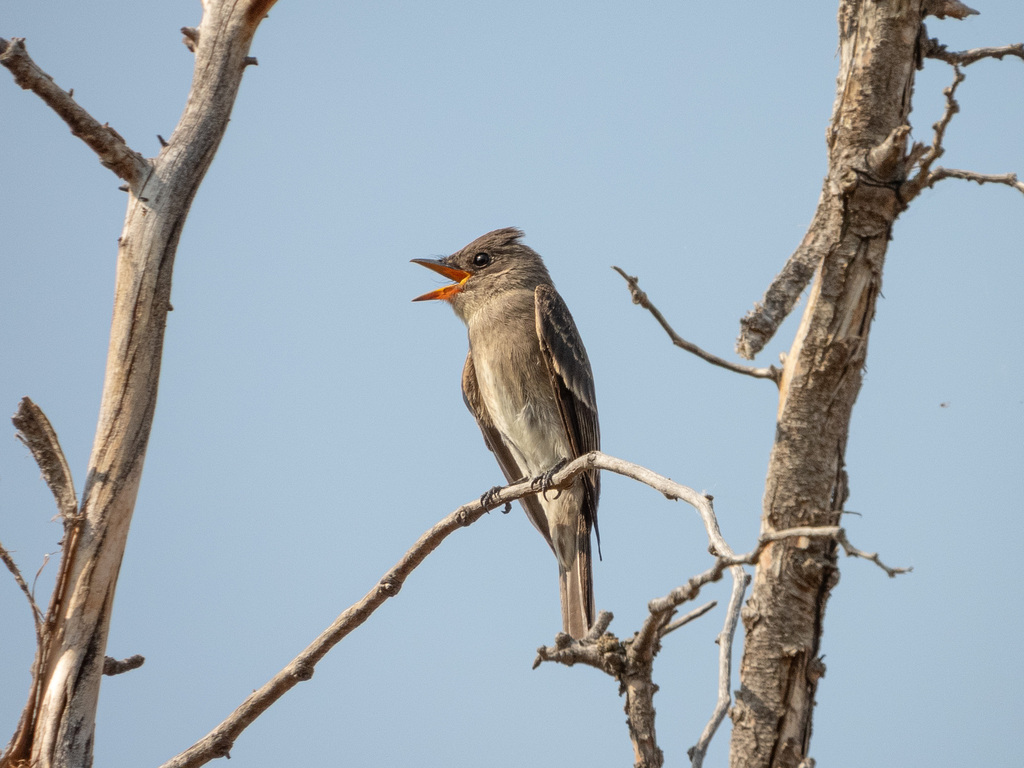
(c) Jason Alexander, some rights reserved (CC BY) · licence
Family: Tyrannidae · Class: Aves · Order: Passeriformes
Contopus sordidulus (Western Wood-Pewee) is a California animal in the Tyrannidae family.
The Western Wood-Pewee is a medium-sized flycatcher measuring 14 to 16 cm (5.5 to 6.3 inches) in length with a wingspan of 25 to 28 cm (9.8 to 11 inches). Adults weigh approximately 12 to 14 grams. The species displays olive-brown to grayish-brown upperparts with darker wings and tail. The underparts are pale yellow to whitish with olive-gray wash on the breast and flanks. Two distinct whitish wing bars cross the darker flight feathers. The bill is relatively long and broad with a dark upper mandible and pale yellow to orange lower mandible with a dark tip. The species lacks an eye ring, distinguishing it from similar Empidonax flycatchers. The Western Wood-Pewee breeds throughout much of western North America, from British Columbia south to Central America. In California, the species occurs in suitable habitat from sea level to approximately 2,750 meters (9,000 feet) elevation. Breeding populations are found throughout the state except in the Colorado and Mojave deserts and the Central Valley. The species is a neotropical migrant, wintering from western Mexico to Panama and returning to California breeding grounds from late April through early June. Breeding habitat consists of open woodlands, forest edges, riparian corridors, and parks with scattered trees. The species favors areas with moderate canopy cover that provide both perching sites and open spaces for aerial foraging. Common habitat types include oak woodlands, mixed coniferous forests, cottonwood-willow riparian zones, and urban parks with mature trees. The species adapts to elevations from coastal areas to montane forests, showing preference for areas with 25 to 75 percent canopy cover. Western Wood-Pewees are sit-and-wait predators that capture flying insects from exposed perches. The diet consists primarily of flies, beetles, moths, flying ants, and other aerial arthropods. Birds typically sally forth from conspicuous perches 3 to 15 meters above ground, returning to the same or nearby perch after capturing prey. The species is known for its distinctive three-part song, a plaintive "pee-ah-wee" call delivered primarily at dawn and dusk. Breeding occurs from May through July, with females constructing cup-shaped nests on horizontal tree branches 2 to 15 meters above ground. Clutches typically contain 2 to 4 eggs, which are incubated for 12 to 13 days. Young fledge after 14 to 18 days but remain dependent on parents for an additional two weeks. The Western Wood-Pewee is not federally or state listed and maintains stable populations across much of its range. However, the species has experienced regional declines, particularly in urban areas and intensively managed forests. According to Partners in Flight, North American populations declined by approximately 1.2 percent annually between 1966 and 2019. Primary threats include habitat loss from development and forest management practices, pesticide use that reduces insect prey availability, and climate change affecting migration timing and breeding success. Conservation efforts focus on maintaining diverse forest structure and preserving riparian corridors that provide critical breeding and foraging habitat.
Classification
Class: Aves · Order: Passeriformes · Family: Tyrannidae
Frequently asked questions
How is Contopus sordidulus classified?
Contopus sordidulus belongs to class Aves, order Passeriformes, family Tyrannidae.
What family does Contopus sordidulus belong to?
Contopus sordidulus is in the Tyrannidae family.
What is Contopus sordidulus?
The Western Wood-Pewee is a medium-sized flycatcher measuring 14 to 16 cm (5.5 to 6.3 inches) in length with a wingspan of 25 to 28 cm (9.8 to 11 inches).
Is Contopus sordidulus found in California?
Yes. Contopus sordidulus is recorded in California in The California Species Project's catalogue.
Related species
Other California species in the same genus, family, or bioregion.
Data from The California Species Project — 14,000+ California species with verified data from CNPS, CDFW, USFWS, and more.