Contopus virens
Eastern Wood-Pewee
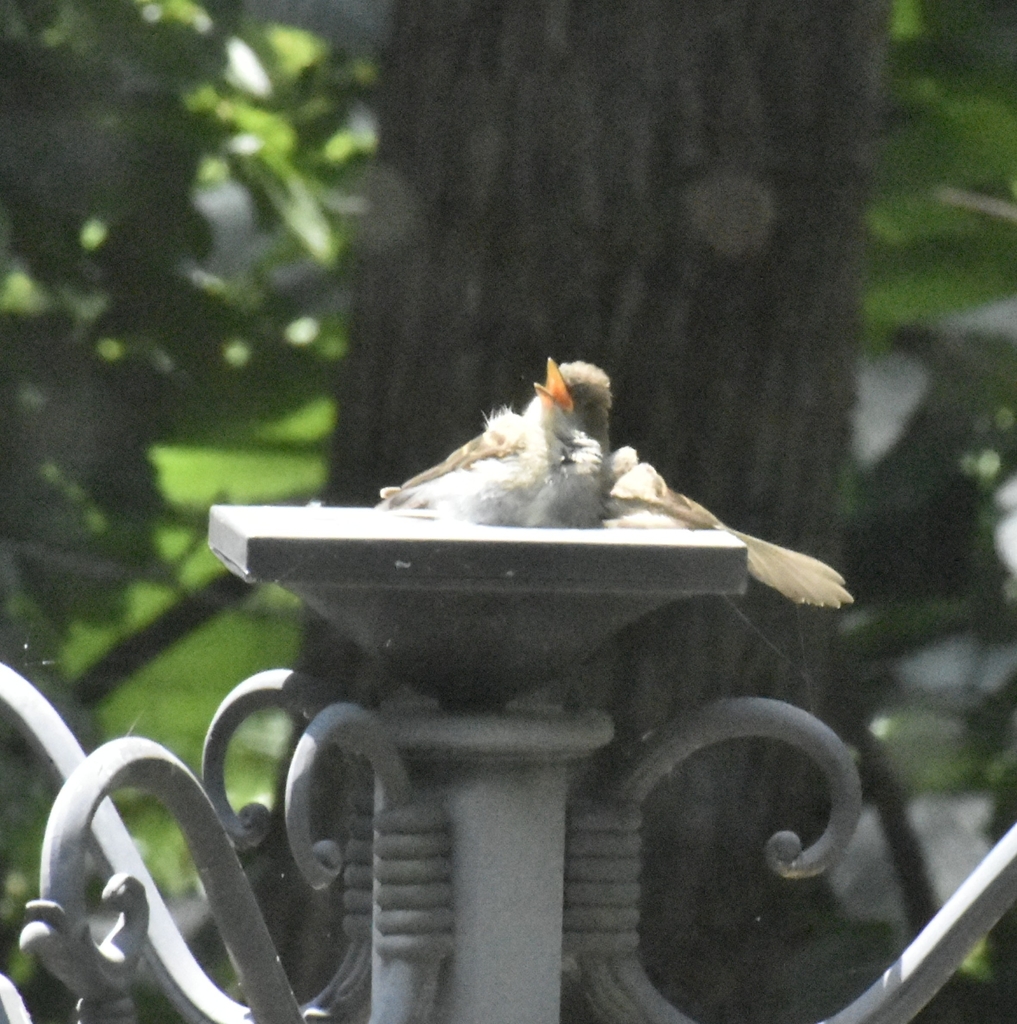
(c) Whitney Mattila, some rights reserved (CC BY) · licence
Family: Tyrannidae · Class: Aves · Order: Passeriformes
Contopus virens (Eastern Wood-Pewee) is a California animal in the Tyrannidae family.
The Eastern Wood-Pewee is a medium-sized flycatcher measuring 14 to 16.5 cm (5.5 to 6.5 inches) in length with a wingspan of 23 to 26 cm (9 to 10 inches). Adults weigh 12 to 14 grams. The species exhibits minimal sexual dimorphism, with both sexes displaying olive-brown to grayish-brown upperparts and pale yellowish-white underparts. Two prominent white wing bars contrast against darker flight feathers. The bill is blackish above with an orange-yellow base on the lower mandible. A distinctive whitish eye ring encircles dark eyes, and the crown may appear slightly crested when raised. Juveniles resemble adults but show buffer wing bars and more pronounced yellowish wash on the underparts. Historically, Eastern Wood-Pewees bred across eastern North America from southeastern Canada south to the Gulf Coast and west to the Great Plains. In California, this species occurs primarily as a vagrant, with scattered records primarily from the southeastern deserts and southern Central Valley during migration periods. Most California observations occur between late August and early October, with occasional spring records from April through May. The species is considered casual to accidental in the state, with fewer than 50 documented records since the 1900s. Eastern Wood-Pewees inhabit mature deciduous and mixed forests, forest edges, and woodlands with open understory. During the breeding season, they prefer areas with tall canopy trees for foraging and dead snags or horizontal branches for nesting. In California, vagrant individuals are typically found in riparian woodlands, desert oases with mature trees, and urban parks with established tree cover. The species shows preference for habitats with flying insect abundance and perching sites 3 to 15 meters above ground. This aerial insectivore captures prey through sally flights from exposed perches, returning to the same or nearby perch after each foraging attempt. Diet consists primarily of flying insects including flies, beetles, moths, flying ants, and small wasps. Eastern Wood-Pewees are known for their distinctive song, a plaintive whistle described as "pee-a-wee" with a rising inflection on the final note. Breeding occurs from May through August in their primary range, with females constructing cup-shaped nests on horizontal branches 6 to 20 meters high. Clutch size typically ranges from 2 to 4 eggs, with incubation lasting 12 to 13 days. The Eastern Wood-Pewee is not federally listed and maintains stable populations across much of its breeding range, though long-term Breeding Bird Survey data indicate gradual population declines since the 1960s. Partners in Flight estimates the North American population at approximately 10 million individuals. Primary threats include habitat loss from deforestation, forest fragmentation, and potential impacts from pesticide use reducing insect prey availability. Climate change may affect insect emergence timing and migration patterns. In California, the species faces no specific conservation concerns due to its vagrant status, though habitat preservation in riparian areas may benefit occasional visitors.
Classification
Class: Aves · Order: Passeriformes · Family: Tyrannidae
Frequently asked questions
How is Contopus virens classified?
Contopus virens belongs to class Aves, order Passeriformes, family Tyrannidae.
What family does Contopus virens belong to?
Contopus virens is in the Tyrannidae family.
What is Contopus virens?
The Eastern Wood-Pewee is a medium-sized flycatcher measuring 14 to 16.5 cm (5.5 to 6.5 inches) in length with a wingspan of 23 to 26 cm (9 to 10 inches).
Is Contopus virens found in California?
Yes. Contopus virens is recorded in California in The California Species Project's catalogue.
Related species
Other California species in the same genus, family, or bioregion.
Data from The California Species Project — 14,000+ California species with verified data from CNPS, CDFW, USFWS, and more.