Copestylum violaceum
Purple Bromeliad Fly
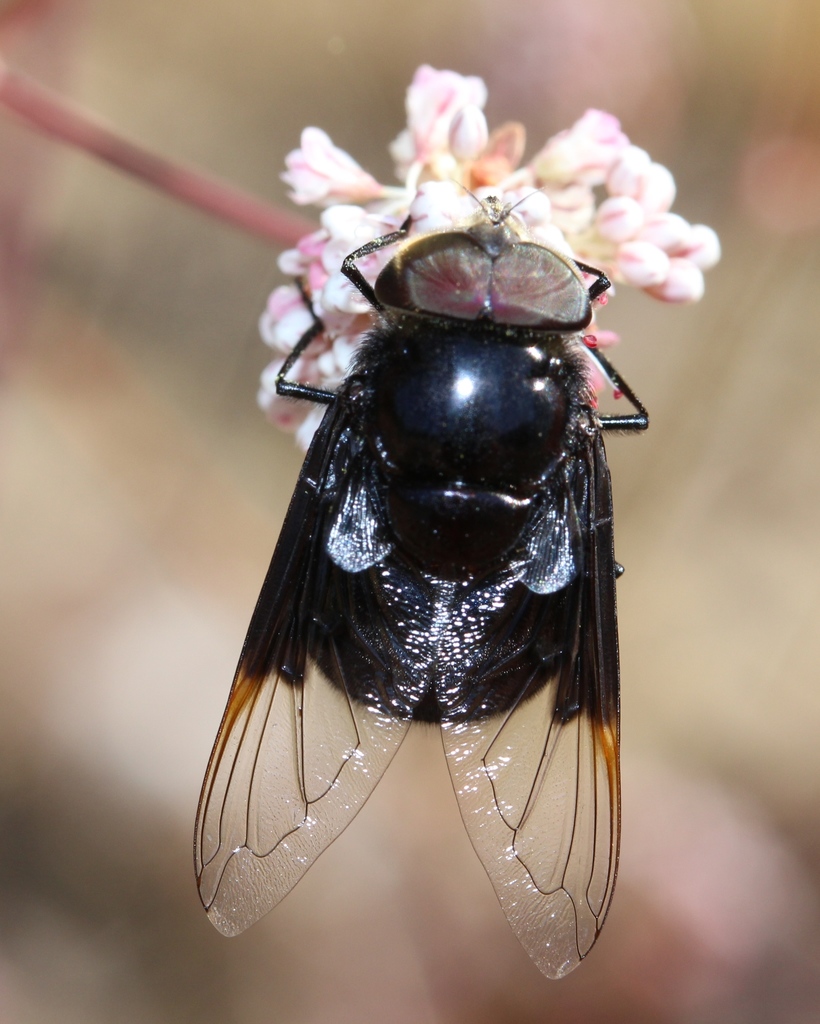
(c) John Hibbard, some rights reserved (CC BY) · licence
Family: Syrphidae · Class: Insecta · Order: Diptera
Copestylum violaceum (Purple Bromeliad Fly) is a California animal in the Syrphidae family.
The Purple Bromeliad Fly is a medium-sized hover fly in the family Syrphidae within the genus Copestylum. Adults measure approximately 16 mm in total length, displaying a distinctive metallic appearance with dark coloration and purple-bronze iridescence (BugGuide 2011). The species exhibits the characteristic hover fly body plan with large compound eyes, short antennae, and a robust thorax. Copestylum violaceum occurs in western North America, with documented records from California. Observations include specimens from San Benito County, specifically from the Aromas area, indicating the species' presence in central coastal California (BugGuide 2011). Additional distribution data for this species remains limited in the scientific literature. The species inhabits diverse terrestrial environments, with documented occurrences in live oak and chaparral habitats. Garden environments also provide suitable habitat, suggesting the species tolerates some degree of human-modified landscapes (BugGuide 2011). Adults are typically found in areas with abundant flowering plants, which provide essential nectar resources. Despite its common name suggesting an association with bromeliads, specific ecological relationships with these plants have not been documented in the available scientific literature for this species. Adult Purple Bromeliad Flies are active during warm months, with documented activity in August (BugGuide 2011). Like other hover flies, adults are important pollinators, visiting flowers for nectar while inadvertently transferring pollen between plants. The species exhibits the characteristic hovering flight behavior of syrphids, maintaining stationary position near flowers or potential mates. Larval biology remains poorly documented in the scientific literature. Based on general Copestylum ecology, larvae likely develop in aquatic or semi-aquatic environments, though specific microhabitat requirements for C. violaceum have not been established through research. No federal or state conservation listing status has been established for Copestylum violaceum. The species appears to maintain populations within its known range, though comprehensive population assessments have not been conducted. Potential threats likely include habitat loss from urban development and agricultural conversion, particularly in coastal California regions. The species' documented presence in garden environments suggests some tolerance of moderate habitat modification. Scientific documentation for this species remains limited. The information presented here is based on available photographic records and observational data from BugGuide (2011). Detailed ecological studies, taxonomic relationships within the genus Copestylum, and larval biology require further research. If you have additional verified information about this species' biology, distribution, or ecology, please contact us to help improve this species account.
Classification
Class: Insecta · Order: Diptera · Family: Syrphidae
Frequently asked questions
How is Copestylum violaceum classified?
Copestylum violaceum belongs to class Insecta, order Diptera, family Syrphidae.
What family does Copestylum violaceum belong to?
Copestylum violaceum is in the Syrphidae family.
What is Copestylum violaceum?
The Purple Bromeliad Fly is a medium-sized hover fly in the family Syrphidae within the genus Copestylum.
Is Copestylum violaceum found in California?
Yes. Copestylum violaceum is recorded in California in The California Species Project's catalogue.
Related species
Other California species in the same genus, family, or bioregion.
Data from The California Species Project — 14,000+ California species with verified data from CNPS, CDFW, USFWS, and more.