Coragyps atratus
Black Vulture
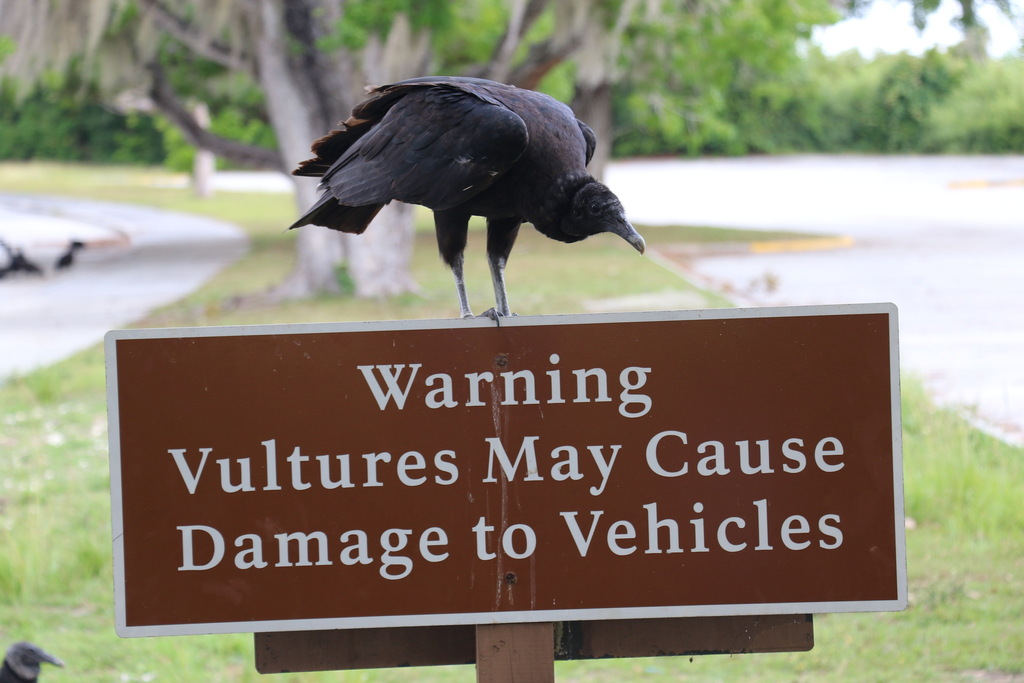
(c) Cricket Raspet, some rights reserved (CC BY) · licence
Family: Cathartidae · Class: Aves · Order: Cathartiformes
Coragyps atratus (Black Vulture) is a California animal in the Cathartidae family.
The Black Vulture is a large scavenging bird with distinctive black plumage and broad wings. Adults measure 56 to 68 cm (22 to 27 inches) in length with a wingspan of 1.3 to 1.5 meters (4.3 to 4.9 feet). Body weight ranges from 1.6 to 3.0 kg (3.5 to 6.6 pounds). The entire body is covered in black feathers, with a contrasting bare, dark gray to black head and neck. In flight, the species displays prominent white patches near the wingtips on the undersides of the primary flight feathers. The tail is short and square, distinguishing it from the longer, more wedge-shaped tail of the Turkey Vulture. Legs are pale gray to white. The Black Vulture's breeding range extends from the southeastern United States south through Central America to northern South America. In North America, the species occurs from New Jersey west to Kansas and south to Texas and Florida. The range has expanded northward in recent decades, with populations now established in Pennsylvania, Ohio, and other northern states. In California, Black Vultures are extremely rare vagrants, with only a few documented records primarily in the southeastern desert regions near the Arizona border. Black Vultures inhabit open and semi-open landscapes including agricultural areas, pastures, wetlands, and woodland edges. They prefer areas with adequate thermal updrafts for soaring and proximity to reliable carrion sources. The species roosts communally in large trees, abandoned buildings, or cliff faces. Unlike Turkey Vultures, Black Vultures lack a well-developed sense of smell and rely primarily on vision to locate food sources. As obligate scavengers, Black Vultures feed exclusively on carrion, including mammals, birds, reptiles, and fish. They are highly social, often feeding in groups and following Turkey Vultures to carcasses. Black Vultures are aggressive at feeding sites and can dominate Turkey Vultures despite being smaller. The species exhibits strong flight capabilities, soaring on thermals and updrafts with minimal wing flapping. Breeding occurs from February through August, varying by latitude. Pairs construct simple nests on the ground under dense vegetation, in hollow logs, or in abandoned buildings. Females typically lay two pale blue eggs with dark markings. Incubation lasts 38 to 45 days, with both parents sharing duties. Chicks fledge after 75 to 80 days but may remain with parents for several additional weeks. The Black Vulture is not federally listed and maintains stable populations throughout most of its range. The species is classified as Least Concern by the International Union for Conservation of Nature. Population trends show increases in many areas, attributed to expanded agricultural activities and road networks that provide carrion sources. In California, the species remains an extremely rare visitor with no established breeding populations. Climate change may facilitate continued northward range expansion as winter temperatures moderate in previously unsuitable areas.
Classification
Class: Aves · Order: Cathartiformes · Family: Cathartidae
Frequently asked questions
How is Coragyps atratus classified?
Coragyps atratus belongs to class Aves, order Cathartiformes, family Cathartidae.
What family does Coragyps atratus belong to?
Coragyps atratus is in the Cathartidae family.
What is Coragyps atratus?
The Black Vulture is a large scavenging bird with distinctive black plumage and broad wings.
Is Coragyps atratus found in California?
Yes. Coragyps atratus is recorded in California in The California Species Project's catalogue.
Related species
Other California species in the same genus, family, or bioregion.
Data from The California Species Project — 14,000+ California species with verified data from CNPS, CDFW, USFWS, and more.