Corbicula fluminea
Asian Clam
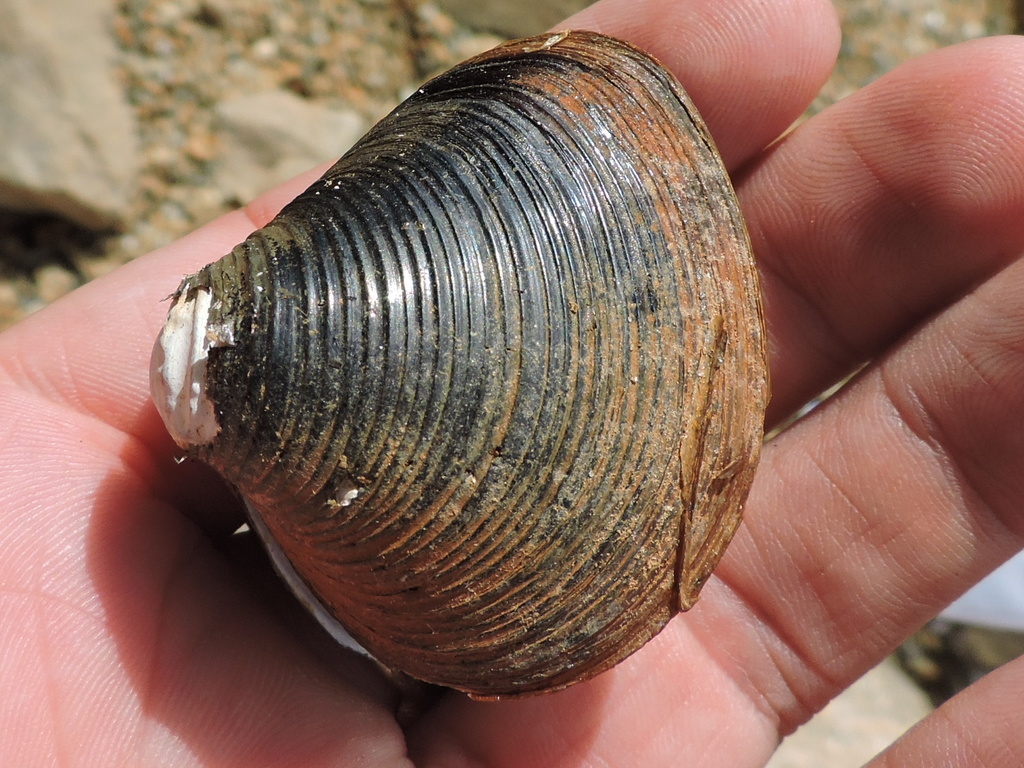
(c) Sam Kieschnick, some rights reserved (CC BY) · licence
Family: Corbiculidae · Class: Bivalvia · Order: Venerida
Corbicula fluminea (Asian Clam) is a California animal in the Corbiculidae family.
The Asian clam is a small freshwater bivalve mollusk measuring typically less than 25 mm (1 inch) in length. The shell displays a triangular to acutely oval shape with a centrally located, prominent beak on the dorsal margin. Distinctive serrated lateral teeth extend on both sides of the beak, serving as a key identifying characteristic. Shell coloration varies from yellowish to light or dark brown, or black, depending on age and environmental conditions. The species exhibits prominent growth ridges on the outer shell surface (USFWS 2011). Corbicula fluminea is native to southeastern China, Korea, southeastern Russia, and the Ussuri Basin. The species was introduced to North America in the early 1900s and first recorded in the United States in 1938 (USFWS 2011). Since introduction, Asian clams have spread extensively throughout major waterways across the continental United States. In the Pacific Northwest, the species occurs in the Columbia River system and was recently discovered in Lake Tahoe in sandy areas near residential developments (Xerces Society 2018). Asian clams inhabit a variety of freshwater environments, showing tolerance for diverse environmental conditions. They prefer medium to large rivers with sand or gravel substrates but can establish populations in lakes, reservoirs, and slower-moving waters. The species demonstrates high adaptability to different water chemistry conditions and temperature ranges. Historically, water temperatures below 2°C (35-37°F) were considered lethal, though thermal pollution from sources like cooling water discharges has enabled establishment in colder northern waters (Xerces Society 2018). Corbicula fluminea functions as a suspension feeder, filtering plankton and organic particles from the water column. The species is a functional hermaphrodite that incubates larvae in gill chambers when water temperatures exceed 15°C. Reproduction is highly plastic, with capability for self-fertilization at different ploidy levels and androgenesis, a form of male quasi-sexual reproduction. Multiple consecutive spawning events can occur when environmental conditions are favorable (USFWS 2024). In native habitats, lifespan typically ranges from 2 to 3 years, but individuals may live up to 5 years in introduced populations (USFWS 2024). As an invasive species, Asian clams pose significant ecological concerns in North American freshwater systems. Dense populations can alter nutrient cycling and compete with native freshwater mussels for food resources and habitat space. The species may directly consume glochidia (larvae) of native mussel species, potentially impacting their reproductive success. In some Pacific Northwest waterbodies, Asian clams have become the most numerous bivalve species, particularly in shallow water habitats where thousands of shells may litter shorelines (Xerces Society 2018). The disappearance of native freshwater mussels from some western watersheds, including California's Anodonta californiensis from the Owens River basin, has been attributed partly to competition from established Asian clam populations.
Classification
Class: Bivalvia · Order: Venerida · Family: Corbiculidae
Frequently asked questions
How is Corbicula fluminea classified?
Corbicula fluminea belongs to class Bivalvia, order Venerida, family Corbiculidae.
What family does Corbicula fluminea belong to?
Corbicula fluminea is in the Corbiculidae family.
What is Corbicula fluminea?
The Asian clam is a small freshwater bivalve mollusk measuring typically less than 25 mm (1 inch) in length.
Is Corbicula fluminea found in California?
Yes. Corbicula fluminea is recorded in California in The California Species Project's catalogue.
More California species
This species has no close relatives in our California data — here are other species to explore.
Data from The California Species Project — 14,000+ California species with verified data from CNPS, CDFW, USFWS, and more.