Cordulia shurtleffii
American Emerald
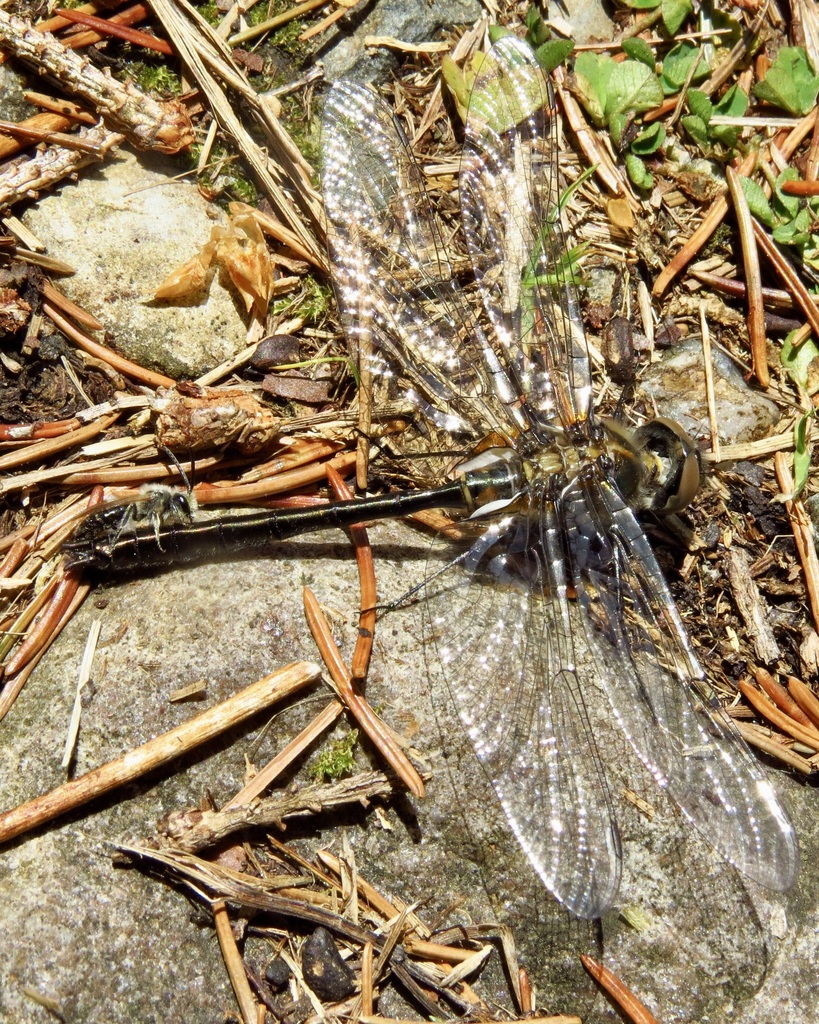
(c) Bernie Paquette, some rights reserved (CC BY) · licence
Family: Corduliidae · Class: Insecta · Order: Odonata
Cordulia shurtleffii (American Emerald) is a California animal in the Corduliidae family.
The American emerald (Cordulia shurtleffii) is a medium-sized dragonfly in the family Corduliidae with a body length of 46-48 mm (1.8-1.9 inches). Adults display the metallic green coloration characteristic of emerald dragonflies, with males typically showing more pronounced emerald hues on the thorax and abdomen. The species can be distinguished from similar emeralds by specific male appendage structures and female subgenital plate characteristics, though field identification often requires close examination. Cordulia shurtleffii has one of the most extensive distributions among North American dragonflies, occurring across much of Canada and the northern United States. In Canada, the species ranges from British Columbia to the Maritime Provinces, including Alberta, Manitoba, New Brunswick, Newfoundland, Nova Scotia, Northwest Territories, Ontario, Prince Edward Island, Quebec, Saskatchewan, and Yukon Territory. Within the United States, populations occur from Alaska south through the western states including California, Colorado, Idaho, Montana, Nevada, Oregon, Utah, Washington, and Wyoming, and across the northern tier states to the Atlantic coast (NatureServe 2025). The American emerald inhabits a variety of wetland types, showing particular affinity for bog and fen complexes, sedge marshes, and slow-moving streams with organic substrates. In mountainous regions, the species occurs at moderate to high elevations, often associated with beaver ponds and other semi-permanent water bodies surrounded by coniferous or mixed forest. Larvae develop in shallow areas with accumulated organic matter, requiring one to two years to complete development depending on local climate conditions. Adults emerge in late spring through mid-summer, with peak flight periods varying by latitude and elevation. Males establish territories over suitable breeding habitat, patrolling areas of open water near emergent vegetation. Females deposit eggs by tapping the water surface or inserting them into floating organic matter. Adults are active predators, capturing flying insects including midges, mosquitoes, and small moths. The species demonstrates considerable dispersal capability, with individuals documented traveling several kilometers between breeding sites. NatureServe assigns the American emerald a global conservation status of G5 (secure), reflecting its wide distribution and relatively stable populations across most of its range. However, state-level rankings reveal significant regional variation, with the species listed as S1 (critically imperiled) in North Carolina and Ohio, and S3 (vulnerable) in Connecticut, Maryland, Pennsylvania, and Virginia (NatureServe 2025). Climate change poses potential long-term threats, particularly to southern populations, through altered precipitation patterns, increased drought frequency, and rising temperatures that may reduce suitable habitat. Wetland degradation from development, water diversions, and invasive species also threatens local populations. The species' inclusion in multiple state wildlife action plans as a Species of Greatest Conservation Need underscores the importance of continued monitoring and habitat protection, particularly in peripheral portions of its range where populations may be most vulnerable to environmental changes.
Classification
Class: Insecta · Order: Odonata · Family: Corduliidae
Frequently asked questions
How is Cordulia shurtleffii classified?
Cordulia shurtleffii belongs to class Insecta, order Odonata, family Corduliidae.
What family does Cordulia shurtleffii belong to?
Cordulia shurtleffii is in the Corduliidae family.
What is Cordulia shurtleffii?
The American emerald (Cordulia shurtleffii) is a medium-sized dragonfly in the family Corduliidae with a body length of 46-48 mm (1.8-1.9 inches).
Is Cordulia shurtleffii found in California?
Yes. Cordulia shurtleffii is recorded in California in The California Species Project's catalogue.
More California species
This species has no close relatives in our California data — here are other species to explore.
Data from The California Species Project — 14,000+ California species with verified data from CNPS, CDFW, USFWS, and more.