Corthylio calendula
Ruby-crowned Kinglet
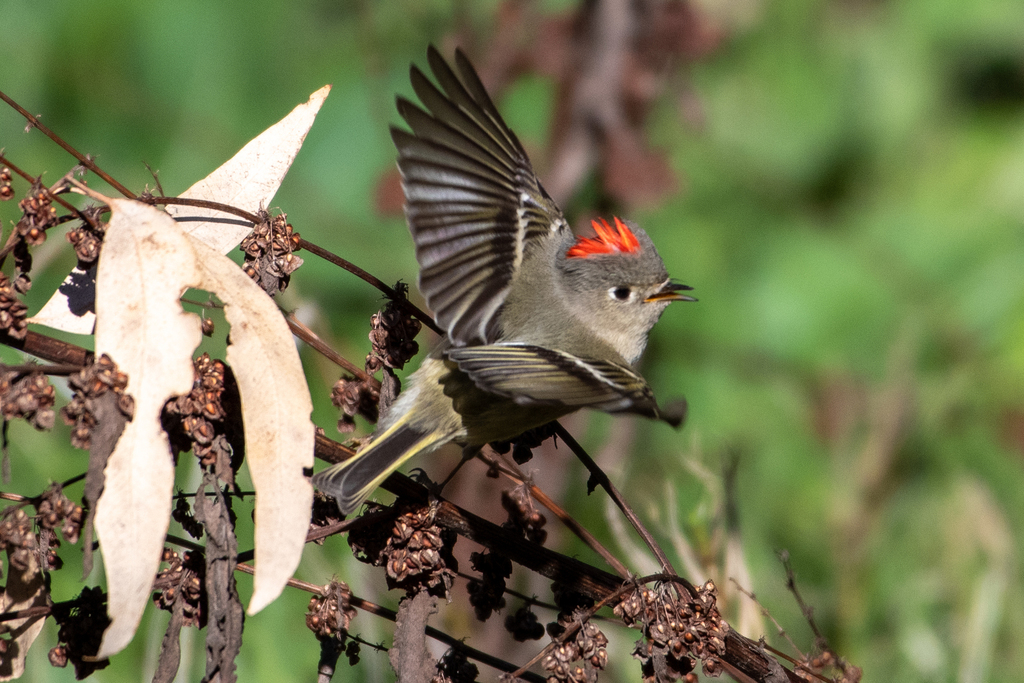
(c) Jonathan Eisen, some rights reserved (CC BY) · licence
Family: Regulidae · Class: Aves · Order: Passeriformes
Corthylio calendula (Ruby-crowned Kinglet) is a California animal in the Regulidae family.
The Ruby-crowned Kinglet is a diminutive songbird measuring 9 to 11 cm (3.5 to 4.3 inches) in length with a wingspan of 16 to 18 cm (6.3 to 7.1 inches). Adults weigh 5 to 10 grams, making them one of North America's smallest passerines. The species displays subtle sexual dimorphism in plumage. Both sexes have olive-green upperparts and grayish-white underparts, with two prominent white wing bars and a distinctive white eye ring that gives the face a spectacled appearance. Males possess a bright red crown patch that is typically concealed but becomes visible when raised during territorial displays or aggressive encounters. Females lack this red crown entirely. The bill is thin, straight, and black, adapted for gleaning small insects from foliage. Ruby-crowned Kinglets breed across boreal and montane coniferous forests from Alaska to Newfoundland, extending south through the western mountains to Mexico. In California, breeding populations occur primarily in higher elevation coniferous forests of the Sierra Nevada, Cascade Range, and northern Coast Ranges, typically above 1,200 meters (4,000 feet). During winter, the species expands its range significantly, occurring throughout most of California from sea level to mountainous areas, including urban parks and riparian woodlands. Breeding habitat consists of dense coniferous forests dominated by spruce, fir, pine, and hemlock. The species shows particular preference for mature forests with multilayered canopies that provide abundant nesting sites and foraging opportunities. During winter and migration, Ruby-crowned Kinglets occupy a broader range of habitats including mixed woodlands, riparian forests, chaparral, parks, and gardens. They are frequently found in association with mixed-species foraging flocks. Ruby-crowned Kinglets are primarily insectivorous, consuming beetles, flies, caterpillars, aphids, scale insects, and spiders. They employ various foraging techniques including gleaning insects from bark and foliage, hover-gleaning from leaf surfaces, and occasionally catching insects in short aerial sallies. During winter, the diet is supplemented with small amounts of plant material including seeds and berries. Breeding occurs from May through July, with females constructing deep, cup-shaped nests suspended from conifer branches 1 to 30 meters above ground. Clutch size ranges from 7 to 12 eggs, among the largest clutches of any North American songbird relative to body size. Incubation lasts 12 to 14 days, performed exclusively by females. The Ruby-crowned Kinglet is not federally or state listed and maintains stable populations across most of its range. According to the North American Breeding Bird Survey, populations have remained relatively stable over the past several decades. Climate change poses potential long-term threats through shifts in suitable habitat availability, particularly at higher elevations where warming temperatures may reduce suitable breeding habitat. Forest management practices that maintain diverse age structures and multilayered canopies benefit this species.
Classification
Class: Aves · Order: Passeriformes · Family: Regulidae
Frequently asked questions
How is Corthylio calendula classified?
Corthylio calendula belongs to class Aves, order Passeriformes, family Regulidae.
What family does Corthylio calendula belong to?
Corthylio calendula is in the Regulidae family.
What is Corthylio calendula?
The Ruby-crowned Kinglet is a diminutive songbird measuring 9 to 11 cm (3.5 to 4.3 inches) in length with a wingspan of 16 to 18 cm (6.3 to 7.1 inches).
Is Corthylio calendula found in California?
Yes. Corthylio calendula is recorded in California in The California Species Project's catalogue.
Related species
Other California species in the same genus, family, or bioregion.
Data from The California Species Project — 14,000+ California species with verified data from CNPS, CDFW, USFWS, and more.