Corvus brachyrhynchos
American Crow
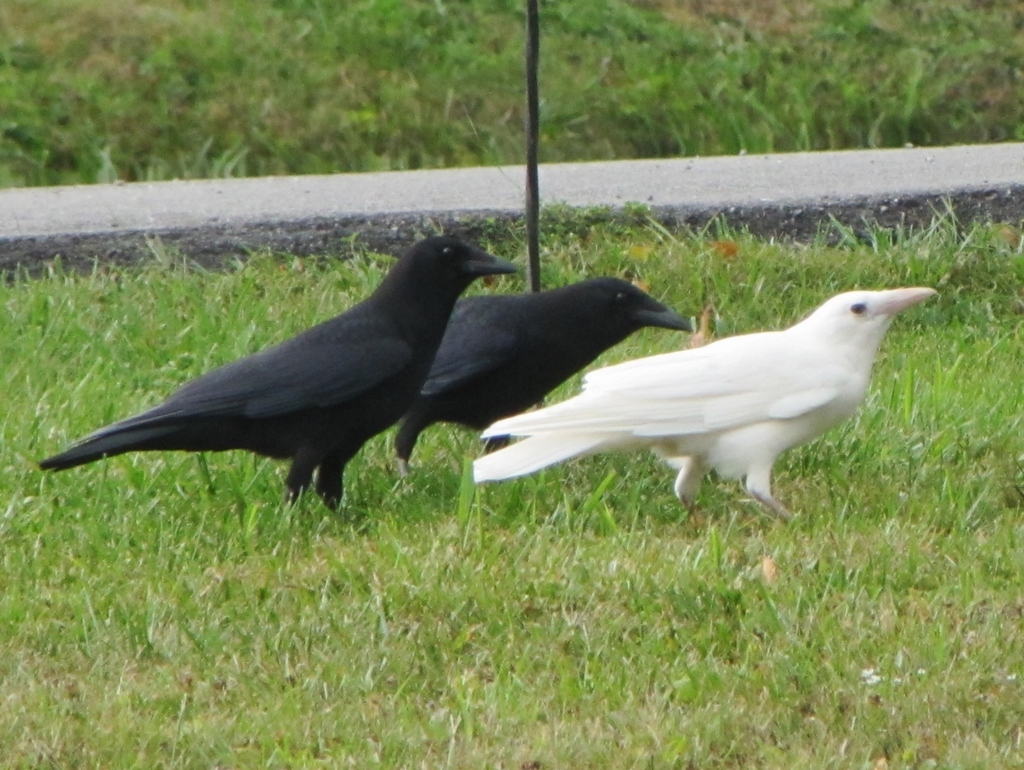
no rights reserved · CC0
Family: Corvidae · Class: Aves · Order: Passeriformes
Corvus brachyrhynchos (American Crow) is a California animal in the Corvidae family.
The American Crow is a large, robust passerine measuring 43 to 53 centimeters (17 to 21 inches) in length with a wingspan of 84 to 100 centimeters (33 to 39 inches). Adults weigh between 316 and 620 grams (11 to 22 ounces). The species displays entirely black plumage with a glossy, iridescent sheen that appears blue or purple in direct sunlight. The bill is thick, straight, and black, measuring 5 to 6 centimeters in length. The tail is fan-shaped and moderately long. Males are typically larger than females, though sexual dimorphism is minimal. Juveniles appear duller with brownish-black plumage and may show some white patches. American Crows occur throughout most of North America, from southern Canada to northern Mexico. In California, they are year-round residents found in all counties except at the highest elevations of the Sierra Nevada and Cascade ranges. The species is most abundant in lowland areas, particularly the Central Valley, coastal regions, and urban centers. Northern populations may migrate southward during winter, supplementing California's resident population. The species adapts to diverse habitats including agricultural lands, urban and suburban areas, parks, woodlands, riparian corridors, and open grasslands. American Crows are typically found from sea level to approximately 1,200 meters (4,000 feet) elevation, though they occasionally occur higher. They prefer areas with scattered trees for roosting and nesting, combined with open ground for foraging. The species thrives in human-modified landscapes and has expanded its range into urban environments. American Crows are highly social, forming large flocks outside the breeding season that may contain hundreds to thousands of individuals. They are omnivorous, consuming insects, small mammals, bird eggs and nestlings, carrion, grains, fruits, and human food waste. Breeding occurs from March through June, with pairs constructing stick nests 4 to 18 meters above ground in tree forks. Females lay 3 to 6 bluish-green eggs with dark markings. Incubation lasts 16 to 18 days, and young fledge after 28 to 35 days. Family groups may remain together through the first winter, with offspring sometimes assisting in raising subsequent broods. The species demonstrates advanced cognitive abilities, using tools and solving complex problems. The American Crow is not federally or state-listed and maintains stable populations throughout California. According to the North American Breeding Bird Survey, continental populations have remained relatively stable since 1970, with some regional increases. In California, populations appear secure with no significant conservation concerns. The species benefits from agricultural practices and urban development that provide diverse food sources. Historical persecution through hunting and poisoning programs has largely ceased, allowing populations to recover. Current threats are minimal and include vehicle strikes in urban areas and occasional disease outbreaks such as West Nile virus, though populations typically recover quickly from such events.
Classification
Class: Aves · Order: Passeriformes · Family: Corvidae
Frequently asked questions
How is Corvus brachyrhynchos classified?
Corvus brachyrhynchos belongs to class Aves, order Passeriformes, family Corvidae.
What family does Corvus brachyrhynchos belong to?
Corvus brachyrhynchos is in the Corvidae family.
What is Corvus brachyrhynchos?
The American Crow is a large, robust passerine measuring 43 to 53 centimeters (17 to 21 inches) in length with a wingspan of 84 to 100 centimeters (33 to 39 inches).
Is Corvus brachyrhynchos found in California?
Yes. Corvus brachyrhynchos is recorded in California in The California Species Project's catalogue.
Related species
Other California species in the same genus, family, or bioregion.
Data from The California Species Project — 14,000+ California species with verified data from CNPS, CDFW, USFWS, and more.