Corvus cryptoleucus
Chihuahuan Raven
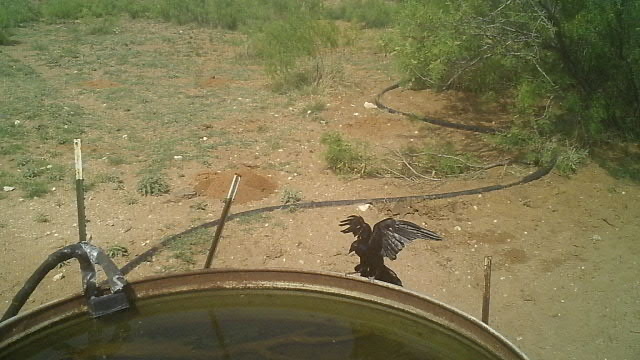
(c) CH Hemphill, some rights reserved (CC BY) · licence
Family: Corvidae · Class: Aves · Order: Passeriformes
Corvus cryptoleucus (Chihuahuan Raven) is a California animal in the Corvidae family.
The Chihuahuan Raven is a medium-sized corvid measuring approximately 43-51 cm (17-20 inches) in length with a wingspan of 86-109 cm (34-43 inches). Adults are entirely black with a glossy sheen, but are distinguished from other ravens by white patches at the base of neck feathers that become visible when the wind ruffles plumage or during social displays—a feature reflected in its scientific name cryptoleucus, meaning "hidden white" (Birds of the World). The species is intermediate in size between the American Crow and Common Raven, with a moderately wedge-shaped tail and proportionally smaller bill than the Common Raven. The Chihuahuan Raven occupies a limited range in desert regions of southwestern North America, extending from Mexico into the southwestern United States. Its range includes portions of New Mexico, Arizona, western Texas, southeastern Colorado, and southwestern Kansas (Birds of the World). In California, the species occurs as a rare visitor to the southeastern desert regions, primarily the Colorado Desert and eastern Mojave Desert areas. This species inhabits arid grasslands, desert scrublands, and semi-desert regions, showing a preference for open habitats with scattered vegetation. Unlike Common Ravens that utilize diverse habitat types, Chihuahuan Ravens are more specialized, occupying desert and grassland environments characterized by sparse tree cover and thorny shrubs. They often utilize power lines, telephone poles, and isolated trees for perching and nesting. Chihuahuan Ravens are opportunistic omnivores, feeding on insects, small vertebrates, carrion, seeds, and human-provided food sources. They are known predators of bird eggs and nestlings, including those of ground-nesting species. The species exhibits complex social behavior, defending relatively small territories around nest sites during breeding season but often nesting communally in suitable areas. They are not traditionally migratory but form large winter flocks that generally drift southward through the winter months, often moving beyond their breeding habitats (Birds of the World). Breeding pairs construct stick nests in trees, shrubs, or on human-made structures. The Chihuahuan Raven is listed as a Bird of Conservation Concern by the U.S. Fish and Wildlife Service as of 2021, reflecting concerns about population trends and habitat pressures. While not federally protected under the Endangered Species Act, the species faces threats from habitat loss due to agricultural conversion, urban development, and changes in grazing practices. Climate change may further impact suitable desert habitat. The species is protected under the Migratory Bird Treaty Act. Population monitoring is challenging due to the species' remote habitat and tendency to form mobile flocks outside breeding season. Conservation efforts focus on maintaining suitable desert grassland habitat and monitoring population trends through breeding bird surveys.
Classification
Class: Aves · Order: Passeriformes · Family: Corvidae
Frequently asked questions
How is Corvus cryptoleucus classified?
Corvus cryptoleucus belongs to class Aves, order Passeriformes, family Corvidae.
What family does Corvus cryptoleucus belong to?
Corvus cryptoleucus is in the Corvidae family.
What is Corvus cryptoleucus?
The Chihuahuan Raven is a medium-sized corvid measuring approximately 43-51 cm (17-20 inches) in length with a wingspan of 86-109 cm (34-43 inches).
Is Corvus cryptoleucus found in California?
Yes. Corvus cryptoleucus is recorded in California in The California Species Project's catalogue.
Related species
Other California species in the same genus, family, or bioregion.
Data from The California Species Project — 14,000+ California species with verified data from CNPS, CDFW, USFWS, and more.