Corynactis californica
Californian Strawberry Anemone
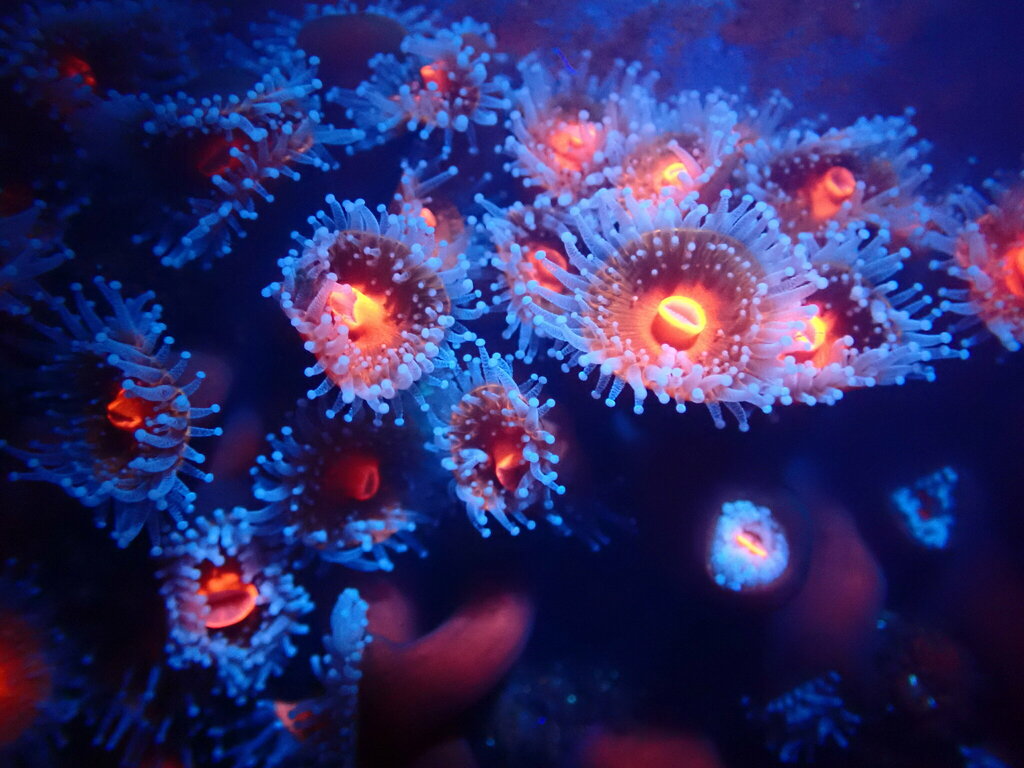
(c) Cricket Raspet, some rights reserved (CC BY) · licence
Family: Corallimorphidae · Class: Anthozoa · Order: Corallimorpharia
Corynactis californica (Californian Strawberry Anemone) is a California animal in the Corallimorphidae family.
Corynactis californica is a marine cnidarian belonging to the order Corallimorpharia, commonly known as the Californian strawberry anemone or club-tipped anemone. This species forms dense aggregations on hard substrates along the Pacific coast. Individual polyps are small, typically measuring 12-25 mm in diameter when expanded, with a cylindrical column topped by a flattened oral disc surrounded by numerous short, club-tipped tentacles that give the species its common name. The most distinctive feature of C. californica is its variable coloration within aggregated colonies. Polyps display vibrant colors including pink, red, orange, purple, white, and brown, with individual aggregations typically maintaining uniform coloration. The tentacles are characteristically swollen at their tips, distinguishing this species from true sea anemones. The oral disc contains a central mouth surrounded by radiating patterns that often contrast with the tentacle color. C. californica occurs along the Pacific coast from British Columbia to Baja California, Mexico, with populations documented throughout California's marine waters. The species inhabits rocky intertidal and subtidal zones, typically found on vertical rock faces, in crevices, and on the undersides of ledges. It occurs from the low intertidal zone to depths exceeding 30 meters, preferring areas with moderate to strong water movement that facilitate feeding. This species demonstrates the ability to form extensive colonies covering large areas of hard substrate. According to research documented in marine biology literature, aggregations can attain densities of up to 3,000 individuals per square meter on rock reefs (Animal Diversity Web). The colonies create colorful carpets across rocky surfaces, with distinct color boundaries often marking territorial divisions between different genetic clones. SeaLifeBase reports that these dense aggregations are a characteristic feature of the species' ecology in Pacific coastal environments. C. californica exhibits exclusively asexual reproduction through longitudinal fission and budding (Animal Diversity Web; SeaLifeBase). Individual polyps divide to produce genetically identical offspring, resulting in monochromatic aggregations where all individuals share the same color pattern. This clonal reproduction allows rapid colonization of suitable habitat and formation of extensive populations. The species feeds primarily on small planktonic organisms, detritus, and suspended organic matter captured by the tentacles' nematocysts. Like many marine invertebrates, C. californica faces potential threats from ocean acidification, warming sea temperatures, and coastal development that affects rocky intertidal habitats. However, the species appears relatively resilient and maintains stable populations throughout its range. Its ability to reproduce asexually and form dense aggregations may provide some buffering against environmental stressors. The species plays an important ecological role in rocky intertidal communities, competing for space with other sessile organisms and providing habitat structure for smaller invertebrates. No specific conservation measures are currently in place for this species, and it lacks formal conservation status assessments at state or federal levels.
Classification
Class: Anthozoa · Order: Corallimorpharia · Family: Corallimorphidae
Frequently asked questions
How is Corynactis californica classified?
Corynactis californica belongs to class Anthozoa, order Corallimorpharia, family Corallimorphidae.
What family does Corynactis californica belong to?
Corynactis californica is in the Corallimorphidae family.
What is Corynactis californica?
Corynactis californica is a marine cnidarian belonging to the order Corallimorpharia, commonly known as the Californian strawberry anemone or club-tipped anemone.
Is Corynactis californica found in California?
Yes. Corynactis californica is recorded in California in The California Species Project's catalogue.
More California species
This species has no close relatives in our California data — here are other species to explore.
Data from The California Species Project — 14,000+ California species with verified data from CNPS, CDFW, USFWS, and more.