Coryphista meadii
Barberry Geometer
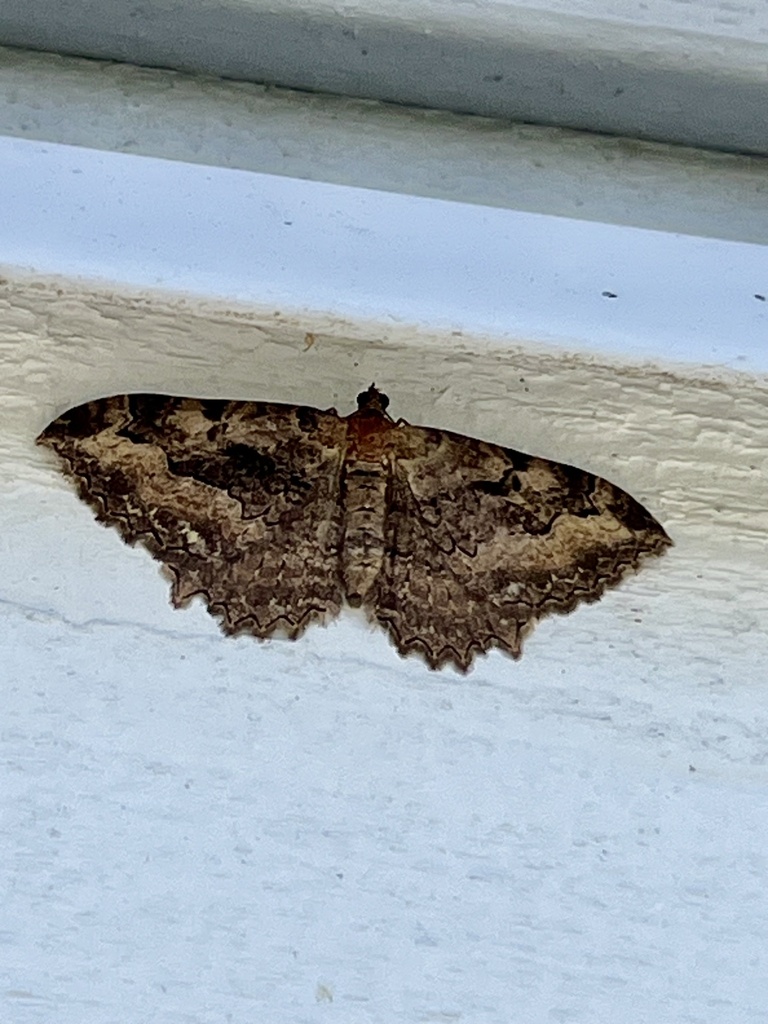
(c) Sheila Furlong, some rights reserved (CC BY-SA) · licence
Family: Geometridae · Class: Insecta · Order: Lepidoptera
Coryphista meadii (Barberry Geometer) is a California animal in the Geometridae family.
The Barberry Geometer (Coryphista meadii) is a small moth in the family Geometridae, characterized by the looping locomotion typical of geometrid caterpillars. Adults have a wingspan of approximately 20-25 mm (0.8-1.0 inches), with forewings displaying mottled gray and brown patterns that provide effective camouflage against tree bark. The wings often show subtle darker cross-lines and may have small white or light-colored spots. Males typically have more feathery antennae compared to females, and both sexes hold their wings horizontally when at rest, creating a triangular silhouette. Coryphista meadii has an extensive range across all of the United States and southern Canada, making it one of the more widely distributed geometrid moths in North America. The species occurs from coast to coast, spanning multiple climate zones and elevation ranges. This broad distribution suggests considerable ecological adaptability across diverse geographic regions. The species inhabits deciduous and mixed forests where its host plants occur, typically in areas with moderate to dense canopy cover. Adults are attracted to artificial lights and can be found in suburban areas adjacent to wooded habitats. The moth occupies elevations from sea level to mountainous regions, demonstrating tolerance for varied environmental conditions. Preferred habitats include forest edges, woodland clearings, and riparian zones where host vegetation is abundant. Barberry Geometer larvae feed on various shrubs and small trees, with barberry (Berberis species) serving as a primary host plant, as suggested by the common name. However, like many geometrid species, the larvae likely utilize multiple plant families. The caterpillars are typical "inchworms" that move by bringing their rear end up to meet their front legs, then extending forward to take the next "step." Adults are primarily nocturnal, with flight periods typically occurring from late spring through summer, though timing varies across the species' extensive range. Females deposit eggs on or near host plants, where they overwinter before hatching the following season. Currently, Coryphista meadii has no federal or state conservation listing status, reflecting its wide distribution and presumably stable populations. The species appears to be relatively common throughout much of its range, with no immediate conservation concerns identified. However, like many forest-dependent lepidopteran species, local populations may be affected by habitat fragmentation, pesticide use, and climate change impacts on host plant distributions. The moth's broad geographic range and apparent ecological flexibility likely provide some resilience against regional environmental changes, though long-term population trends have not been extensively studied across all portions of its range.
Classification
Class: Insecta · Order: Lepidoptera · Family: Geometridae
Frequently asked questions
How is Coryphista meadii classified?
Coryphista meadii belongs to class Insecta, order Lepidoptera, family Geometridae.
What family does Coryphista meadii belong to?
Coryphista meadii is in the Geometridae family.
What is Coryphista meadii?
The Barberry Geometer (Coryphista meadii) is a small moth in the family Geometridae, characterized by the looping locomotion typical of geometrid caterpillars.
Is Coryphista meadii found in California?
Yes. Coryphista meadii is recorded in California in The California Species Project's catalogue.
Related species
Other California species in the same genus, family, or bioregion.
Data from The California Species Project — 14,000+ California species with verified data from CNPS, CDFW, USFWS, and more.