Cosmia calami
American dun-bar Moth
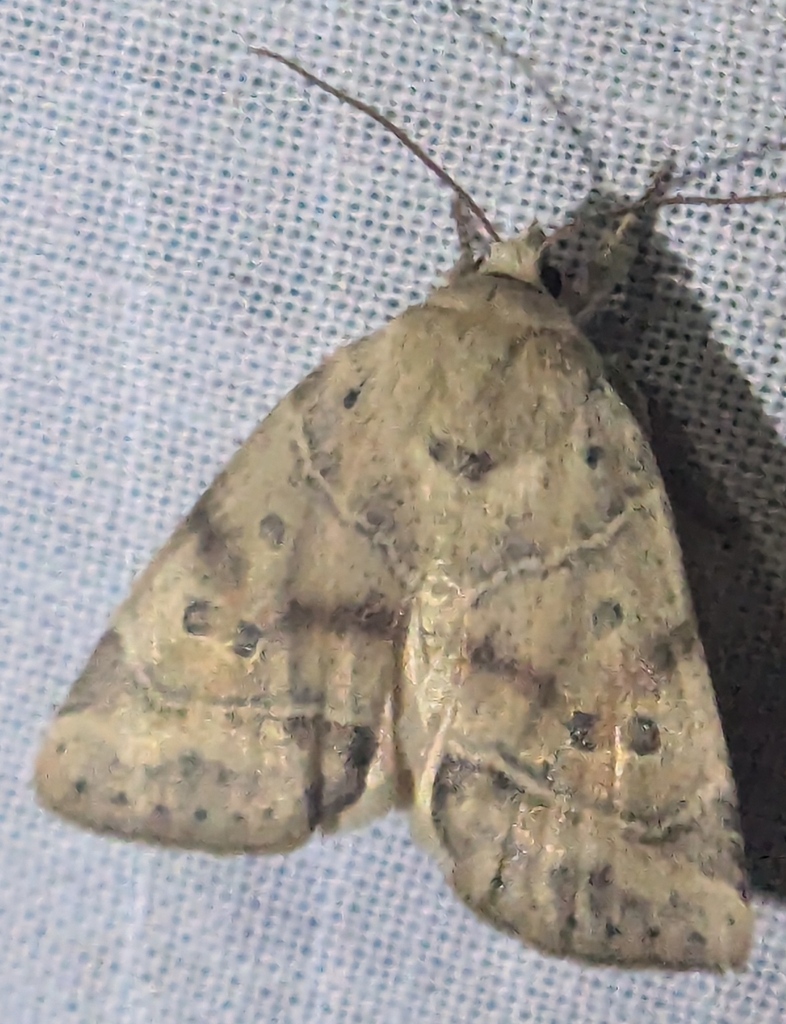
(c) Matthew Spoor, some rights reserved (CC BY) · licence
Family: Noctuidae · Class: Insecta · Order: Lepidoptera
Cosmia calami (American dun-bar Moth) is a California animal in the Noctuidae family.
The American dun-bar moth (Cosmia calami) is a medium-sized nocturnal lepidopteran in the family Noctuidae. Adults typically measure 35-40 mm (1.4-1.6 inches) in wingspan. The forewings display a characteristic pattern of brown and gray coloration with darker crosslines and a distinctive kidney-shaped reniform spot. The hindwings are lighter, typically pale gray to whitish with darker margins. Males can be distinguished from females by their more feathered antennae and slightly smaller size. This species occurs across much of eastern and central North America, with its range extending from southeastern Canada south to Florida and west to the Great Plains. In California, Cosmia calami represents a western population disjunct from the main eastern range, though specific distribution records within the state require further documentation. The species appears to be uncommon to rare in California, with limited collection records. American dun-bar moths inhabit deciduous and mixed woodlands, particularly areas with substantial populations of their primary host plants. Adults are attracted to areas with mature trees and forest edges. The species shows a preference for mesic woodland environments rather than dry or xeric habitats. Elevation preferences in California are not well documented but likely correspond to suitable habitat conditions. Larvae feed primarily on grasses (Poaceae), particularly species of Poa, Festuca, and other common woodland grasses. The caterpillars are typically green to brown with longitudinal stripes and feed nocturnally. Adults are active during summer months, typically from June through August, and are attracted to artificial lights. Males locate females through pheromone detection. The species is univoltine, producing one generation per year. Overwintering occurs in the pupal stage in soil or leaf litter. The conservation status of Cosmia calami in California is not well established due to limited survey data and taxonomic uncertainty. The species is not federally or state listed but may be of conservation concern given its apparently restricted distribution in the state. The western populations may represent a distinct subspecies or ecotype adapted to California conditions. Primary potential threats include habitat loss from development and forest management practices, particularly in riparian and mixed woodland areas. Climate change may affect the species through alterations in host plant distribution and phenology. Light pollution could impact adult behavior and reproduction. The species would benefit from systematic surveys to determine its current distribution and population status in California, as well as genetic analysis to clarify the relationship between western and eastern populations.
Classification
Class: Insecta · Order: Lepidoptera · Family: Noctuidae
Frequently asked questions
How is Cosmia calami classified?
Cosmia calami belongs to class Insecta, order Lepidoptera, family Noctuidae.
What family does Cosmia calami belong to?
Cosmia calami is in the Noctuidae family.
What is Cosmia calami?
The American dun-bar moth (Cosmia calami) is a medium-sized nocturnal lepidopteran in the family Noctuidae.
Is Cosmia calami found in California?
Yes. Cosmia calami is recorded in California in The California Species Project's catalogue.
Related species
Other California species in the same genus, family, or bioregion.
Data from The California Species Project — 14,000+ California species with verified data from CNPS, CDFW, USFWS, and more.