Cottus gulosus
Riffle sculpin
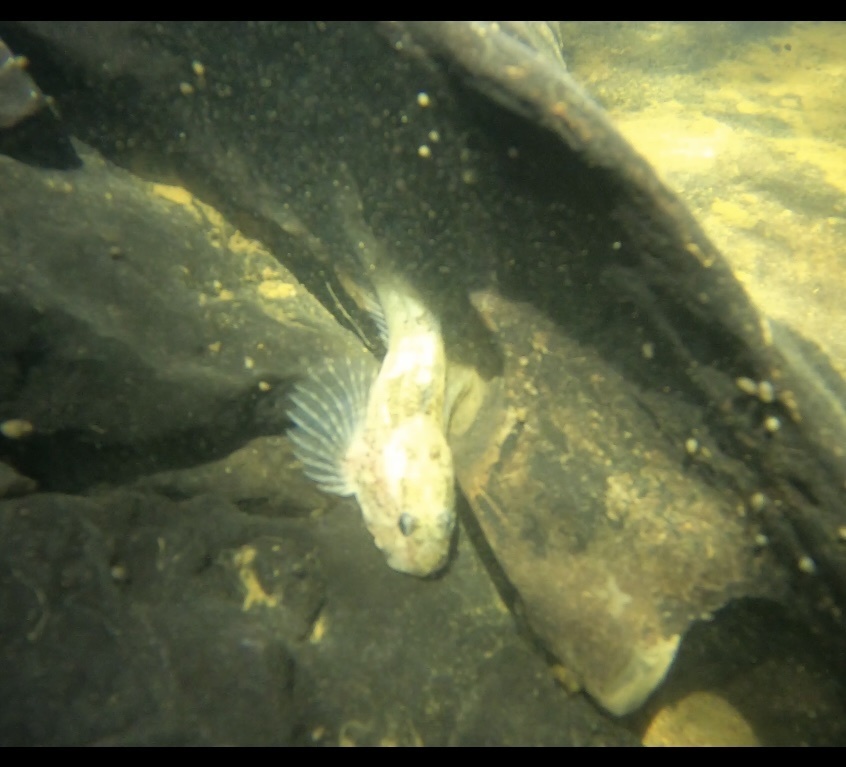
no rights reserved · CC0
Family: Cottidae · Class: Actinopterygii · Order: Perciformes
Conservation status: G5 S3S4
Cottus gulosus (Riffle sculpin) is a California animal in the Cottidae family.
The riffle sculpin is a small freshwater fish endemic to California's coastal drainages. Adults typically measure 50 to 100 mm (2.0 to 3.9 inches) in total length, with a robust, torpedo-shaped body adapted for life in fast-flowing waters. The head is broad and flattened, comprising approximately one-third of the total body length. The species displays mottled brown and gray coloration with darker bars across the back and sides, providing effective camouflage against rocky substrates. Large pectoral fins extend horizontally from the body, and the first dorsal fin contains 7 to 9 spines. Riffle sculpins occur exclusively in coastal drainages of California, from the Russian River system in Sonoma County south to the Salinas River system in Monterey County. The species inhabits portions of the Sacramento-San Joaquin drainage system and several smaller coastal watersheds. Populations are documented in tributaries of the American River, Mokelumne River, and various streams in the San Francisco Bay Area. The species' range has contracted from historical levels due to habitat modifications and water diversions. This sculpin requires cool, clear streams with rocky or gravel substrates and moderate to fast water flow. Riffle sculpins typically inhabit riffles, runs, and pool margins at elevations ranging from near sea level to approximately 600 meters (1,970 feet). Water temperatures in occupied habitats generally remain below 20°C (68°F) during summer months. The species shows strong preferences for areas with abundant cover provided by boulders, cobble, and undercut banks. Dissolved oxygen levels must remain high, typically above 7 mg/L. Riffle sculpins are benthic predators that feed primarily on aquatic invertebrates including mayfly nymphs, caddisfly larvae, chironomid larvae, and small crustaceans. Adults are territorial and exhibit site fidelity, often occupying the same pool or riffle section for extended periods. Spawning occurs from February through May, with peak activity in March and April. Males establish territories under large rocks or in crevices, where they attract females to deposit adhesive egg masses. Clutch sizes range from 50 to 200 eggs depending on female size. Males guard the nest and fan the eggs until hatching occurs after 3 to 4 weeks. The riffle sculpin maintains a global rank of G5, indicating the species is secure overall, but receives a state rank of S3S4 in California, reflecting moderate conservation concern at the state level. Population declines have been documented in several watersheds due to habitat degradation, water diversions, and urbanization. Primary threats include altered flow regimes, increased water temperatures, sedimentation from land use changes, and habitat fragmentation by dams and diversions. The species' limited dispersal ability makes populations particularly vulnerable to local extirpations. Conservation efforts focus on maintaining instream flows and protecting riparian corridors in occupied watersheds.
Classification
Class: Actinopterygii · Order: Perciformes · Family: Cottidae
Conservation status
G5 S3S4
Frequently asked questions
How is Cottus gulosus classified?
Cottus gulosus belongs to class Actinopterygii, order Perciformes, family Cottidae.
What family does Cottus gulosus belong to?
Cottus gulosus is in the Cottidae family.
Is Cottus gulosus protected or of conservation concern?
Cottus gulosus carries the following status: G5 S3S4.
What is Cottus gulosus?
The riffle sculpin is a small freshwater fish endemic to California's coastal drainages.
Is Cottus gulosus found in California?
Yes. Cottus gulosus is recorded in California in The California Species Project's catalogue.
Related species
Other California species in the same genus, family, or bioregion.
Data from The California Species Project — 14,000+ California species with verified data from CNPS, CDFW, USFWS, and more.