Cottus klamathensis klamathensis
Upper Klamath marbled sculpin
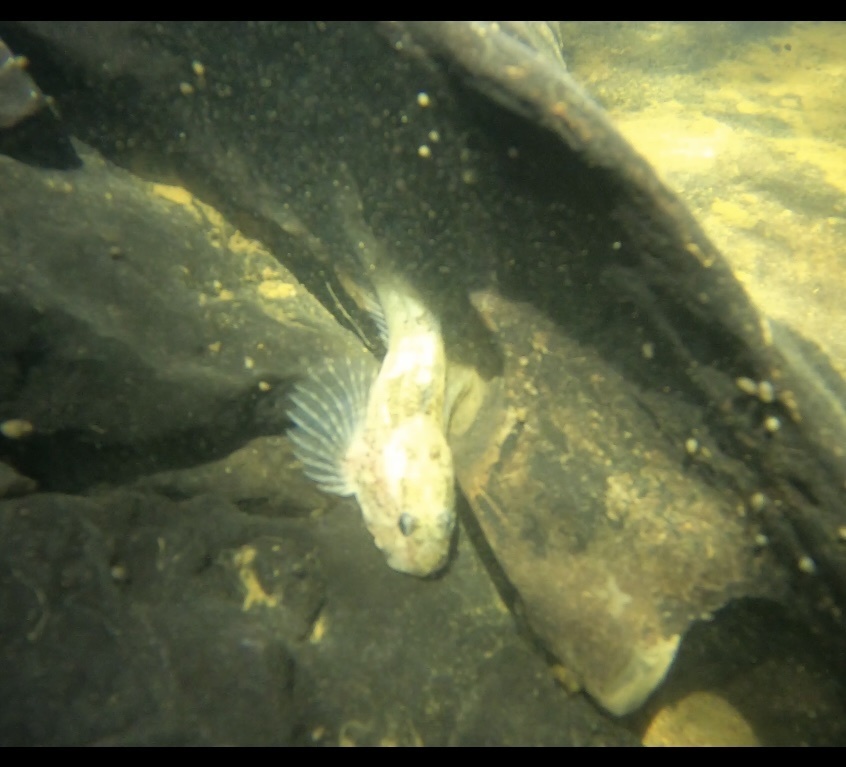
no rights reserved · CC0
Family: Cottidae · Class: Actinopterygii · Order: Perciformes
Conservation status: G4T1T2 S1S2
Cottus klamathensis klamathensis (Upper Klamath marbled sculpin) is a California animal in the Cottidae family.
The Upper Klamath marbled sculpin (Cottus klamathensis klamathensis) is a small freshwater fish endemic to the upper Klamath River basin in northern California and southern Oregon. This subspecies is distinguished from other sculpin by its mottled brown and gray coloration with irregular dark bands across the body and fins. Adults typically reach 75 to 100 mm (3.0 to 3.9 inches) in total length. The head is broad and flattened with a terminal mouth, and the body tapers posteriorly. Like other sculpins, it lacks scales and has enlarged pectoral fins that extend laterally from the body. The first dorsal fin is lower than the second, and the caudal fin is rounded. Historically, the Upper Klamath marbled sculpin occupied tributaries and mainstem areas of the upper Klamath River system above Klamath Falls, Oregon, extending into Siskiyou County, California. The subspecies is now restricted to a few tributaries in the upper Klamath basin, with California populations documented in streams draining into Upper Klamath Lake. Suitable habitat has been significantly reduced from historical levels due to water diversions, habitat modification, and competition from introduced species. This sculpin inhabits cool, clear streams and springs with rocky or gravelly substrates. Optimal habitat includes areas with moderate to swift current, water temperatures below 20°C (68°F), and dissolved oxygen levels exceeding 6 mg/L. The species requires clean gravel and cobble for spawning and interstitial spaces for shelter. Adults are typically found in pools and runs with depths ranging from 0.3 to 1.5 meters (1 to 5 feet), while juveniles occupy shallow riffle areas and stream margins with abundant cover. Upper Klamath marbled sculpin are benthic predators that feed primarily on aquatic invertebrates including mayfly nymphs, caddisfly larvae, chironomid larvae, and small crustaceans. Adults are territorial and largely sedentary, moving primarily during spawning periods. Reproduction occurs from late winter through early spring, typically February through April, when water temperatures reach 8 to 12°C (46 to 54°F). Males establish nesting territories under rocks or in crevices, where females deposit 100 to 300 adhesive eggs. Males guard the nest until eggs hatch after 4 to 6 weeks. Juveniles reach sexual maturity at 2 to 3 years of age. The Upper Klamath marbled sculpin has a global rank of G4T1T2, indicating the subspecies is critically imperiled to imperiled, and a California state rank of S1S2, reflecting extreme rarity within the state. Primary threats include habitat degradation from agricultural practices, water diversions that reduce stream flows, sedimentation, and elevated water temperatures. Competition and hybridization with introduced Pitt sculpin (Cottus pitensis) poses an additional threat to genetic integrity. The species' limited distribution and small population size make it particularly vulnerable to environmental changes and stochastic events.
Classification
Class: Actinopterygii · Order: Perciformes · Family: Cottidae
Conservation status
G4T1T2 S1S2
Frequently asked questions
How is Cottus klamathensis klamathensis classified?
Cottus klamathensis klamathensis belongs to class Actinopterygii, order Perciformes, family Cottidae.
What family does Cottus klamathensis klamathensis belong to?
Cottus klamathensis klamathensis is in the Cottidae family.
Is Cottus klamathensis klamathensis protected or of conservation concern?
Cottus klamathensis klamathensis carries the following status: G4T1T2 S1S2.
What is Cottus klamathensis klamathensis?
The Upper Klamath marbled sculpin (Cottus klamathensis klamathensis) is a small freshwater fish endemic to the upper Klamath River basin in northern California and southern Oregon.
Is Cottus klamathensis klamathensis found in California?
Yes. Cottus klamathensis klamathensis is recorded in California in The California Species Project's catalogue.
Related species
Other California species in the same genus, family, or bioregion.
Data from The California Species Project — 14,000+ California species with verified data from CNPS, CDFW, USFWS, and more.