Crambus leachellus
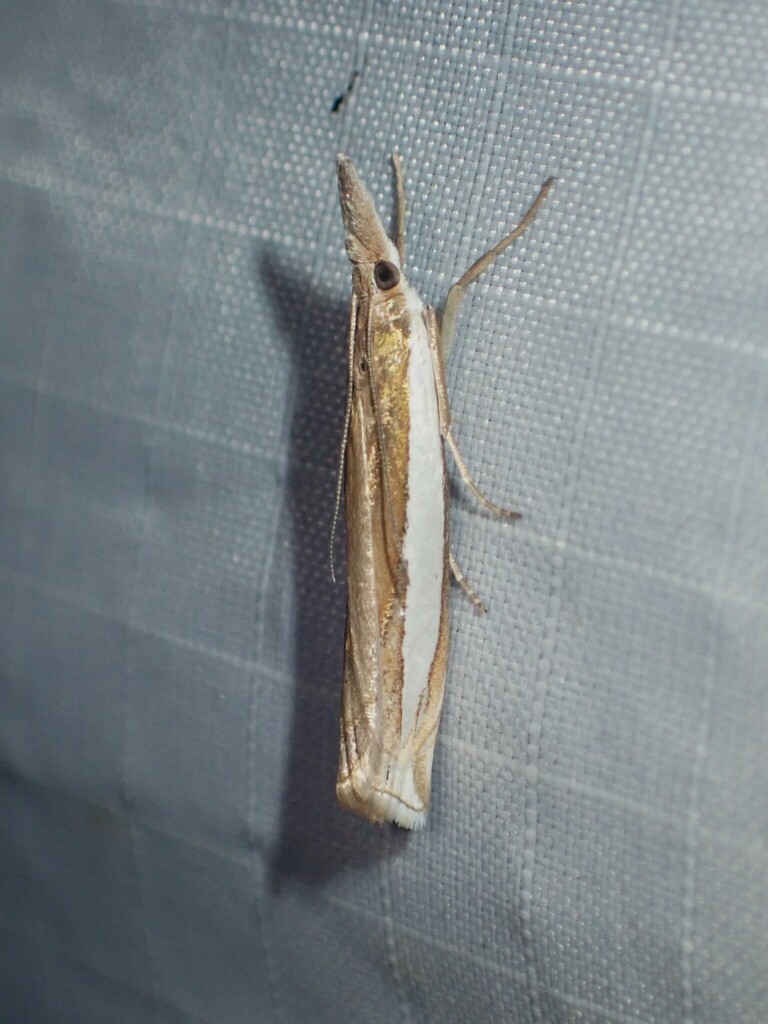
(c) Louis Imbeau, some rights reserved (CC BY) · licence
Family: Crambidae · Class: Insecta · Order: Lepidoptera
Crambus leachellus is a California animal in the Crambidae family.
Crambus leachellus is a small moth species in the family Crambidae, commonly known as grass moths or snout moths. This lepidopteran exhibits the typical characteristics of the genus Crambus, with a narrow, elongated body and wings that fold closely around the abdomen when at rest. Adult moths typically measure 12 to 18 mm (0.5 to 0.7 inches) in wingspan. The forewings are generally pale yellow to light brown with subtle darker markings, while the hindwings are typically lighter in coloration with reduced patterning. The species exhibits sexual dimorphism common to many Crambidae, with males possessing more prominent labial palps that extend forward like a snout. The antennae in males are often more feathered or ciliate compared to the thread-like antennae of females. Wing patterns may include faint longitudinal lines or spots, though specific diagnostic features for C. leachellus require examination under magnification. Crambus leachellus occurs in North America, with records from various regions across the continent. The species' distribution appears to be associated with grassland and prairie habitats, consistent with the ecological preferences of most Crambus species. Specific range boundaries and population distributions require further taxonomic verification, as the Crambus genus contains numerous closely related species that can be difficult to distinguish without detailed morphological or molecular analysis. The species inhabits grasslands, prairies, and areas dominated by graminoid vegetation. Like other members of the genus, C. leachellus likely requires specific grass species as larval host plants. The larvae are typically root feeders or stem borers, developing within or near the base of grass plants. Adults are generally active during evening and nighttime hours, attracted to artificial lights. Larval development follows the typical lepidopteran pattern, with eggs deposited near suitable host plants. Caterpillars feed on grass roots, crown tissues, or lower stem portions, creating galleries or feeding chambers. Pupation typically occurs in the soil or plant debris near the host. The species likely produces one or two generations per year, depending on local climate conditions and latitude. Adult flight periods vary geographically but typically occur during warmer months from late spring through early fall. Males are often attracted to pheromones released by females, with mating occurring during nighttime hours. The species demonstrates the cryptic behavior typical of many grass moths, remaining hidden within vegetation during daylight hours. There is currently no federal or state conservation status assigned to Crambus leachellus. The species appears to lack formal conservation assessments, which is common among many smaller lepidopteran species. Population trends and specific threats are not well documented. Like many grassland-associated species, potential threats may include habitat conversion, agricultural intensification, and altered fire regimes that affect native grassland ecosystems. The taxonomic status and ecological requirements of this species would benefit from additional research to better understand its conservation needs and population status across its range.
Classification
Class: Insecta · Order: Lepidoptera · Family: Crambidae
Frequently asked questions
How is Crambus leachellus classified?
Crambus leachellus belongs to class Insecta, order Lepidoptera, family Crambidae.
What family does Crambus leachellus belong to?
Crambus leachellus is in the Crambidae family.
What is Crambus leachellus?
Crambus leachellus is a small moth species in the family Crambidae, commonly known as grass moths or snout moths.
Is Crambus leachellus found in California?
Yes. Crambus leachellus is recorded in California in The California Species Project's catalogue.
Related species
Other California species in the same genus, family, or bioregion.
Data from The California Species Project — 14,000+ California species with verified data from CNPS, CDFW, USFWS, and more.