Crassadoma gigantea
Giant Rock Scallop
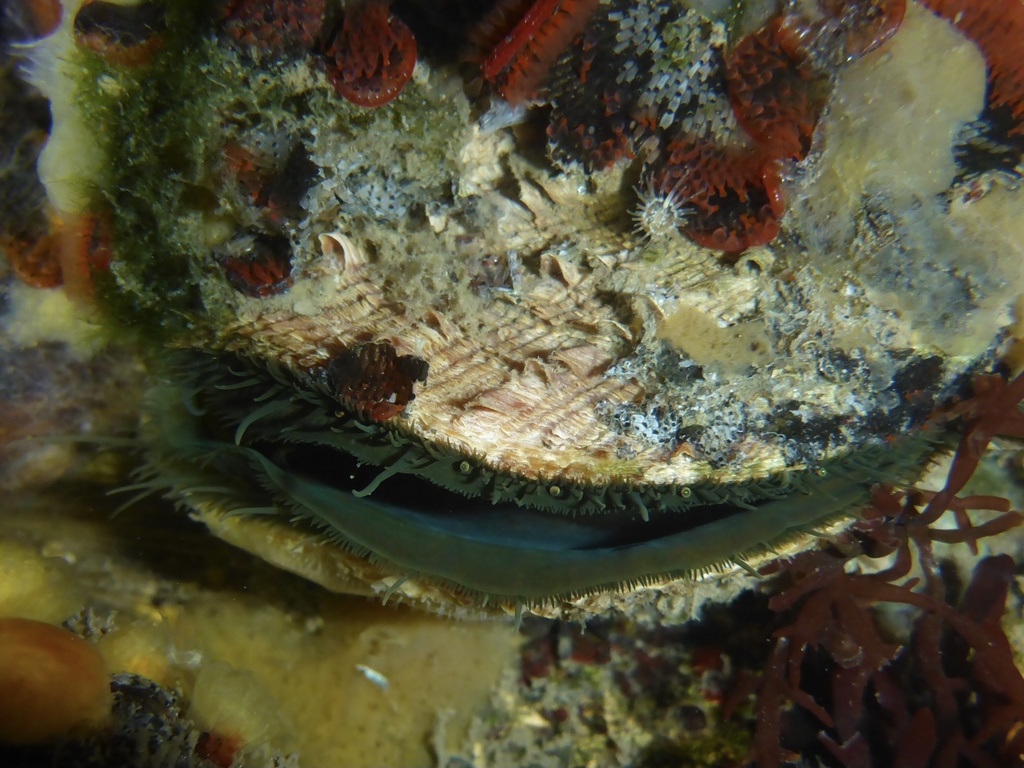
(c) Cricket Raspet, some rights reserved (CC BY) · licence
Family: Pectinidae · Class: Bivalvia · Order: Pectinida
Crassadoma gigantea (Giant Rock Scallop) is a California animal in the Pectinidae family.
The giant rock scallop is a large marine bivalve mollusk native to the northeastern Pacific Ocean. Adults can reach shell lengths of up to 254 mm (10 inches), making this one of the largest scallop species in North American waters. The shells are typically fan-shaped with prominent radiating ribs, ranging in color from white to orange, purple, or brown. The upper valve is often more convex than the lower valve, and older individuals may develop thick, heavy shells with irregular growth patterns. Giant rock scallops occur along the Pacific coast from Alaska to Baja California, with populations documented in California waters from the Oregon border south to Point Conception. The species is found in rocky intertidal and subtidal habitats, typically attaching to hard substrates including bedrock, boulders, and artificial structures. In California, populations are present in marine protected areas including Point Arena State Marine Reserve and Russian Gulch State Marine Conservation Area, where they contribute to rocky reef ecosystems. This species inhabits depths ranging from the low intertidal zone to approximately 80 meters (262 feet) below mean lower low water. Giant rock scallops prefer areas with moderate to strong water movement and are commonly found on vertical rock faces, in crevices, and on the undersides of rocky overhangs. They require hard substrates for attachment via byssal threads, which they use to secure themselves to the seafloor throughout their adult lives. Giant rock scallops are filter feeders, using their gills to capture phytoplankton, small zooplankton, and organic detritus from the water column. Unlike many other scallop species, giant rock scallops are sessile as adults and do not swim. Reproduction occurs through broadcast spawning, with females releasing millions of eggs into the water column where they are fertilized by sperm released by males. Spawning typically occurs during warmer months when phytoplankton productivity is highest. Larvae undergo a planktonic phase lasting several weeks before settling and metamorphosing into juvenile scallops. While not federally listed, giant rock scallop populations face pressure from commercial and recreational harvesting, habitat degradation, and climate change impacts including ocean acidification. The species' sessile nature and slow growth rates make populations vulnerable to overexploitation. In California, the species benefits from protection within marine protected areas where commercial and recreational take is restricted or prohibited. Research has documented higher abundances and larger individual sizes within protected areas compared to adjacent fished areas, suggesting that spatial protections can effectively support population recovery. Water quality degradation and coastal development continue to pose threats to nearshore rocky reef habitats essential for this species' survival.
Classification
Class: Bivalvia · Order: Pectinida · Family: Pectinidae
Frequently asked questions
How is Crassadoma gigantea classified?
Crassadoma gigantea belongs to class Bivalvia, order Pectinida, family Pectinidae.
What family does Crassadoma gigantea belong to?
Crassadoma gigantea is in the Pectinidae family.
What is Crassadoma gigantea?
The giant rock scallop is a large marine bivalve mollusk native to the northeastern Pacific Ocean.
Is Crassadoma gigantea found in California?
Yes. Crassadoma gigantea is recorded in California in The California Species Project's catalogue.
More California species
This species has no close relatives in our California data — here are other species to explore.
Data from The California Species Project — 14,000+ California species with verified data from CNPS, CDFW, USFWS, and more.