Creagrus furcatus
Swallow-tailed Gull
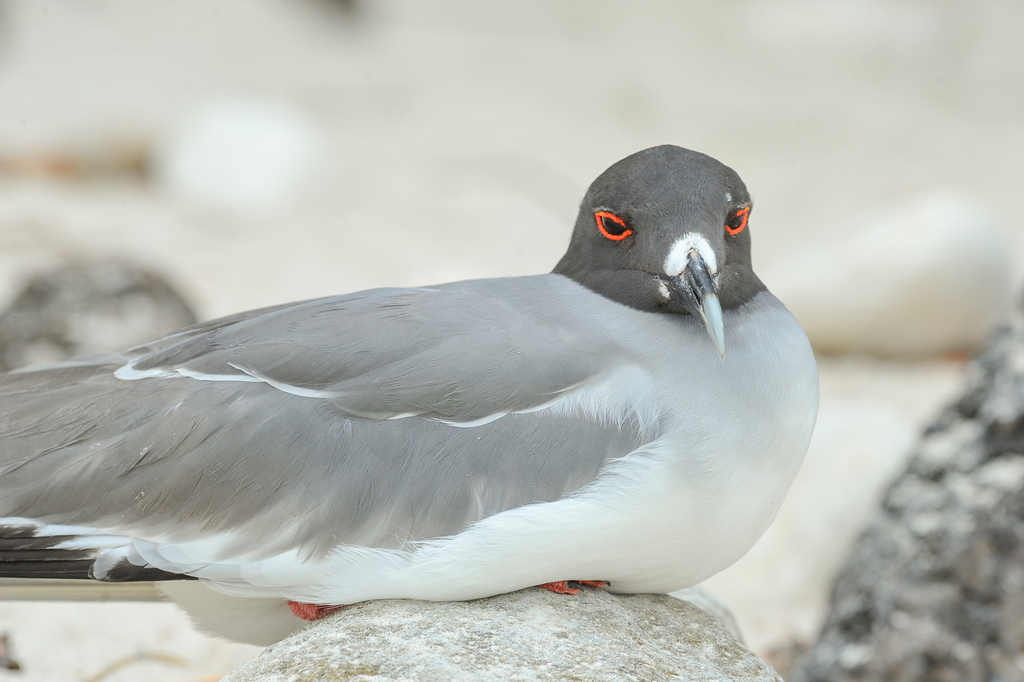
(c) Morten Ross, some rights reserved (CC BY) · licence
Family: Laridae · Class: Aves · Order: Charadriiformes
Creagrus furcatus (Swallow-tailed Gull) is a California animal in the Laridae family.
The Swallow-tailed Gull is a medium-sized seabird distinguished by its deeply forked tail, which gives the species its common name. Adults measure 51 to 58 cm (20 to 23 inches) in length with a wingspan of approximately 130 cm (51 inches). The species exhibits distinctive plumage with a dark gray hood that extends to the upper breast, contrasting with white underparts and pale gray upperparts. The wings show black tips and trailing edges. Juveniles display brownish mottling and lack the pronounced tail fork of adults. The bill is black with a yellow tip, and the legs are red to orange-red. Swallow-tailed Gulls are endemic to the Galápagos Islands, where they breed on rocky cliffs and lava ledges throughout the archipelago. The species is considered vagrant to California and the western United States, with rare sightings documented along the Pacific Coast. Most North American records occur during El Niño events when oceanographic conditions may transport individuals northward from their equatorial range. California sightings are typically concentrated in coastal waters from central to southern regions. In their native range, Swallow-tailed Gulls inhabit marine environments, nesting on steep cliff faces and rocky outcrops on islands. They are strictly nocturnal feeders, a unique characteristic among gulls. The species forages in deep oceanic waters, often traveling considerable distances from breeding colonies to feeding areas. During vagrant appearances in California, individuals are typically observed in nearshore marine waters and occasionally from shore-based locations. Swallow-tailed Gulls are specialized feeders, consuming primarily squid and small fish captured through surface dipping and shallow diving. Their large eyes are adapted for nocturnal foraging, allowing them to locate bioluminescent prey in dark waters. The species is monogamous with a breeding cycle that spans approximately 9 to 10 months. Pairs typically lay a single egg in a scrape on rocky substrate. The extended breeding cycle results in overlapping generations, with some individuals breeding while others are still raising offspring from previous attempts. The global population of Swallow-tailed Gulls is estimated at 10,000 to 15,000 breeding pairs, according to BirdLife International. The species is classified as Near Threatened by the IUCN due to its restricted range and small population size. Primary threats include introduced predators on nesting islands, fisheries interactions, and climate variability affecting prey availability. El Niño events can significantly impact breeding success through changes in food distribution. Conservation efforts focus on controlling introduced species in the Galápagos and monitoring population trends. The species' vagrant status in California means it receives no specific protection under state or federal endangered species legislation, though it benefits from general seabird protection measures.
Classification
Class: Aves · Order: Charadriiformes · Family: Laridae
Frequently asked questions
How is Creagrus furcatus classified?
Creagrus furcatus belongs to class Aves, order Charadriiformes, family Laridae.
What family does Creagrus furcatus belong to?
Creagrus furcatus is in the Laridae family.
What is Creagrus furcatus?
The Swallow-tailed Gull is a medium-sized seabird distinguished by its deeply forked tail, which gives the species its common name.
Is Creagrus furcatus found in California?
Yes. Creagrus furcatus is recorded in California in The California Species Project's catalogue.
Related species
Other California species in the same genus, family, or bioregion.
Data from The California Species Project — 14,000+ California species with verified data from CNPS, CDFW, USFWS, and more.