Crepidula adunca
Hooked Slippersnail
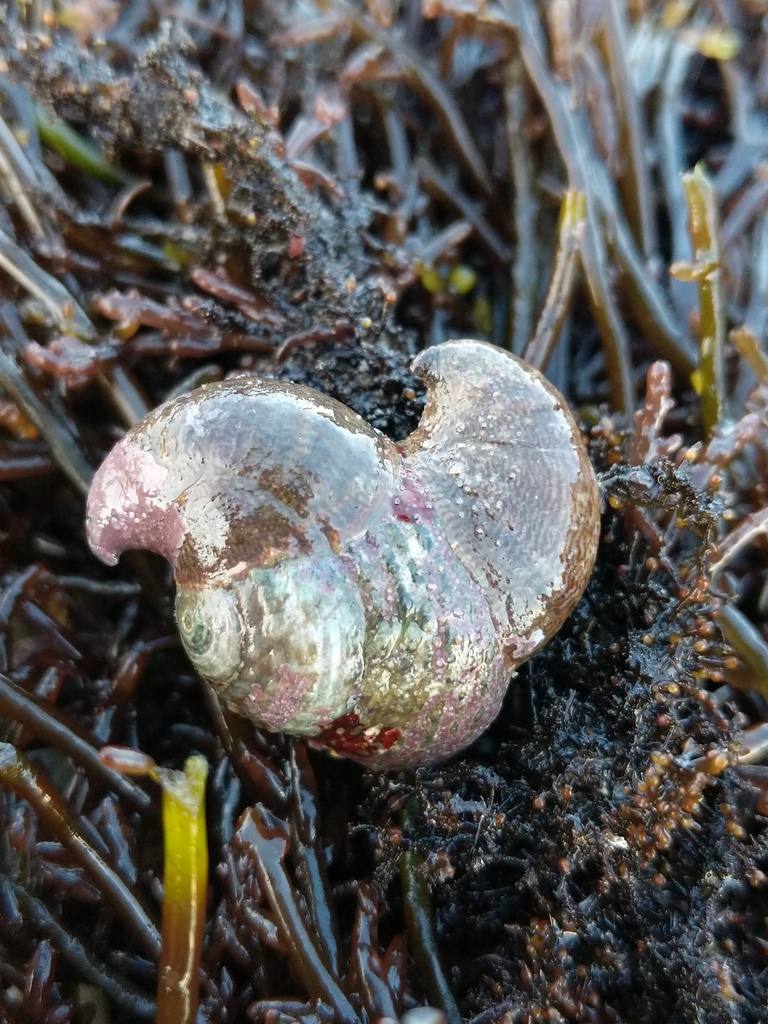
(c) Trevor Van Loon, some rights reserved (CC BY) · licence
Family: Calyptraeidae · Class: Gastropoda · Order: Littorinimorpha
Crepidula adunca (Hooked Slippersnail) is a California animal in the Calyptraeidae family.
The hooked slippersnail (Crepidula adunca) is a small marine gastropod mollusk in the family Calyptraeidae, commonly known as slipper snails or boat shells. This species is characterized by its distinctive hooked or curved shell apex, which gives it its common name. The shell typically measures 15-30 mm in length and exhibits a conical, cap-like shape with a curved or twisted spire. The exterior surface is usually grayish-brown to tan, often with fine growth lines, while the interior displays a white or pale coloration with a prominent shelf-like structure called a septum. Crepidula adunca occurs along the Pacific coast of North America, ranging from British Columbia, Canada, to Baja California, Mexico. In California, the species is distributed throughout the state's coastline, from the rocky intertidal zones of northern California to the warmer waters of southern California. The species is commonly found in central California locations including the Farallon Islands and coastal areas with suitable rocky substrate. This marine gastropod inhabits rocky intertidal and subtidal zones, typically in areas with moderate to high wave action. The species prefers hard substrates including rocks, shells, and artificial structures where it can securely attach. Hooked slippersnails are commonly found from the low intertidal zone to depths of approximately 50 meters. They often occur in aggregations and may be found attached to various surfaces including mussel beds, barnacle clusters, and other hard-shelled organisms. Crepidula adunca exhibits typical calyptraeid reproductive behavior, being sequential hermaphrodites that begin life as males and later transition to females. This species is a filter feeder, using its gill to capture plankton and organic particles from the water column. The animals form characteristic stacks or chains, with larger, older females at the bottom and smaller males positioned above. During reproduction, males transfer sperm to females through a long penis that extends around the shell margin. Females brood their eggs in a capsule beneath their shell, and larvae develop through a planktonic veliger stage before settling and metamorphosing into juvenile snails. The hooked slippersnail does not have special conservation status at federal or state levels and is considered a common species throughout its range. However, like many intertidal organisms, populations may be affected by coastal development, pollution, ocean acidification, and climate change impacts on marine ecosystems. The species serves as an important component of rocky intertidal food webs, both as a filter feeder that processes plankton and as prey for various predators including sea stars, crabs, and birds. Its ability to form dense aggregations makes it a significant contributor to local ecosystem dynamics in suitable habitats.
Classification
Class: Gastropoda · Order: Littorinimorpha · Family: Calyptraeidae
Frequently asked questions
How is Crepidula adunca classified?
Crepidula adunca belongs to class Gastropoda, order Littorinimorpha, family Calyptraeidae.
What family does Crepidula adunca belong to?
Crepidula adunca is in the Calyptraeidae family.
What is Crepidula adunca?
The hooked slippersnail (Crepidula adunca) is a small marine gastropod mollusk in the family Calyptraeidae, commonly known as slipper snails or boat shells.
Is Crepidula adunca found in California?
Yes. Crepidula adunca is recorded in California in The California Species Project's catalogue.
Related species
Other California species in the same genus, family, or bioregion.
Data from The California Species Project — 14,000+ California species with verified data from CNPS, CDFW, USFWS, and more.