Cribrinopsis albopunctata
White-spotted Rose Anemone
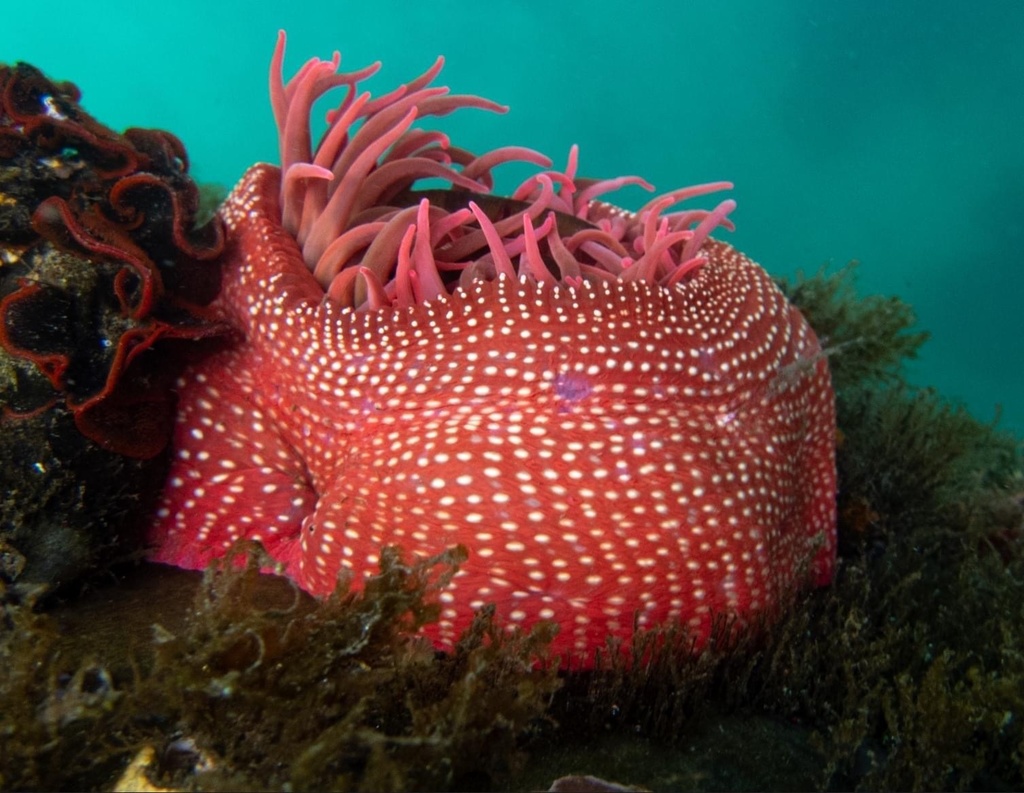
(c) Topher Mueller, some rights reserved (CC BY) · licence
Family: Actiniidae · Class: Anthozoa · Order: Actiniaria
Cribrinopsis albopunctata (White-spotted Rose Anemone) is a California animal in the Actiniidae family.
The white-spotted rose anemone is a large marine cnidarian that inhabits the rocky intertidal and subtidal zones of the northeastern Pacific Ocean. This species belongs to the family Actiniidae and represents one of the larger anemone species found along the Pacific coast. Adults commonly exceed 8 cm in diameter, with the column reaching up to 15 cm in width and extending to 25 cm in height (SIMoN, Actiniaria.com). The most distinctive feature of Cribrinopsis albopunctata is its striking coloration pattern. The cylindrical column is typically dark red or vermilion, though specimens may display rose-colored or white variations, becoming paler toward the base (Actiniaria.com). The body surface is marked by characteristic columns of white dots that give the species its common name. The tentacles exhibit a gradient coloration, appearing red at the tips and transitioning to golden brown at the base (SIMoN). This species occurs along the Pacific coast of North America, with documented populations extending from Alaska to California. The anemone inhabits rocky intertidal and subtidal environments, particularly areas with hard substrates that provide stable attachment sites. It is commonly found in marine protected areas including Point Cabrillo State Marine Reserve and Big Flat State Marine Conservation Area, where it contributes to the diverse invertebrate communities characteristic of California's rocky reefs and kelp forest ecosystems (CDFW). White-spotted rose anemones prefer habitats with moderate to strong water movement, which facilitates feeding and gas exchange. They typically attach to rock surfaces, pier pilings, and other hard substrates in depths ranging from low intertidal zones to several meters underwater. The species thrives in areas where upwelling brings nutrient-rich waters that support abundant zooplankton populations. Like other sea anemones, C. albopunctata is a carnivorous cnidarian that captures prey using stinging cells called cnidocytes located in its tentacles. The diet consists primarily of small fish, crustaceans, mollusks, and other invertebrates that come within reach of the extended tentacles. The species exhibits typical actiniarian feeding behavior, using its tentacles to paralyze prey before transferring it to the central mouth opening. Reproduction occurs through both sexual and asexual means, with the species capable of producing clones through fission, contributing to local population maintenance and genetic structure patterns observed in molecular studies (bioRxiv). Currently, no specific conservation status has been assigned to the white-spotted rose anemone at federal or state levels. The species appears to maintain stable populations within its range, particularly in marine protected areas where human disturbance is limited. However, like other marine invertebrates, it may face potential threats from ocean acidification, warming waters, and coastal development that could alter its rocky habitat requirements.
Classification
Class: Anthozoa · Order: Actiniaria · Family: Actiniidae
Frequently asked questions
How is Cribrinopsis albopunctata classified?
Cribrinopsis albopunctata belongs to class Anthozoa, order Actiniaria, family Actiniidae.
What family does Cribrinopsis albopunctata belong to?
Cribrinopsis albopunctata is in the Actiniidae family.
What is Cribrinopsis albopunctata?
The white-spotted rose anemone is a large marine cnidarian that inhabits the rocky intertidal and subtidal zones of the northeastern Pacific Ocean.
Is Cribrinopsis albopunctata found in California?
Yes. Cribrinopsis albopunctata is recorded in California in The California Species Project's catalogue.
Related species
Other California species in the same genus, family, or bioregion.
Data from The California Species Project — 14,000+ California species with verified data from CNPS, CDFW, USFWS, and more.