Crossopriza lyoni
Tailed Cellar Spider
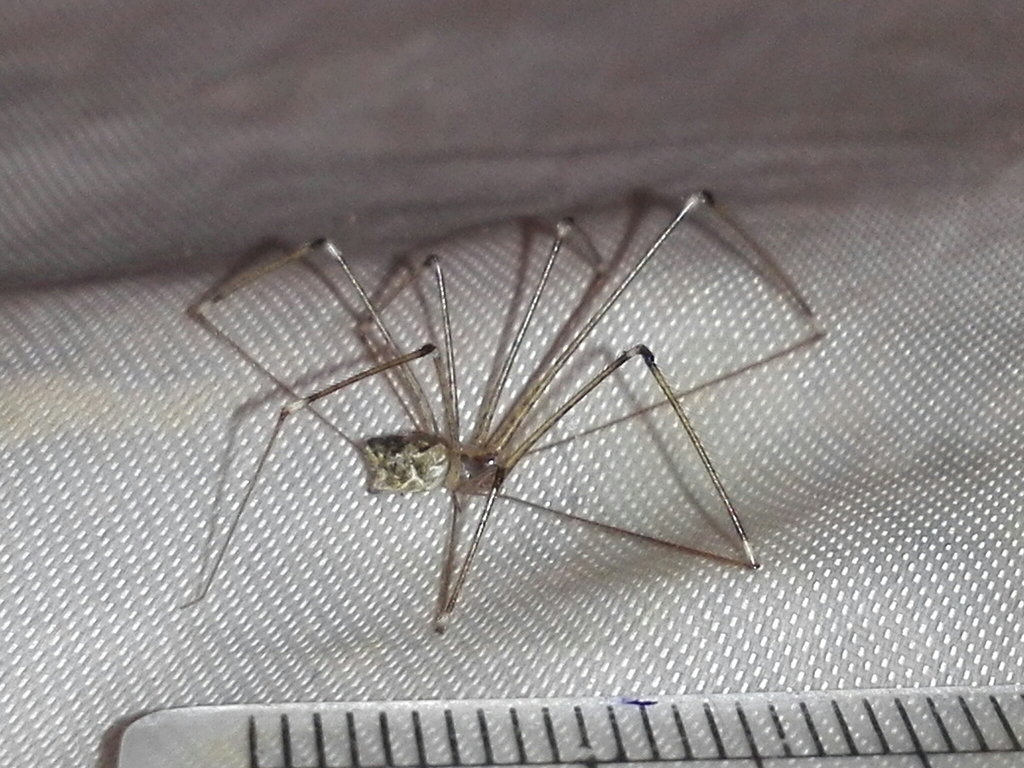
(c) Vihansith Kulatunga, some rights reserved (CC BY-SA) · licence
Family: Pholcidae · Class: Arachnida · Order: Araneae
Crossopriza lyoni (Tailed Cellar Spider) is a California animal in the Pholcidae family.
The tailed cellar spider is a widespread arachnid species that has adapted to living in close association with human structures. This synanthropic spider belongs to the family Pholcidae, commonly known as cellar spiders or daddy longlegs spiders, though it is distinct from harvestmen which share the latter common name. Tailed cellar spiders are characterized by their elongated legs relative to body size, typical of the Pholcidae family. The body is relatively small and pale, with a distinctive elongated abdomen that gives the species its "tailed" common name. Like other cellar spiders, they possess long, thin legs that are several times longer than their body length. The cephalothorax and abdomen are typically light brown to yellowish in coloration. This species has achieved a nearly cosmopolitan distribution, occurring across multiple continents including North America, where it has become well-established. In California, Crossopriza lyoni can be found throughout urban and suburban areas where suitable artificial structures provide habitat. The species' association with human habitation has facilitated its widespread dispersal through commerce and transportation. Tailed cellar spiders show a strong preference for indoor environments and artificial structures rather than natural habitats. They commonly inhabit basements, cellars, garages, attics, and other dark, undisturbed areas of buildings. The spiders construct irregular, three-dimensional webs in corners and crevices, often where walls meet ceilings or in storage areas with minimal human activity. These locations provide protection from predators and environmental extremes while offering access to prey. As web-building predators, tailed cellar spiders feed primarily on small flying insects that become entangled in their webs, including flies, mosquitoes, small moths, and gnats. Their hunting strategy is passive, relying on prey to encounter their webs rather than actively pursuing targets. When prey is captured, the spider quickly immobilizes it with silk before feeding. Reproduction follows typical spider patterns, with females producing egg sacs that they carry attached to their spinnerets until the eggs hatch. One notable behavior of cellar spiders, including C. lyoni, is their defensive response to disturbance. When threatened, they rapidly vibrate or bounce in their webs, creating a blurred appearance that may confuse predators or make them difficult to target accurately. This species is not subject to any conservation listing or protection measures. As a synanthropic species that has benefited from human activities and urban development, tailed cellar spiders face no significant conservation threats. Their populations appear stable and may even be increasing in areas of urban expansion. The species' ability to thrive in human-modified environments and its broad ecological tolerance suggest it will continue to maintain viable populations throughout its introduced range. No specific management actions are needed for this non-native but largely benign species that has integrated into urban ecosystems.
Classification
Class: Arachnida · Order: Araneae · Family: Pholcidae
Frequently asked questions
How is Crossopriza lyoni classified?
Crossopriza lyoni belongs to class Arachnida, order Araneae, family Pholcidae.
What family does Crossopriza lyoni belong to?
Crossopriza lyoni is in the Pholcidae family.
What is Crossopriza lyoni?
The tailed cellar spider is a widespread arachnid species that has adapted to living in close association with human structures.
Is Crossopriza lyoni found in California?
Yes. Crossopriza lyoni is recorded in California in The California Species Project's catalogue.
Related species
Other California species in the same genus, family, or bioregion.
Data from The California Species Project — 14,000+ California species with verified data from CNPS, CDFW, USFWS, and more.