Crotalus willardi obscurus
New Mexican ridge-nosed rattlesnake
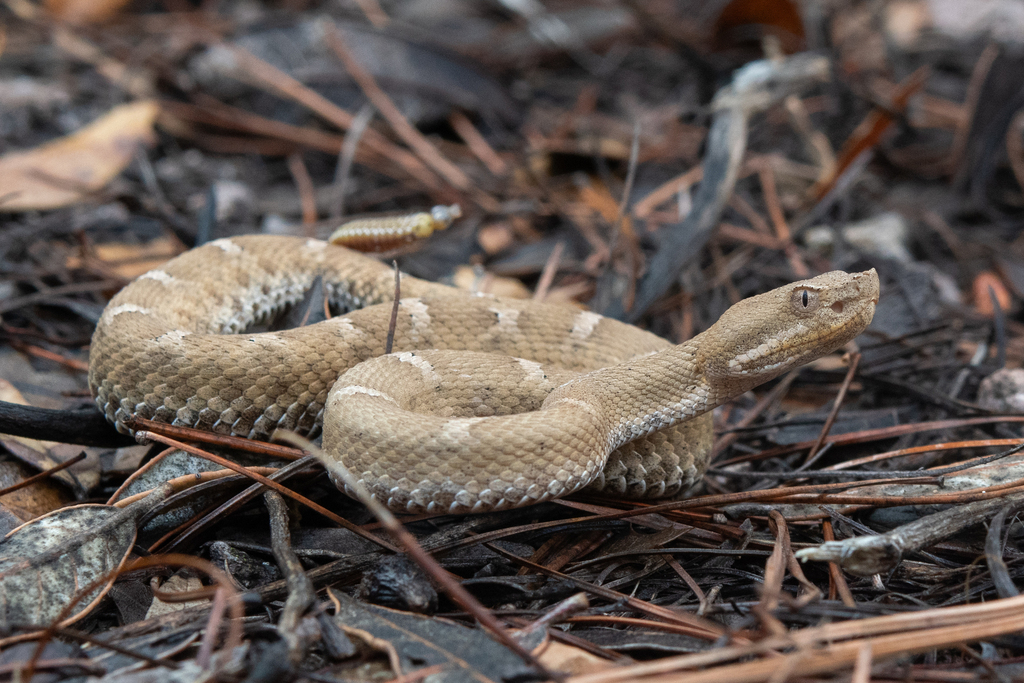
(c) Court Harding, some rights reserved (CC BY) · licence
Family: Viperidae · Class: Reptilia · Order: Squamata
Conservation status: Threatened
Crotalus willardi obscurus (New Mexican ridge-nosed rattlesnake) is a California animal in the Viperidae family.
The New Mexican ridge-nosed rattlesnake is a small montane viper reaching a maximum length of 66 centimeters (26 inches). The species exhibits pale gray to gray-brown dorsal coloration without prominent facial markings that distinguish other ridge-nosed rattlesnake subspecies. The dorsal pattern consists of pale crossbars edged with darker pigmentation along the anterior and posterior margins. The ventral surface is cream to white with occasional mottling of grayish to reddish brown coloration. Juveniles display distinctive dark gray or black tails, though some individuals may exhibit light yellow tail coloration (USFWS Species Profile). This subspecies of Crotalus willardi occurs in montane regions of New Mexico, Arizona, and Mexico. The species' range is extremely restricted, with populations documented in isolated mountain ranges within this tri-state region. In the United States, confirmed populations exist in specific mountain systems along the Arizona-New Mexico border region. The New Mexican ridge-nosed rattlesnake inhabits high-elevation environments characteristic of Madrean pinyon-juniper woodland ecosystems. According to NatureServe, the species occurs within this specialized montane habitat type, which features pinyon pine and juniper trees at elevations typically above 1,500 meters (4,900 feet). The subspecies requires specific microhabitat conditions within these woodland environments, including rocky outcrops and areas with appropriate thermal regulation opportunities. Limited ecological data exists for this cryptic subspecies, reflecting its extremely secretive nature and low population densities. The species exhibits typical rattlesnake behavior patterns, including ambush predation and seasonal activity cycles that correspond with montane climate patterns. Reproductive ecology follows general Crotalus patterns, with females producing live young through ovoviviparous reproduction. Diet likely consists of small mammals, birds, and lizards appropriate to its body size, though specific prey preferences have not been extensively documented. The U.S. Fish and Wildlife Service listed the New Mexican ridge-nosed rattlesnake as threatened under the Endangered Species Act, with protection extending to wherever the subspecies is found. The subspecies receives a NatureServe global rank of G5T1T2, indicating the overall species is secure but this particular subspecies is critically imperiled to imperiled (NatureServe Explorer). The extreme rarity of this subspecies presents significant conservation challenges, with field surveys requiring extensive effort to detect individuals. According to USFWS staff reports, expert researchers average over 800 hours of survey time per detection in some populations, highlighting the subspecies' cryptic nature and low densities. Federal expenditure reports from 1998-2000 document modest but consistent conservation funding, with annual expenditures ranging from approximately $18,800 to $86,050 during this period. Primary threats likely include habitat fragmentation, climate change impacts on montane ecosystems, and the subspecies' naturally restricted range and small population sizes. The subspecies' conservation depends on maintaining intact montane woodland habitats and continued monitoring of the few known populations across its limited range.
Classification
Class: Reptilia · Order: Squamata · Family: Viperidae
Conservation status
Threatened
Frequently asked questions
How is Crotalus willardi obscurus classified?
Crotalus willardi obscurus belongs to class Reptilia, order Squamata, family Viperidae.
What family does Crotalus willardi obscurus belong to?
Crotalus willardi obscurus is in the Viperidae family.
Is Crotalus willardi obscurus protected or of conservation concern?
Crotalus willardi obscurus carries the following status: Threatened.
What is Crotalus willardi obscurus?
The New Mexican ridge-nosed rattlesnake is a small montane viper reaching a maximum length of 66 centimeters (26 inches).
Is Crotalus willardi obscurus found in California?
Yes. Crotalus willardi obscurus is recorded in California in The California Species Project's catalogue.
Related species
Other California species in the same genus, family, or bioregion.
Data from The California Species Project — 14,000+ California species with verified data from CNPS, CDFW, USFWS, and more.