Crotaphytus bicinctores
Great Basin Collared Lizard
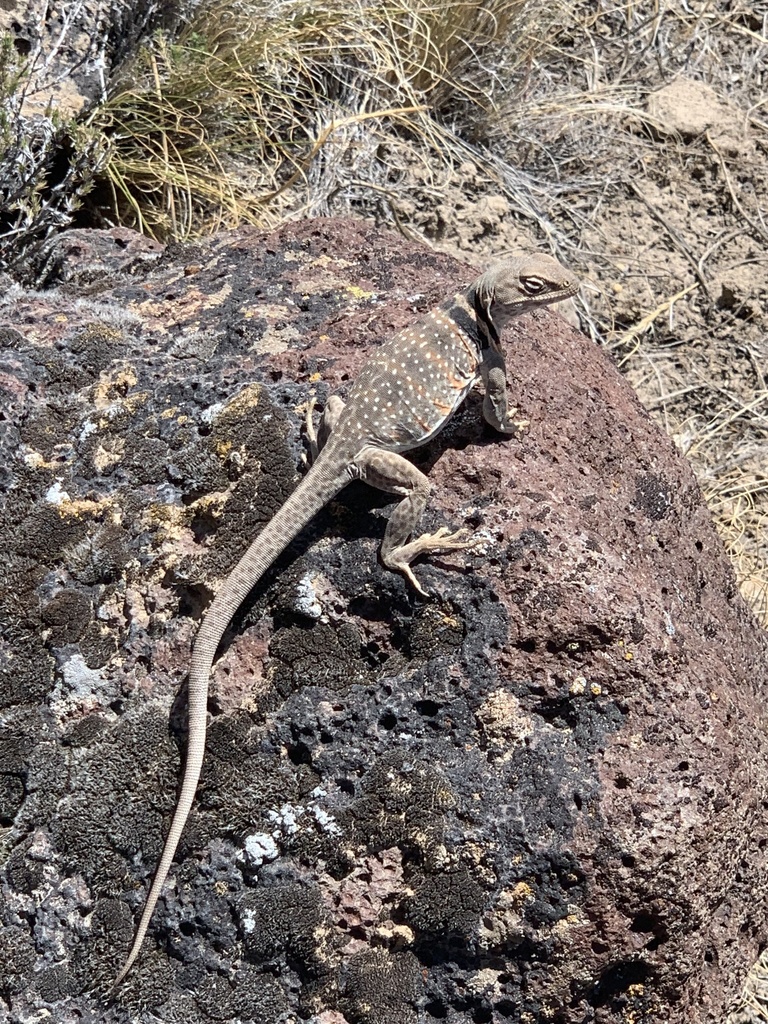
no rights reserved · CC0
Family: Crotaphytidae · Class: Reptilia · Order: Squamata
Crotaphytus bicinctores (Great Basin Collared Lizard) is a California animal in the Crotaphytidae family.
The Great Basin Collared Lizard (Crotaphytus bicinctores) is a robust, medium-sized lizard measuring 89 to 140 mm (3.5 to 5.5 inches) in snout-vent length, with a total length including tail reaching up to 356 mm (14 inches). Adults display a broad head, powerful jaws, and long hind legs adapted for rapid locomotion. The species is characterized by two prominent black collar bands across the neck, separated by a light-colored band. Body coloration varies from yellowish-green to blue-green dorsally, with females often showing orange or reddish spots during breeding season. The tail displays alternating light and dark bands. The Great Basin Collared Lizard occurs in the eastern Mojave Desert and Great Basin regions of California, with populations documented in Inyo, Mono, and San Bernardino counties. The species' California range represents the western edge of a broader distribution that extends eastward through Nevada, Utah, Arizona, and into Colorado and New Mexico. In California, populations are primarily found in the Panamint Mountains, White Mountains, and scattered locations in the eastern Sierra Nevada. This species inhabits arid and semi-arid environments characterized by rocky outcrops, canyon walls, boulder fields, and rocky slopes. Elevational range extends from approximately 1,200 to 2,400 meters (3,900 to 7,900 feet). Preferred habitat includes areas with abundant rock crevices and ledges that provide shelter and thermoregulatory sites. Vegetation is typically sparse, consisting of desert shrub communities dominated by sagebrush, shadscale, and various cacti. The lizards require open areas for foraging and basking, along with nearby rock formations for escape cover. Great Basin Collared Lizards are diurnal, heliothermic predators that emerge during morning hours to bask on rocks and achieve optimal body temperatures. They are opportunistic carnivores, feeding primarily on insects including grasshoppers, beetles, and ants, but also consume smaller lizards and occasionally plant material. The species exhibits territorial behavior, with males defending prime basking and foraging areas. Breeding occurs from May through July, with females depositing 2 to 8 eggs in sandy or gravelly soil beneath rocks or in crevices. Incubation lasts approximately 60 to 75 days, with hatchlings emerging in late summer. When threatened, these lizards can run bipedally on their hind legs at speeds exceeding 24 kilometers per hour (15 mph). The Great Basin Collared Lizard is not federally listed and appears to maintain stable populations within its California range as of December 2025. Primary conservation concerns include habitat fragmentation from development, off-road vehicle activity, and collection for the pet trade. Climate change may affect the species through altered precipitation patterns and increased temperatures in already arid habitats. The species' dependence on specific rocky habitat types makes it vulnerable to localized disturbances, though its broad elevational range provides some resilience to environmental changes.
Classification
Class: Reptilia · Order: Squamata · Family: Crotaphytidae
Frequently asked questions
How is Crotaphytus bicinctores classified?
Crotaphytus bicinctores belongs to class Reptilia, order Squamata, family Crotaphytidae.
What family does Crotaphytus bicinctores belong to?
Crotaphytus bicinctores is in the Crotaphytidae family.
What is Crotaphytus bicinctores?
The Great Basin Collared Lizard (Crotaphytus bicinctores) is a robust, medium-sized lizard measuring 89 to 140 mm (3.5 to 5.5 inches) in snout-vent length, with a total length including tail reaching up to 356 mm (14 inches).
Is Crotaphytus bicinctores found in California?
Yes. Crotaphytus bicinctores is recorded in California in The California Species Project's catalogue.
Related species
Other California species in the same genus, family, or bioregion.
Data from The California Species Project — 14,000+ California species with verified data from CNPS, CDFW, USFWS, and more.