Crotaphytus vestigium
Baja California Collared Lizard
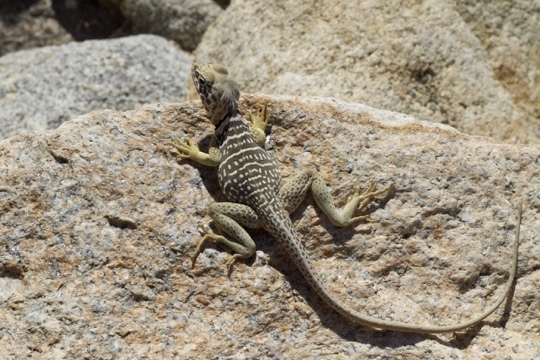
(c) Emily Herriott, some rights reserved (CC BY) · licence
Family: Crotaphytidae · Class: Reptilia · Order: Squamata
Crotaphytus vestigium (Baja California Collared Lizard) is a California animal in the Crotaphytidae family.
The Baja California collared lizard (Crotaphytus vestigium) is a medium-sized lizard in the family Crotaphytidae, characterized by its robust build and distinctive coloration patterns. Adults typically measure 76 to 127 mm (3.0 to 5.0 inches) in snout-to-vent length, with males generally larger than females. The species displays sexual dimorphism in coloration, with males exhibiting bright blue-green body coloration and prominent black collar markings around the neck during breeding season. Females and juveniles are more subdued, showing brown to gray base coloration with darker crossbands. Both sexes possess large heads relative to body size, powerful jaw muscles, and long hind legs adapted for rapid locomotion. Historically, this species was found in extreme southern California, specifically in San Diego County near the Mexican border. However, the Baja California collared lizard is now considered extirpated from California, with its last confirmed occurrence in the state documented in the early 20th century. The species' primary range extends throughout Baja California, Mexico, from the California border south to approximately 30 degrees north latitude. Small populations persist in coastal and inland areas of northwestern Baja California. Baja California collared lizards inhabit arid and semi-arid environments, particularly rocky areas with granite boulders, canyon walls, and rocky hillsides. The species shows preference for areas with scattered vegetation, including coastal sage scrub and chaparral plant communities. Elevation ranges from sea level to approximately 1,200 meters (3,937 feet). Suitable habitat requires rock outcrops or boulder piles that provide basking sites, shelter, and elevated perches for territorial displays and predator detection. This species exhibits typical crotaphytid behaviors, including territorial defense and active foraging strategies. Males establish territories during the breeding season, displaying from prominent rock perches and engaging in aggressive interactions with intruders. The diet consists primarily of insects, spiders, and other small arthropods, with larger individuals occasionally consuming smaller lizards. Breeding occurs from April through July, with females depositing 2 to 8 eggs in sandy soil beneath rocks or in crevices. Eggs incubate for approximately 60 to 75 days, with hatchlings emerging in late summer. The species is active during daylight hours, with peak activity occurring during morning and late afternoon periods when ambient temperatures are optimal. The conservation status of Crotaphytus vestigium reflects significant concern for this range-restricted species. While not federally listed in the United States due to its extirpation from California, the species faces ongoing threats throughout its Mexican range. Primary threats include habitat loss from urban development, agriculture, and mining activities in Baja California. Climate change poses additional risks through altered precipitation patterns and increased temperature extremes. The small population size and restricted distribution make the species particularly vulnerable to stochastic events and habitat fragmentation. Conservation efforts in Mexico focus on habitat protection and population monitoring, though comprehensive surveys are needed to assess current population status and trends.
Classification
Class: Reptilia · Order: Squamata · Family: Crotaphytidae
Frequently asked questions
How is Crotaphytus vestigium classified?
Crotaphytus vestigium belongs to class Reptilia, order Squamata, family Crotaphytidae.
What family does Crotaphytus vestigium belong to?
Crotaphytus vestigium is in the Crotaphytidae family.
What is Crotaphytus vestigium?
The Baja California collared lizard (Crotaphytus vestigium) is a medium-sized lizard in the family Crotaphytidae, characterized by its robust build and distinctive coloration patterns.
Is Crotaphytus vestigium found in California?
Yes. Crotaphytus vestigium is recorded in California in The California Species Project's catalogue.
Related species
Other California species in the same genus, family, or bioregion.
Data from The California Species Project — 14,000+ California species with verified data from CNPS, CDFW, USFWS, and more.