Crotophaga sulcirostris
Groove-billed Ani
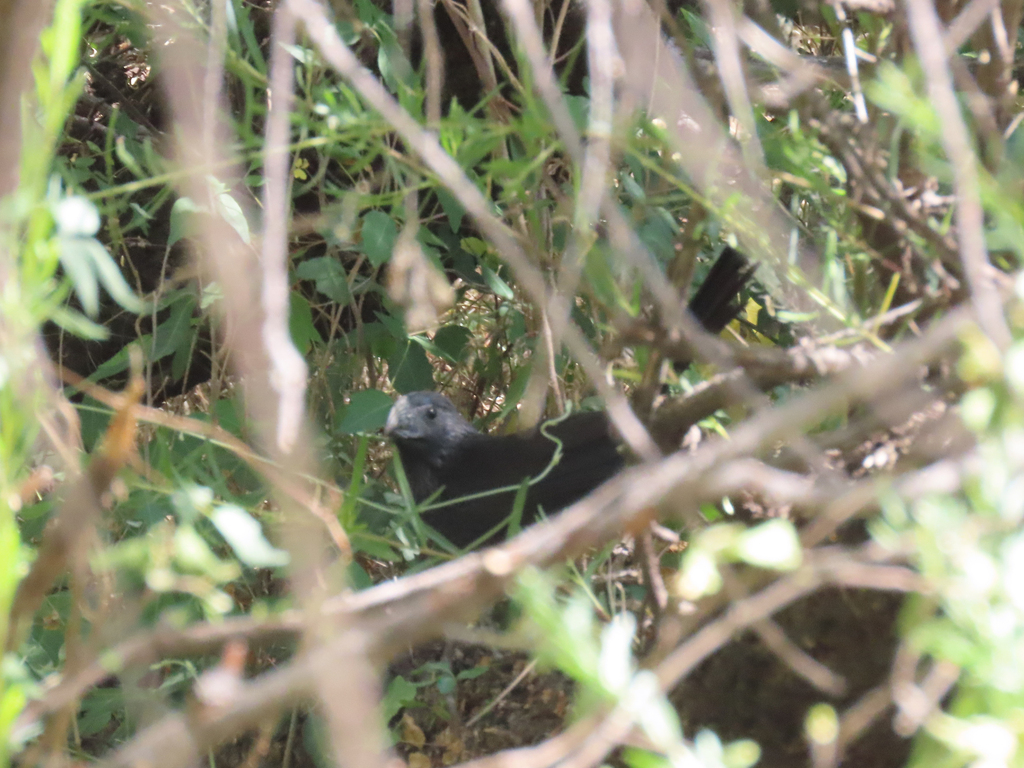
(c) Alina Martin, some rights reserved (CC BY) · licence
Family: Cuculidae · Class: Aves · Order: Cuculiformes
Crotophaga sulcirostris (Groove-billed Ani) is a California animal in the Cuculidae family.
The Groove-billed Ani is a medium-sized blackbird in the cuckoo family, measuring 30 to 35 cm (12 to 14 inches) in length with a wingspan of approximately 41 cm (16 inches). Adults weigh between 70 to 90 grams. The species displays entirely black plumage with a slight iridescent blue-green sheen visible in direct sunlight. The most distinctive feature is the laterally compressed, high-ridged bill with prominent longitudinal grooves along the upper mandible, from which the species derives its common name. The tail is long and graduated, and the legs are black. The Groove-billed Ani ranges from southern Texas through Central America to western Colombia, Ecuador, and northwestern Peru. In North America, the species is primarily resident in the Rio Grande Valley of Texas, with occasional vagrant records in other southwestern states. California records are extremely rare, with only a handful of documented sightings along the southern coast and in the Imperial Valley. Most California observations represent vagrants that have wandered far from their normal range, typically occurring during fall and winter months. This species inhabits tropical and subtropical lowlands, preferring open woodlands, forest edges, agricultural areas, and scrublands. Groove-billed Anis favor areas with scattered trees and dense shrubby vegetation, typically below 1,500 meters elevation. They are commonly found in pastures with livestock, taking advantage of insects disturbed by grazing animals. The species adapts well to human-modified landscapes including farmland and suburban areas with appropriate vegetation structure. Groove-billed Anis are highly social birds that live in communal groups of 8 to 20 individuals year-round. They feed primarily on insects, including grasshoppers, beetles, caterpillars, and ants, often foraging on the ground or catching insects flushed by livestock. The species also consumes small lizards, frogs, and occasionally fruits and seeds. Breeding is communal, with multiple pairs in a group constructing a single large nest of sticks and twigs lined with leaves, typically placed 2 to 6 meters high in dense vegetation. Multiple females lay their blue eggs in the shared nest, with clutches containing 10 to 18 eggs total. Incubation lasts 13 to 15 days, and all group members participate in feeding the young. The Groove-billed Ani is not federally listed and has no special conservation status in California due to its rarity as a vagrant species in the state. Globally, the species maintains stable populations throughout most of its range and is classified as Least Concern by the International Union for Conservation of Nature. In its core range, populations may face localized pressures from habitat conversion and pesticide use in agricultural areas, but overall the species adapts well to human-modified environments and continues to expand its range in some regions.
Classification
Class: Aves · Order: Cuculiformes · Family: Cuculidae
Frequently asked questions
How is Crotophaga sulcirostris classified?
Crotophaga sulcirostris belongs to class Aves, order Cuculiformes, family Cuculidae.
What family does Crotophaga sulcirostris belong to?
Crotophaga sulcirostris is in the Cuculidae family.
What is Crotophaga sulcirostris?
The Groove-billed Ani is a medium-sized blackbird in the cuckoo family, measuring 30 to 35 cm (12 to 14 inches) in length with a wingspan of approximately 41 cm (16 inches).
Is Crotophaga sulcirostris found in California?
Yes. Crotophaga sulcirostris is recorded in California in The California Species Project's catalogue.
Related species
Other California species in the same genus, family, or bioregion.
Data from The California Species Project — 14,000+ California species with verified data from CNPS, CDFW, USFWS, and more.