Cryptochiton stelleri
Gumboot Chiton
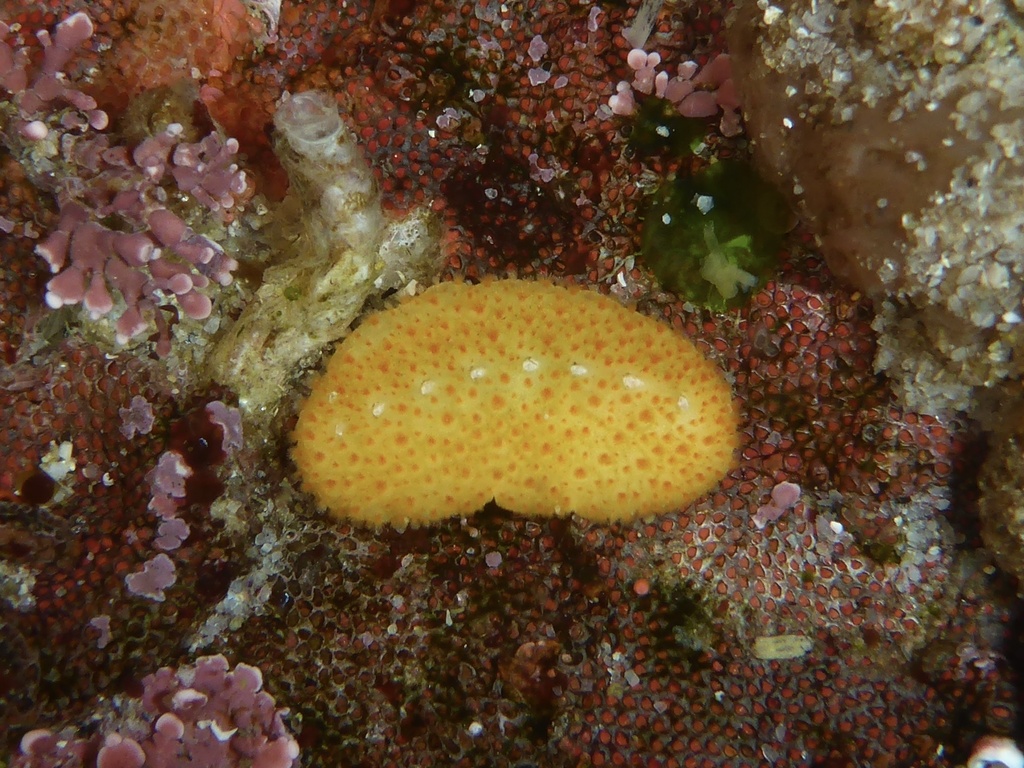
(c) Cricket Raspet, some rights reserved (CC BY) · licence
Family: Acanthochitonidae · Class: Polyplacophora · Order: Chitonida
Cryptochiton stelleri (Gumboot Chiton) is a California animal in the Acanthochitonidae family.
The gumboot chiton is the largest chiton species in the world and the largest marine mollusk in North America. Adults can reach lengths of up to 36 centimeters (14 inches) and weights exceeding 2 kilograms (4.4 pounds). Unlike other chitons, the eight shell plates are completely covered by a thick, leathery girdle that gives the animal its distinctive brick-red to brown coloration and rough, warty texture. The girdle extends well beyond the plates, creating the characteristic oval, dome-shaped appearance that resembles a football or loaf of bread. Gumboot chitons occur along the Pacific coast from Alaska to central California. In California, they are found from the Oregon border south to approximately Monterey Bay, with populations documented in marine protected areas including Big Flat State Marine Conservation Area and Sea Lion Gulch State Marine Reserve along the Lost Coast. The species inhabits rocky intertidal zones and subtidal areas to depths of approximately 20 meters (66 feet). This species requires hard substrate for attachment, typically occurring on exposed rock faces, in tide pools, and on rocky reefs. Gumboot chitons are most commonly found in the low intertidal zone and shallow subtidal areas where wave action provides adequate water circulation. They prefer areas with moderate to strong wave exposure and are often found in crevices or depressions that provide protection from extreme wave forces. The species occurs in water temperatures ranging from 8 to 15 degrees Celsius (46 to 59 degrees Fahrenheit). Gumboot chitons are grazers that feed primarily on algae, sponges, bryozoans, and other encrusting organisms scraped from rock surfaces using their specialized radula. They are most active during high tide and at night when predation risk is reduced. Reproduction involves external fertilization, with females releasing eggs and males releasing sperm into the water column during spring and summer months. Larvae undergo a planktonic phase before settling and metamorphosing into juvenile chitons. Adults can live for several decades, with some individuals estimated to reach ages of 20 years or more. The gumboot chiton has no federal or state listing status and is not considered threatened or endangered. However, populations may be vulnerable to habitat alteration, pollution, and ocean acidification, which can affect shell formation and prey availability. Climate change impacts including rising sea temperatures and altered ocean chemistry represent potential long-term threats. The species benefits from protection within California's marine protected area network, where fishing and collection activities are restricted. As a slow-growing, long-lived species with limited mobility, gumboot chitons serve as indicators of ecosystem health in rocky intertidal communities.
Classification
Class: Polyplacophora · Order: Chitonida · Family: Acanthochitonidae
Frequently asked questions
How is Cryptochiton stelleri classified?
Cryptochiton stelleri belongs to class Polyplacophora, order Chitonida, family Acanthochitonidae.
What family does Cryptochiton stelleri belong to?
Cryptochiton stelleri is in the Acanthochitonidae family.
What is Cryptochiton stelleri?
The gumboot chiton is the largest chiton species in the world and the largest marine mollusk in North America.
Is Cryptochiton stelleri found in California?
Yes. Cryptochiton stelleri is recorded in California in The California Species Project's catalogue.
More California species
This species has no close relatives in our California data — here are other species to explore.
Data from The California Species Project — 14,000+ California species with verified data from CNPS, CDFW, USFWS, and more.