Ctenolepisma lineatum
Four-lined Silverfish
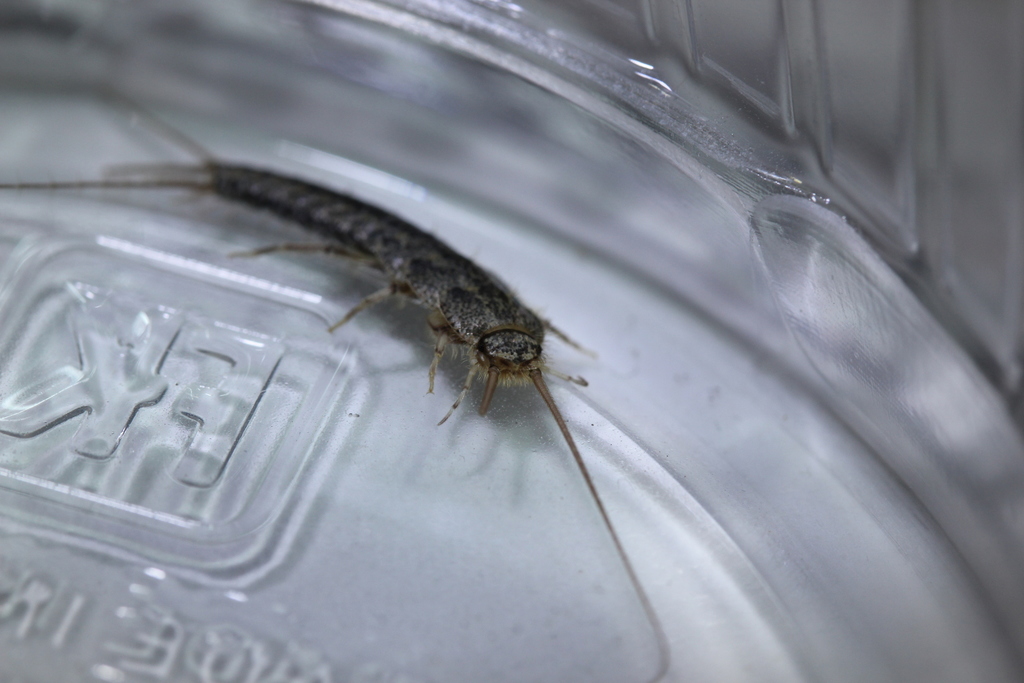
(c) Zachary Dankowicz, some rights reserved (CC BY) · licence
Family: Lepismatidae · Class: Insecta · Order: Zygentoma
Ctenolepisma lineatum (Four-lined Silverfish) is a California animal in the Lepismatidae family.
The Four-lined Silverfish is a small, primitive wingless insect measuring approximately 15 mm (0.6 inches) in body length. The species displays a distinctive pattern of four dark longitudinal lines running down its pale gray to brownish back, which distinguishes it from other silverfish species. The body is covered in minute scales that give it a metallic appearance, and it possesses three long, thread-like appendages at the posterior end called cerci. Two pairs of small fingerlike processes called styli are present on the underside of the rear abdomen. Ctenolepisma lineatum has a broad distribution across North America, occurring from the midwestern and southern United States. According to BugGuide observations, the species has been documented in states including California, Indiana, and Maryland (BugGuide 2025). In California, it can be found as a household pest, particularly in southern regions where it may establish populations in human structures. This species inhabits a variety of environments, showing considerable adaptability to both natural and artificial habitats. In natural settings, Four-lined Silverfish occupy cracks and crevices in rocky areas, under bark, and in leaf litter. In human environments, they are commonly found in homes from basement to attic, including closets, storage areas, kitchens, and garages. The species demonstrates a strong preference for dark, humid locations and actively avoids light, remaining hidden during daylight hours. Four-lined Silverfish are nocturnal scavengers that feed on a diverse array of organic materials. Their diet includes paper products, particularly those with starch-based glues or pastes, starched clothing, dried foods, and various organic debris. They are capable of digesting cellulose and can survive on materials that are nutritionally poor for most other insects. The species exhibits a complex life cycle typical of primitive insects. Females deposit eggs in batches of 2-20 individuals, placing them in protected cracks and crevices. The first instar larvae lack the characteristic scales and setae, with scales appearing during the fourth instar and reproductive organs developing by the fourteenth instar. Sexual maturity is reached after 2-3 years, and adults may continue to molt 3-5 times annually for an additional five years. The Four-lined Silverfish has no formal conservation status and is not considered threatened. The species appears to be maintaining stable populations and has actually benefited from human activities that provide suitable habitat. In some regions, particularly southern California, it is considered a minor household pest due to its potential to damage paper products, books, and clothing. However, infestations rarely reach levels that cause significant economic damage, and the species plays a beneficial role in natural ecosystems by contributing to decomposition processes.
Classification
Class: Insecta · Order: Zygentoma · Family: Lepismatidae
Frequently asked questions
How is Ctenolepisma lineatum classified?
Ctenolepisma lineatum belongs to class Insecta, order Zygentoma, family Lepismatidae.
What family does Ctenolepisma lineatum belong to?
Ctenolepisma lineatum is in the Lepismatidae family.
What is Ctenolepisma lineatum?
The Four-lined Silverfish is a small, primitive wingless insect measuring approximately 15 mm (0.6 inches) in body length.
Is Ctenolepisma lineatum found in California?
Yes. Ctenolepisma lineatum is recorded in California in The California Species Project's catalogue.
Related species
Other California species in the same genus, family, or bioregion.
Data from The California Species Project — 14,000+ California species with verified data from CNPS, CDFW, USFWS, and more.