Ctenucha rubroscapus
Red-Shouldered Ctenucha
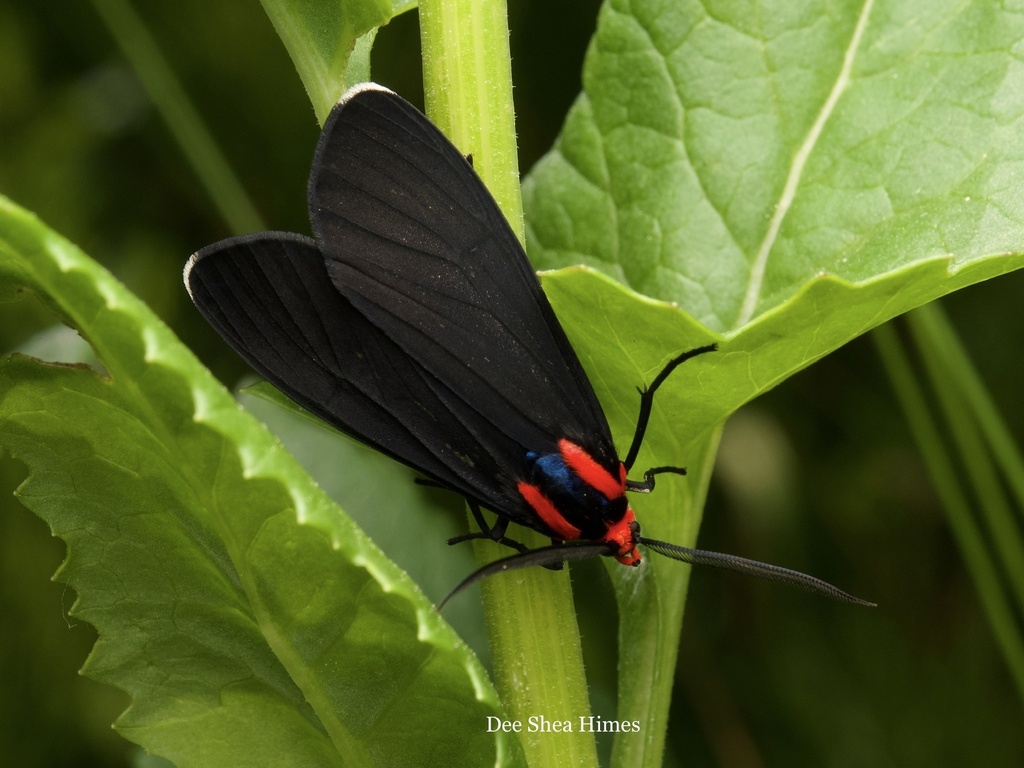
(c) Dee Shea Himes, some rights reserved (CC BY) · licence
Family: Erebidae · Class: Insecta · Order: Lepidoptera
Ctenucha rubroscapus (Red-Shouldered Ctenucha) is a California animal in the Erebidae family.
The Red-Shouldered Ctenucha is a medium-sized moth in the family Erebidae, characterized by distinctive reddish-orange or brick-red shoulder patches that give the species its common name. Adults have a wingspan of approximately 32-42 mm (1.3-1.7 inches), with forewings that are predominantly dark gray to black with the prominent red or orange-red shoulder markings at the base of the forewings. The hindwings are typically darker, appearing blackish-brown to black. The thorax displays the same reddish coloration as the shoulder patches, while the abdomen is dark with metallic blue-black scaling. Males and females are similar in appearance, though females tend to be slightly larger. Ctenucha rubroscapus occurs from southern coastal Washington south along the Pacific coast and Sierra Nevada to central California. The species' distribution follows two primary corridors: the coastal region from Washington through California, and the Sierra Nevada mountain range extending into central California. This range encompasses diverse elevational gradients from near sea level along the coast to montane environments in the Sierra Nevada, though specific elevation limits require further documentation. The species inhabits grasslands, meadows, and open woodland areas where its host plants are abundant. Red-Shouldered Ctenucha larvae feed on various grasses, particularly species in the genus Dactylis (orchard grass) and Elymus (wildrye grass), both members of the Poaceae family. Adults are typically found in areas with mixed grass communities, including coastal prairies, mountain meadows, and forest openings. The moth shows a preference for habitats with moderate moisture levels and diverse grass species composition. Red-Shouldered Ctenucha exhibits typical erebid moth behavior, with adults being primarily nocturnal. The species likely has one generation per year, with flight periods varying by latitude and elevation. Adults are attracted to artificial lights and may be encountered at porch lights or moth traps during their active season. Larvae are grass feeders, likely overwintering in the larval stage and pupating in spring. The caterpillars construct cocoons in leaf litter or soil surface debris. Mating behavior involves pheromone attraction, with females releasing chemical attractants to draw males for reproduction. The Red-Shouldered Ctenucha does not appear on federal or California state endangered species lists, suggesting stable populations within its range. However, like many grass-dependent species, it may face localized threats from habitat conversion, agricultural intensification, and invasive plant species that alter native grass communities. Coastal development and urbanization could impact populations in lower elevation coastal areas, while forest management practices might affect montane populations. The species' dependence on native grass communities makes it potentially vulnerable to climate change effects that alter precipitation patterns and growing seasons. Conservation of diverse grassland habitats and native grass species would benefit this moth and associated grass-dependent fauna.
Classification
Class: Insecta · Order: Lepidoptera · Family: Erebidae
Frequently asked questions
How is Ctenucha rubroscapus classified?
Ctenucha rubroscapus belongs to class Insecta, order Lepidoptera, family Erebidae.
What family does Ctenucha rubroscapus belong to?
Ctenucha rubroscapus is in the Erebidae family.
What is Ctenucha rubroscapus?
The Red-Shouldered Ctenucha is a medium-sized moth in the family Erebidae, characterized by distinctive reddish-orange or brick-red shoulder patches that give the species its common name.
Is Ctenucha rubroscapus found in California?
Yes. Ctenucha rubroscapus is recorded in California in The California Species Project's catalogue.
Related species
Other California species in the same genus, family, or bioregion.
Data from The California Species Project — 14,000+ California species with verified data from CNPS, CDFW, USFWS, and more.