Culaea inconstans
Brook stickleback
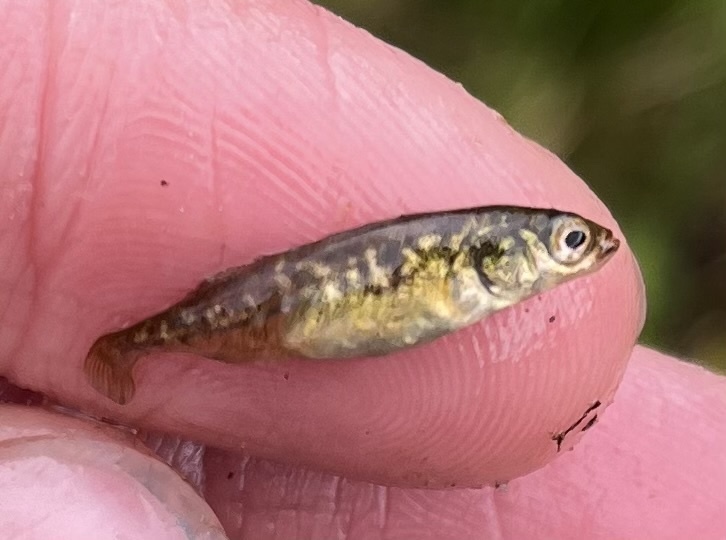
(c) Dustin Snider, some rights reserved (CC BY) · licence
Family: Gasterosteidae · Class: Actinopterygii · Order: Perciformes
Culaea inconstans (Brook stickleback) is a California animal in the Gasterosteidae family.
The brook stickleback is a small freshwater fish measuring typically 35-65 mm (1.4-2.6 inches) in total length, with a maximum recorded length of 87 mm (3.4 inches). The body is elongated and laterally compressed, with a narrow caudal peduncle. Coloration varies seasonally and by sex, with breeding males developing darker pigmentation and territorial behaviors. The species is characterized by 4-6 isolated dorsal spines anterior to the soft dorsal fin, distinguishing it from other North American sticklebacks. The pelvic fins are reduced or absent in many populations, and when present, consist of a spine and 0-1 soft rays. Brook stickleback have an extensive North American distribution, ranging from Nova Scotia to the Northwest Territories and eastern British Columbia in Canada, extending south through the Great Lakes-Mississippi River basin to southern Ohio and northern Illinois (FishBase). Despite this broad continental range, the species does not naturally occur in California waters. The presence of this species in California databases likely reflects monitoring of non-native populations or research specimens rather than established wild populations. This species inhabits cool, clear, heavily vegetated waters including spring-fed creeks, small rivers, lakes, and ponds (NatureServe Explorer). Brook stickleback prefer shallow, quiet to flowing pools with abundant aquatic vegetation and typically occur in areas with stable temperatures and high dissolved oxygen levels. They are commonly found in waters with dense macrophyte beds that provide cover and foraging habitat. The species tolerates a range of water chemistry conditions but shows preference for neutral to slightly alkaline pH. Brook stickleback exhibit complex reproductive behaviors typical of the Gasterosteidae family. Males arrive first in shallow waters during spring spawning season and establish territories where they construct nests from plant material and debris. The nest-building male courts females through elaborate displays, guiding them to the nest for egg deposition. After spawning, males provide parental care by guarding the nest and aerating eggs through fanning behaviors until hatching occurs. The species feeds primarily on small invertebrates including chironomid larvae, copepods, cladocerans, and other zooplankton. Juveniles and adults also consume algae and plant matter, particularly during periods when invertebrate prey is scarce. Brook stickleback are not federally listed and maintain stable populations throughout most of their native range. However, the species faces localized threats from habitat degradation, water quality impacts, and competition with introduced species. In some regions, populations have declined due to wetland drainage and stream channelization. The species serves important ecological roles as both predator of invertebrates and prey for larger fish, birds, and aquatic mammals. Research has utilized brook stickleback in laboratory studies examining host-parasite relationships and reproductive behavior, contributing to broader understanding of stickleback evolution and ecology.
Classification
Class: Actinopterygii · Order: Perciformes · Family: Gasterosteidae
Frequently asked questions
How is Culaea inconstans classified?
Culaea inconstans belongs to class Actinopterygii, order Perciformes, family Gasterosteidae.
What family does Culaea inconstans belong to?
Culaea inconstans is in the Gasterosteidae family.
What is Culaea inconstans?
The brook stickleback is a small freshwater fish measuring typically 35-65 mm (1.4-2.6 inches) in total length, with a maximum recorded length of 87 mm (3.4 inches).
Is Culaea inconstans found in California?
Yes. Culaea inconstans is recorded in California in The California Species Project's catalogue.
Related species
Other California species in the same genus, family, or bioregion.
Data from The California Species Project — 14,000+ California species with verified data from CNPS, CDFW, USFWS, and more.