Culex quinquefasciatus
Southern House Mosquito
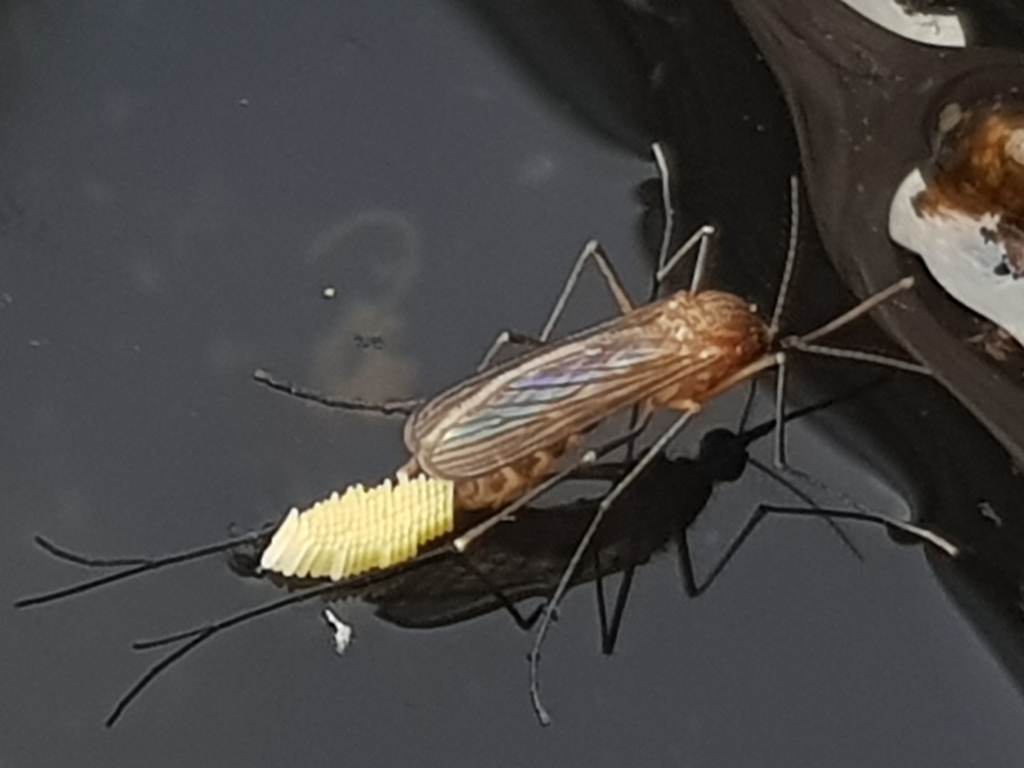
(c) Lek Khauv, some rights reserved (CC BY) · licence
Family: Culicidae · Class: Insecta · Order: Diptera
Culex quinquefasciatus (Southern House Mosquito) is a California animal in the Culicidae family.
The Southern House Mosquito is a medium-sized mosquito species measuring approximately 4-10 mm (0.16-0.39 inches) in length. Adults display brown to dark brown coloration with pale bands on the legs and proboscis. The wings are narrow and clear with dark scales along the veins. Females possess a longer proboscis adapted for blood feeding, while males have more feathery antennae and do not bite. Culex quinquefasciatus has a cosmopolitan distribution, occurring throughout much of the southern United States, including California, and extending into tropical and subtropical regions worldwide. In California, the species is established in urban and suburban areas throughout the state, with populations particularly dense in the Central Valley and southern regions where temperatures remain favorable year-round. This species thrives in human-modified environments, utilizing a wide variety of artificial and natural water sources for breeding. Larvae develop in stagnant or slow-moving water including storm drains, irrigation ditches, septic systems, abandoned containers, bird baths, and ornamental ponds. According to USFWS documentation, in Hawaiian ecosystems the species also breeds in feral animal wallows, water-filled cavities in native tree ferns created by feral pigs, natural tree holes, and pools in intermittent streams. The mosquito tolerates a broad range of water quality conditions and can develop in both clean and organically polluted water. Southern House Mosquitoes are primarily active during evening and nighttime hours, with peak activity occurring from dusk through the middle of the night. Females require blood meals for egg development and preferentially feed on birds, though they will also bite mammals including humans. Males feed exclusively on plant nectar and other sugar sources. The species exhibits multivoltine reproduction, producing multiple generations per year in favorable climates. Females lay egg rafts containing 100-300 eggs on water surfaces. The complete life cycle from egg to adult typically requires 10-14 days under optimal temperature conditions. Overwintering occurs in the adult stage in protected locations such as basements, sewers, and other sheltered areas. While not federally listed, Culex quinquefasciatus is considered a significant public health concern and ecological threat. The species serves as a primary vector for West Nile virus, St. Louis encephalitis, and other arboviruses affecting humans and wildlife. Of particular conservation concern, this mosquito acts as the primary vector for avian malaria and avian pox virus, which have severely impacted native bird populations, especially in Hawaii where the species has contributed to declines of endangered forest birds. USFWS has implemented mosquito suppression programs using Wolbachia-based incompatible insect technique to protect threatened species such as the 'akeke'e and 'akikiki on Kauai and Maui. The species' ability to adapt to urban environments and utilize diverse breeding sites has facilitated its global spread and establishment as a medically and ecologically important pest species.
Classification
Class: Insecta · Order: Diptera · Family: Culicidae
Frequently asked questions
How is Culex quinquefasciatus classified?
Culex quinquefasciatus belongs to class Insecta, order Diptera, family Culicidae.
What family does Culex quinquefasciatus belong to?
Culex quinquefasciatus is in the Culicidae family.
What is Culex quinquefasciatus?
The Southern House Mosquito is a medium-sized mosquito species measuring approximately 4-10 mm (0.16-0.39 inches) in length.
Is Culex quinquefasciatus found in California?
Yes. Culex quinquefasciatus is recorded in California in The California Species Project's catalogue.
Related species
Other California species in the same genus, family, or bioregion.
Data from The California Species Project — 14,000+ California species with verified data from CNPS, CDFW, USFWS, and more.