Cyclocephala lurida
Southern Masked Chafer
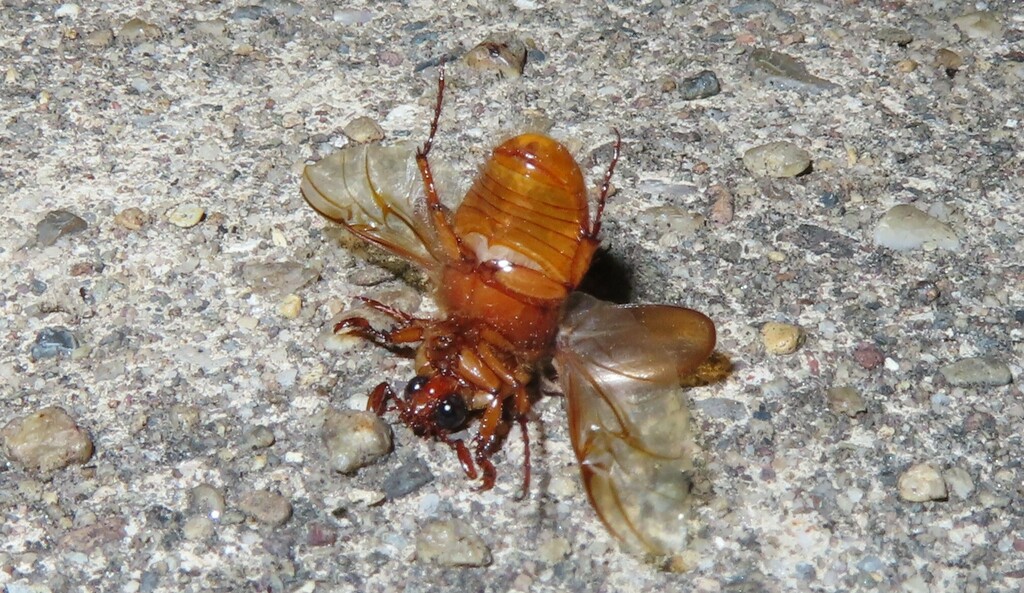
(c) Mila C., some rights reserved (CC BY) · licence
Family: Scarabaeidae · Class: Insecta · Order: Coleoptera
Cyclocephala lurida (Southern Masked Chafer) is a California animal in the Scarabaeidae family.
The Southern Masked Chafer (Cyclocephala lurida) is a medium-sized scarab beetle in the subfamily Dynastinae. Adults typically measure 12-18 mm in length and display a characteristic tan to reddish-brown coloration. The head and pronotum are often darker than the elytra, which may appear lighter brown to yellowish. Like other masked chafers, adults have a distinctive rounded, convex body shape and short, clubbed antennae. The common name "masked chafer" refers to the darkened head region that contrasts with the lighter body coloration. Cyclocephala lurida occurs across much of the southern and western United States, with documented populations extending from the southeastern states westward through Texas, New Mexico, Arizona, and into California. According to NatureServe, the species has a global conservation rank of G4, indicating it is apparently secure across its range. The beetle's distribution includes both desert and semi-arid regions, as well as areas with Mediterranean climate patterns. This species inhabits a variety of habitats including grasslands, chaparral, oak woodlands, and desert scrub communities. Adults are commonly found in areas with sandy or well-drained soils that support their underground larval development. The species occurs from sea level to moderate elevations, adapting to diverse environmental conditions across its range. In California, populations are documented in both coastal and inland regions. Adult Southern Masked Chafers are primarily nocturnal and strongly attracted to artificial lights during their active period, typically from late spring through early fall. Like other Cyclocephala species, they feed on flowers, pollen, and occasionally foliage of various plant species. The larvae, commonly called white grubs, develop underground where they feed on organic matter and plant roots. The life cycle is typically annual, with adults emerging during warm months to mate and lay eggs in suitable soil substrates. Females deposit eggs individually in the soil, where they develop through three larval instars before pupating. Mating behavior often occurs on or near host plants, with adults congregating on flowers during evening and nighttime hours. The species plays a role in pollination of some native plants, though it may occasionally cause minor damage to ornamental plants and turfgrass when populations are high. The Southern Masked Chafer is not federally or state-listed as threatened or endangered. Current populations appear stable across most of its range, though localized impacts from habitat conversion and urbanization may affect some populations. The species' broad distribution and adaptability to various habitat types contribute to its overall security. Climate change and continued urban development represent potential long-term challenges for maintaining suitable habitat, particularly in rapidly developing areas of California and the southwestern United States.
Classification
Class: Insecta · Order: Coleoptera · Family: Scarabaeidae
Frequently asked questions
How is Cyclocephala lurida classified?
Cyclocephala lurida belongs to class Insecta, order Coleoptera, family Scarabaeidae.
What family does Cyclocephala lurida belong to?
Cyclocephala lurida is in the Scarabaeidae family.
What is Cyclocephala lurida?
The Southern Masked Chafer (Cyclocephala lurida) is a medium-sized scarab beetle in the subfamily Dynastinae.
Is Cyclocephala lurida found in California?
Yes. Cyclocephala lurida is recorded in California in The California Species Project's catalogue.
Related species
Other California species in the same genus, family, or bioregion.
Data from The California Species Project — 14,000+ California species with verified data from CNPS, CDFW, USFWS, and more.