Cycloneda sanguinea
Spotless Lady Beetle
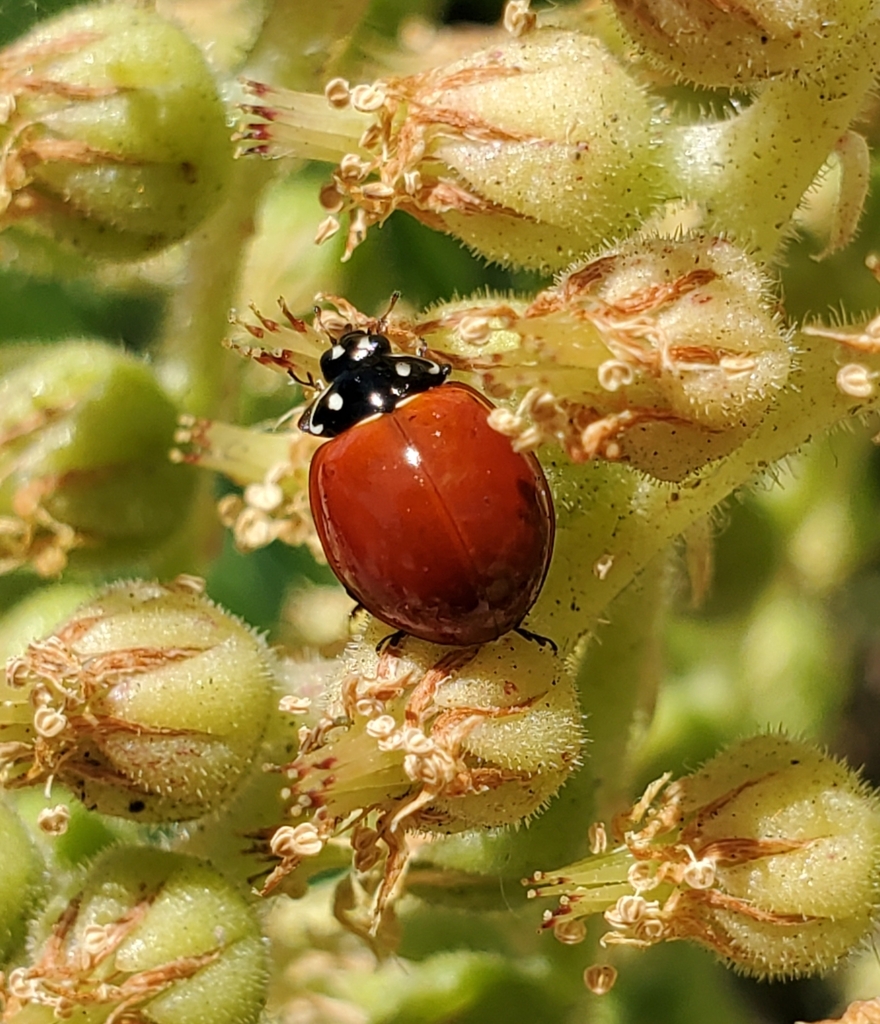
(c) Millie Basden, some rights reserved (CC BY) · licence
Family: Coccinellidae · Class: Insecta · Order: Coleoptera
Cycloneda sanguinea (Spotless Lady Beetle) is a California animal in the Coccinellidae family.
The Spotless Lady Beetle is a small predatory beetle measuring 3.5 to 5.5 mm in length. Adults display a distinctive coloration pattern with bright red to reddish-orange elytra (wing covers) that lack the spots typical of many other lady beetle species, hence the common name "spotless." The pronotum exhibits pale yellow lateral spots that are enclosed or surrounded by black coloration, distinguishing it from closely related species such as Cycloneda polita and C. munda, which have pale yellow "C"-shaped markings or nearly complete yellow rings rather than separate enclosed spots (BugGuide). The head is typically black with yellowish markings, and the legs are variable in coloration from yellowish to dark brown. Cycloneda sanguinea occurs across the southern United States, with its range extending from California to Florida and northward along the Atlantic coast to Virginia (BugGuide). The species is widely distributed throughout California, particularly in agricultural regions and areas with abundant aphid populations. This distribution pattern reflects the species' preference for warm climates and agricultural landscapes where prey species are abundant. The Spotless Lady Beetle inhabits diverse environments including agricultural fields, gardens, orchards, and natural areas with herbaceous vegetation. The species shows a strong association with crops such as cotton and alfalfa, as well as various weed species that support aphid populations (Mike Quinn, BugGuide 2014). Adults are commonly found on plants where soft-bodied insects congregate, particularly during the growing season when prey abundance is highest. As a predatory species, Cycloneda sanguinea feeds primarily on aphids, scale insects, and other soft-bodied arthropods, making it valuable for biological pest control in agricultural systems. Both adults and larvae are voracious predators, with a single individual capable of consuming dozens of aphids per day. The species exhibits seasonal activity patterns, with adults becoming active in spring as temperatures warm and prey becomes available. Reproduction typically occurs during late spring and summer, with females laying clusters of yellow eggs on leaves near aphid colonies. Development from egg to adult takes approximately 3-4 weeks under optimal conditions. Adults may undergo multiple generations per year in warmer climates, allowing populations to respond rapidly to increases in prey abundance. Like many native lady beetle species, Cycloneda sanguinea faces potential conservation challenges from habitat modification and competition with introduced species. Agricultural intensification and pesticide use can reduce both habitat quality and prey availability. However, the species' broad distribution, adaptability to various habitats, and tolerance for disturbed environments suggest relatively stable populations across most of its range. The species benefits from integrated pest management practices that preserve natural enemy populations and reduce reliance on broad-spectrum insecticides. No specific federal or state conservation status has been assigned to this species, indicating it is not currently considered at risk.
Classification
Class: Insecta · Order: Coleoptera · Family: Coccinellidae
Frequently asked questions
How is Cycloneda sanguinea classified?
Cycloneda sanguinea belongs to class Insecta, order Coleoptera, family Coccinellidae.
What family does Cycloneda sanguinea belong to?
Cycloneda sanguinea is in the Coccinellidae family.
What is Cycloneda sanguinea?
The Spotless Lady Beetle is a small predatory beetle measuring 3.5 to 5.5 mm in length.
Is Cycloneda sanguinea found in California?
Yes. Cycloneda sanguinea is recorded in California in The California Species Project's catalogue.
Related species
Other California species in the same genus, family, or bioregion.
Data from The California Species Project — 14,000+ California species with verified data from CNPS, CDFW, USFWS, and more.