Cyclophora dataria
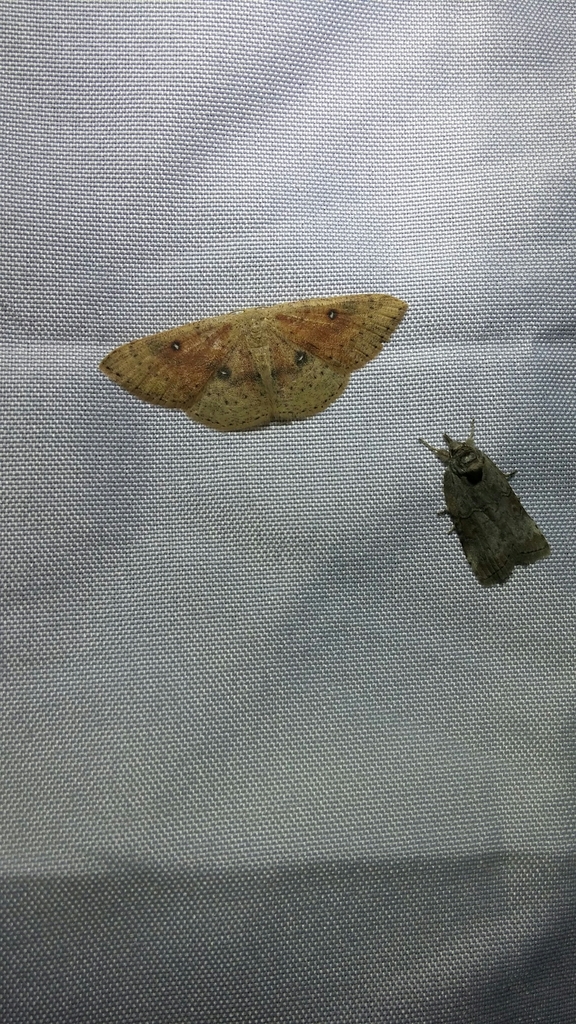
(c) Casey H. Richart, some rights reserved (CC BY) · licence
Family: Geometridae · Class: Insecta · Order: Lepidoptera
Cyclophora dataria is a California animal in the Geometridae family.
Cyclophora dataria is a geometrid moth in the family Geometridae, commonly known as a looper moth or inchworm moth. Adults have a wingspan of approximately 20-25 mm (0.8-1.0 inches), with forewings displaying a distinctive pattern of brown and gray coloration crossed by darker transverse lines. The hindwings are typically paler with similar but less pronounced markings. Males can be distinguished from females by their more feathered antennae and slightly smaller size. The species exhibits sexual dimorphism, with males often showing more contrasted wing patterns than females. This species occurs across western North America, ranging from British Columbia south through California, extending east to Arizona and north to Montana. The distribution follows oak woodland habitats throughout this range, with populations documented in both coastal and interior regions of California. The species' range corresponds closely with the distribution of its host plants in the oak woodlands and mixed oak forests of the western United States. Cyclophora dataria inhabits oak woodlands, mixed oak forests, and oak-dominated chaparral communities from sea level to approximately 2,000 meters (6,500 feet) elevation. The species is closely associated with oak (Quercus spp.) ecosystems, where larvae develop on various oak species. Adults are typically found in areas with mature oak canopy cover, as well as oak woodland edges and openings. The species appears to favor habitats with moderate to dense oak cover rather than sparse oak savanna environments. Adult moths are nocturnal and are attracted to artificial lights during their flight period. Larvae are typical geometrid caterpillars, moving in the characteristic looping motion that gives the family its common name of inchworm moths. The caterpillars feed exclusively on oak foliage, developing through several instars before pupating. Like many geometrid species, larvae often rest during daylight hours by extending their bodies at an angle from twigs, resembling small branches or bark fragments. The species likely has one or two generations per year, though specific details of the life cycle timing may vary with latitude and local climate conditions. Cyclophora dataria currently has no special conservation status at federal or state levels. The species is not listed under the Endangered Species Act nor designated as a species of special concern by California. Population trends are not well documented, but the widespread distribution and association with common oak woodland habitats suggest stable populations across most of the range. However, like other oak-dependent species, Cyclophora dataria may face localized pressures from oak woodland habitat conversion, urban development, and changes in fire regimes. Climate change impacts on oak ecosystems could potentially affect future population stability, particularly at elevation and latitude range margins where suitable oak habitat may shift.
Classification
Class: Insecta · Order: Lepidoptera · Family: Geometridae
Frequently asked questions
How is Cyclophora dataria classified?
Cyclophora dataria belongs to class Insecta, order Lepidoptera, family Geometridae.
What family does Cyclophora dataria belong to?
Cyclophora dataria is in the Geometridae family.
What is Cyclophora dataria?
Cyclophora dataria is a geometrid moth in the family Geometridae, commonly known as a looper moth or inchworm moth.
Is Cyclophora dataria found in California?
Yes. Cyclophora dataria is recorded in California in The California Species Project's catalogue.
Related species
Other California species in the same genus, family, or bioregion.
Data from The California Species Project — 14,000+ California species with verified data from CNPS, CDFW, USFWS, and more.