Cyclophora packardi
Packard's Wave
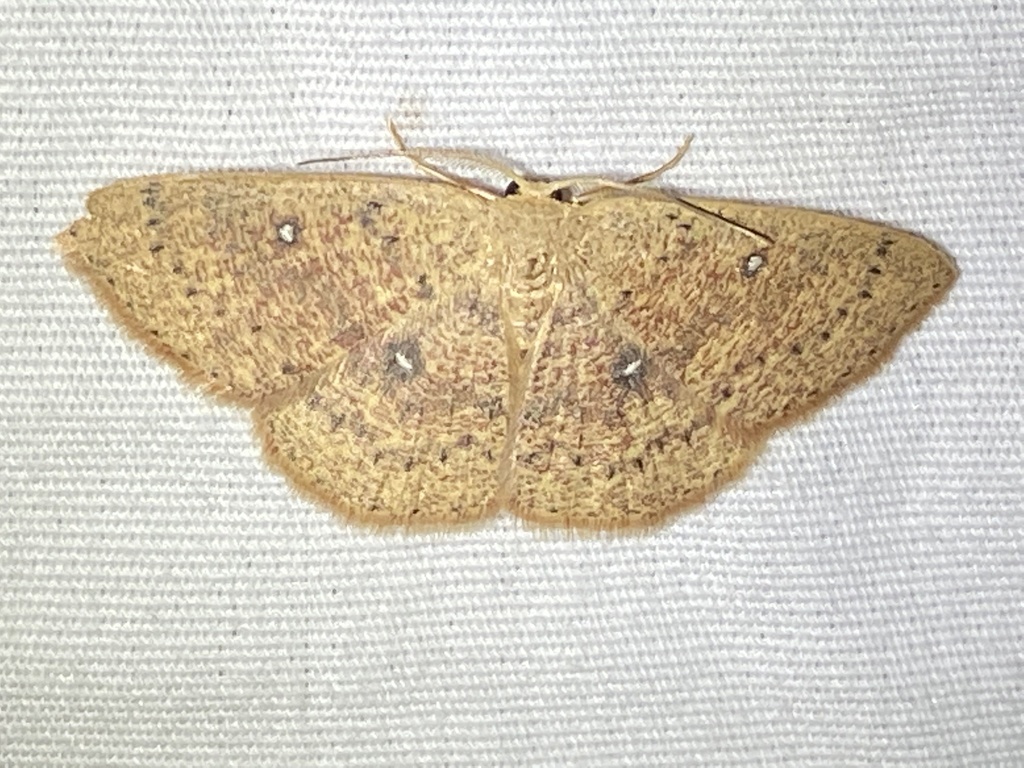
(c) David George, some rights reserved (CC BY) · licence
Family: Geometridae · Class: Insecta · Order: Lepidoptera
Cyclophora packardi (Packard's Wave) is a California animal in the Geometridae family.
Packard's Wave is a small geometrid moth in the family Geometridae, subfamily Larentiinae. Adults have a wingspan typically ranging from 18 to 25 millimeters (0.7 to 1.0 inches). The forewings are pale gray to brownish-gray with distinctive dark transverse lines creating the characteristic "wave" pattern that gives the species its common name. The hindwings are lighter in coloration, often whitish or pale gray, with less pronounced markings. The thorax matches the forewing coloration, and the antennae are thread-like in both sexes, though males may have slightly more feathered antennae. Packard's Wave occurs across much of North America, with records from southern Canada south to Mexico. In the western United States, the species is found from British Columbia through California, with populations documented in the Pacific Northwest, California's Central Valley, and coastal regions. The distribution extends eastward through the Rocky Mountain states and across much of the central and eastern United States. California populations are present in multiple counties, though specific distribution data remains limited. This species inhabits a variety of woodland and forest edge environments, from sea level to moderate elevations. Packard's Wave is associated with deciduous and mixed forests, particularly areas containing its larval host plants. The species shows preference for habitats with oak woodlands, riparian corridors, and forest clearings. Adults are typically found in areas with adequate canopy cover but sufficient openings for flight activity. Packard's Wave is univoltine in most of its range, producing one generation per year. Adults are active during late spring and early summer, typically from May through July, depending on local climate conditions. The species is nocturnal, with adults attracted to artificial lights. Females deposit eggs singly on or near host plant foliage. Larvae feed on various deciduous trees and shrubs, including species in the families Rosaceae and Fagaceae. Oak species (Quercus spp.) serve as primary host plants in many regions. Caterpillars are typical geometrid loopers, moving in the characteristic arching motion. Pupation occurs in the soil or leaf litter, with the pupal stage overwintering. Currently, Packard's Wave has no federal or state conservation listing status. The species appears to maintain stable populations across much of its range, though comprehensive population surveys have not been conducted. Like many forest-associated lepidoptera, potential threats include habitat loss from development and forest management practices, pesticide use, and climate change impacts on host plant phenology. Light pollution may affect adult behavior and reproduction. The species' relatively broad host plant range and wide geographic distribution suggest moderate resilience to environmental changes, though localized populations in fragmented habitats may face greater risks. No specific conservation measures are currently in place for this species.
Classification
Class: Insecta · Order: Lepidoptera · Family: Geometridae
Frequently asked questions
How is Cyclophora packardi classified?
Cyclophora packardi belongs to class Insecta, order Lepidoptera, family Geometridae.
What family does Cyclophora packardi belong to?
Cyclophora packardi is in the Geometridae family.
What is Cyclophora packardi?
Packard's Wave is a small geometrid moth in the family Geometridae, subfamily Larentiinae.
Is Cyclophora packardi found in California?
Yes. Cyclophora packardi is recorded in California in The California Species Project's catalogue.
Related species
Other California species in the same genus, family, or bioregion.
Data from The California Species Project — 14,000+ California species with verified data from CNPS, CDFW, USFWS, and more.