Cydia latiferreana
Filbertworm Moth
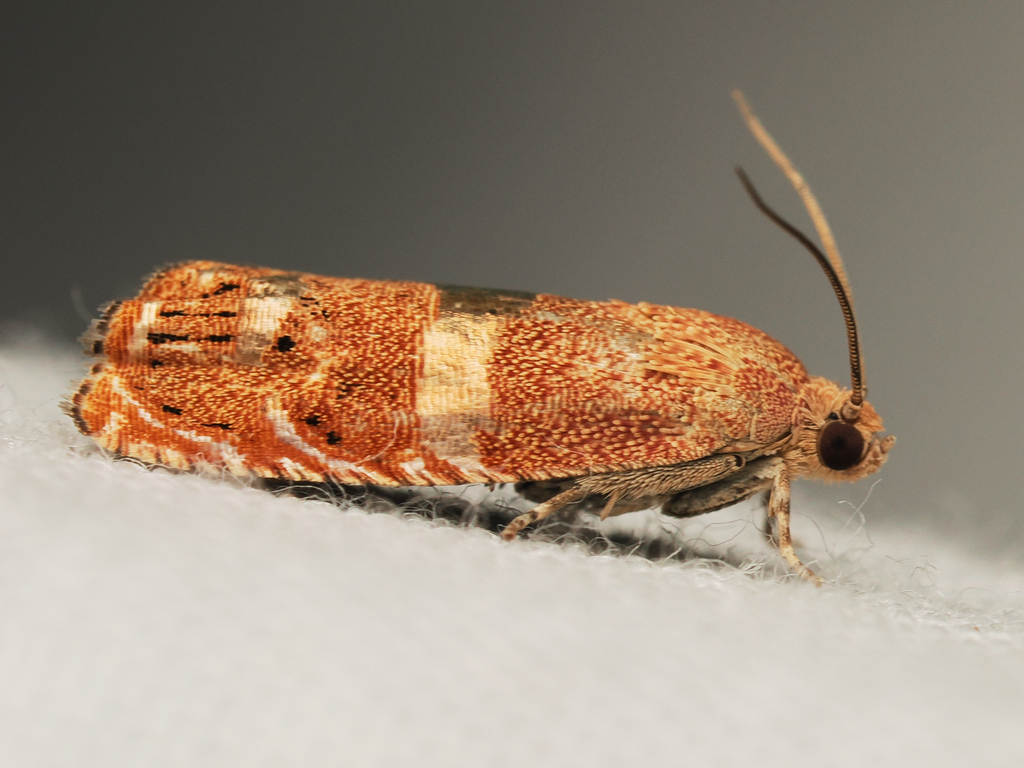
(c) Ken-ichi Ueda, some rights reserved (CC BY) · licence
Family: Tortricidae · Class: Insecta · Order: Lepidoptera
Cydia latiferreana (Filbertworm Moth) is a California animal in the Tortricidae family.
The filbertworm moth (Cydia latiferreana) is a small tortricid moth in the family Tortricidae, belonging to the economically important genus Cydia. Adults typically measure 8 to 12 mm (0.3 to 0.5 inches) in wingspan, with forewings displaying a mottled brown and gray coloration that provides effective camouflage against tree bark. The forewings feature distinctive metallic scaling and irregular pale markings, while the hindwings are uniformly pale gray to whitish. Males possess feathery antennae, and females have thread-like antennae typical of tortricid moths. Cydia latiferreana occurs across western North America, with documented populations extending from British Columbia south through California, Oregon, and Washington. In California, the species has been recorded in the Coast Ranges, Sierra Nevada foothills, and Central Valley regions where suitable host plants occur. The moth's distribution closely follows that of its primary host plants in the family Betulaceae. The species inhabits deciduous woodlands, riparian corridors, and areas adjacent to commercial and ornamental plantings of hazelnuts and related trees. Filbertworm moths are typically found at elevations ranging from sea level to approximately 1,500 meters (4,900 feet), though they are most common in foothill and valley environments. Adults are associated with mixed deciduous forests and urban landscapes where host trees are present. Filbertworm moth larvae are specialized feeders on trees in the family Betulaceae, particularly hazelnuts (Corylus species), but also utilize oak (Quercus) and occasionally other deciduous trees. The common name 'filbertworm' reflects the larval feeding behavior in commercial hazelnut crops. Adult moths emerge in late spring and early summer, typically from May through July, with peak activity occurring during warm evenings. Females lay eggs singly on host plant foliage or bark crevices. First-instar larvae bore into developing nuts or acorns, where they complete their development by feeding on the kernel contents. The species produces one generation per year, overwintering as mature larvae within fallen nuts before pupating in spring. Mating occurs through chemical communication, with females releasing species-specific pheromones to attract males. Adults are primarily nocturnal and are attracted to artificial lights during their flight period. The larvae's feeding behavior can result in premature nut drop and reduced crop yields in commercial hazelnut orchards. Currently, Cydia latiferreana does not appear on federal or state conservation lists, suggesting stable populations across its range. The species likely benefits from both natural woodland habitats and expanded cultivation of ornamental and commercial hazelnut plantings. As a native species that has adapted to both natural and managed landscapes, the filbertworm moth represents a successful example of adaptation to human-modified environments. However, intensive pesticide applications in commercial orchards may pose localized threats to some populations. No specific conservation measures are currently implemented for this species.
Classification
Class: Insecta · Order: Lepidoptera · Family: Tortricidae
Frequently asked questions
How is Cydia latiferreana classified?
Cydia latiferreana belongs to class Insecta, order Lepidoptera, family Tortricidae.
What family does Cydia latiferreana belong to?
Cydia latiferreana is in the Tortricidae family.
What is Cydia latiferreana?
The filbertworm moth (Cydia latiferreana) is a small tortricid moth in the family Tortricidae, belonging to the economically important genus Cydia.
Is Cydia latiferreana found in California?
Yes. Cydia latiferreana is recorded in California in The California Species Project's catalogue.
Related species
Other California species in the same genus, family, or bioregion.
Data from The California Species Project — 14,000+ California species with verified data from CNPS, CDFW, USFWS, and more.