Cygnus buccinator
Trumpeter swan
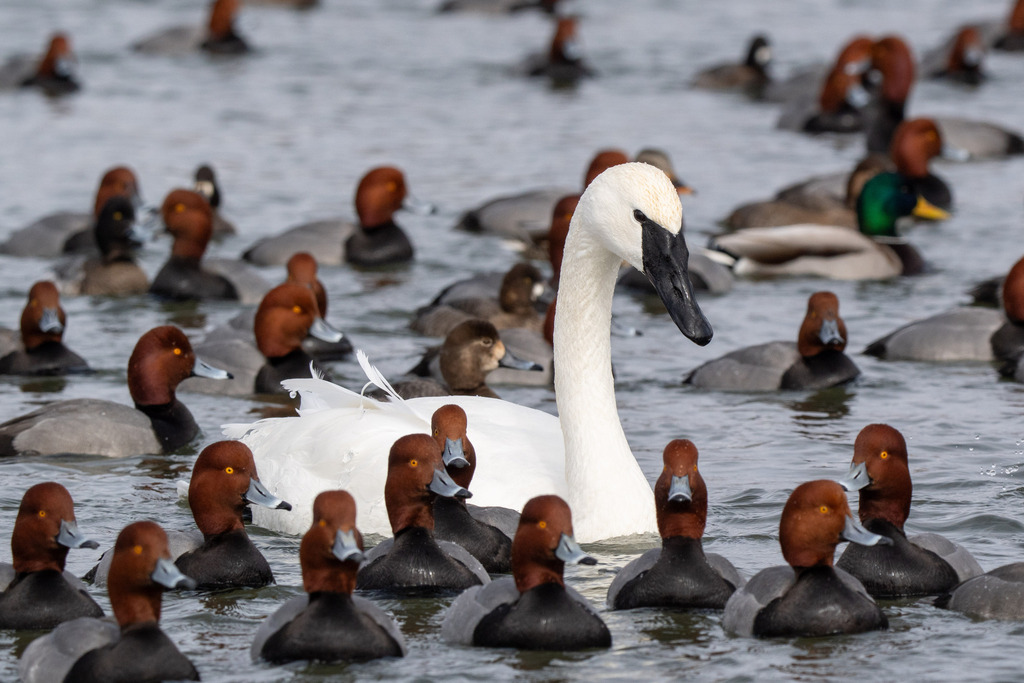
(c) Andrew Lai, some rights reserved (CC BY) · licence
Family: Anatidae · Class: Aves · Order: Anseriformes
Conservation status: FP
Cygnus buccinator (Trumpeter swan) is a California animal in the Anatidae family.
The trumpeter swan is North America's largest waterfowl species and the world's largest swan. Adults measure 138 to 165 cm (54 to 65 inches) in length with a wingspan reaching 244 cm (96 inches). Males typically weigh 10.5 to 12.7 kg (23 to 28 pounds), while females are smaller at 9.4 to 10.8 kg (21 to 24 pounds). The species displays entirely white plumage in adults, with a long, straight neck and large, flat bill that is black with a thin salmon-colored stripe along the cutting edge. Juveniles are gray-brown with pink bills that darken with age. The trumpeter swan is distinguished from the tundra swan by its larger size, lack of yellow marking near the eye, and deeper, more resonant call. Historically, trumpeter swans bred across much of northern North America from Alaska to the Great Lakes region. In California, the species was likely a regular winter visitor to Central Valley wetlands and coastal areas before widespread habitat loss. Current populations in the continental United States are concentrated in Alaska, western Canada, and portions of the northwestern states including Montana, Idaho, Washington, and Oregon. Small numbers winter in California, primarily in the Central Valley and northeastern counties. Trumpeter swans inhabit shallow wetlands including lakes, ponds, marshes, and slow-moving rivers with emergent vegetation. Breeding habitat requires water bodies with abundant submerged aquatic vegetation and minimal human disturbance. Nesting sites are typically on muskrat houses, beaver lodges, or low islands surrounded by water. During winter, the species utilizes agricultural fields, particularly those with waste grain, and open water areas that remain ice-free. The species is primarily herbivorous, feeding on submerged aquatic plants, roots, and tubers obtained by dabbling and tipping up. During winter, trumpeter swans consume agricultural grains including corn, wheat, and barley. Breeding pairs are monogamous and highly territorial, establishing pair bonds that often last multiple seasons. Nesting occurs from April through June, with females laying 3 to 5 cream-colored eggs in large nests constructed from plant material. Incubation lasts 32 to 37 days, and cygnets remain with parents for 3 to 4 months after hatching. Trumpeter swans are classified as Fully Protected under California law, providing the species with complete protection from hunting and harassment. The species experienced severe population declines in the late 1800s and early 1900s due to commercial hunting for feathers and meat, reducing North American populations to fewer than 70 birds by 1935. Intensive management efforts, including habitat protection and restoration, captive breeding programs, and translocation efforts, have facilitated population recovery. Current threats include habitat loss from development and agriculture, collisions with power lines, lead poisoning from fishing tackle, and climate change impacts on wetland ecosystems. According to the California Department of Fish and Wildlife, the species is not currently tracked by the California Natural Diversity Database.
Classification
Class: Aves · Order: Anseriformes · Family: Anatidae
Conservation status
FP
Frequently asked questions
How is Cygnus buccinator classified?
Cygnus buccinator belongs to class Aves, order Anseriformes, family Anatidae.
What family does Cygnus buccinator belong to?
Cygnus buccinator is in the Anatidae family.
Is Cygnus buccinator protected or of conservation concern?
Cygnus buccinator carries the following status: FP.
What is Cygnus buccinator?
The trumpeter swan is North America's largest waterfowl species and the world's largest swan.
Is Cygnus buccinator found in California?
Yes. Cygnus buccinator is recorded in California in The California Species Project's catalogue.
Related species
Other California species in the same genus, family, or bioregion.
Data from The California Species Project — 14,000+ California species with verified data from CNPS, CDFW, USFWS, and more.