Cynips douglasii
Spined Turban Gall Wasp
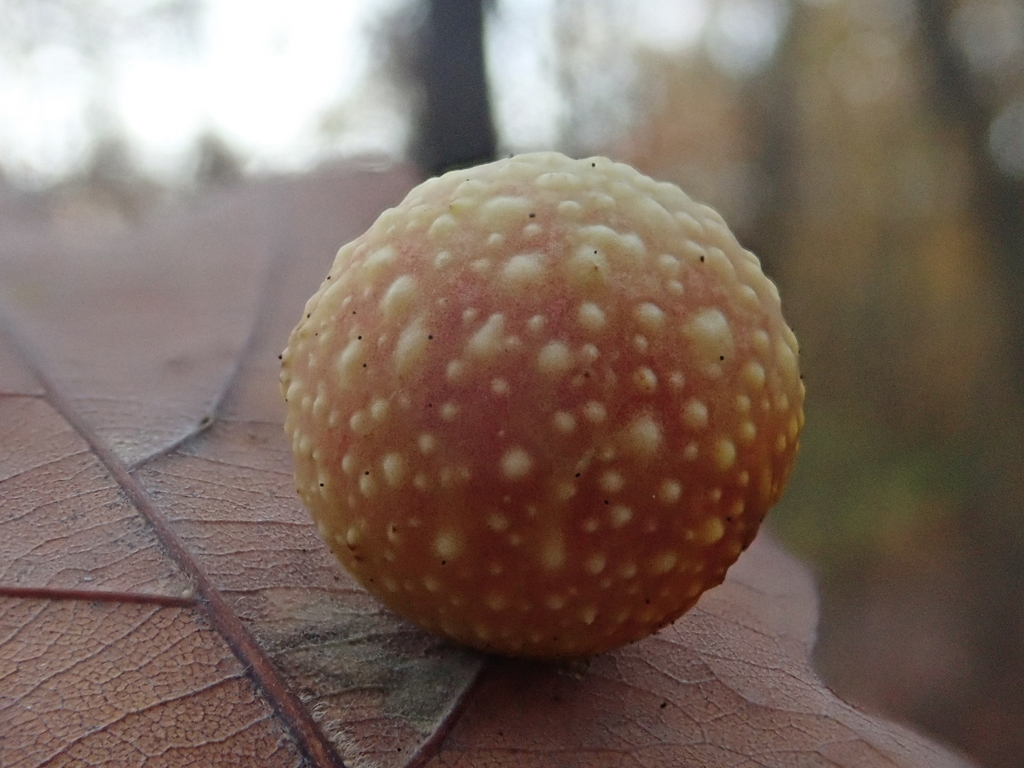
(c) Alexis Tinker-Tsavalas, some rights reserved (CC BY) · licence
Family: Cynipidae · Class: Insecta · Order: Hymenoptera
Cynips douglasii (Spined Turban Gall Wasp) is a California animal in the Cynipidae family.
Cynips douglasii, the spined turbaned gall wasp, is a small hymenopteran in the family Cynipidae that creates distinctive galls on oak trees. Adults are tiny wasps typically measuring 2-4 millimeters in length, with the typical cynipid body structure including a compact thorax and laterally compressed abdomen. The species exhibits sexual dimorphism, with females possessing a prominent ovipositor for egg-laying within oak tissues. This species occurs throughout California wherever suitable oak hosts are present, with documented populations from coastal regions to interior valleys and foothills. The wasp has been recorded on multiple oak species including valley oak (Quercus lobata), blue oak (Q. douglasii), Engelmann oak (Q. engelmannii), and various scrub oak species (BugGuide). Its distribution closely follows that of its white oak group hosts across the state's oak woodlands and savanna ecosystems. Cynips douglasii inhabits oak woodlands, grasslands with scattered oaks, and mixed oak-chaparral communities from sea level to montane elevations. The species shows specificity for white oak group species, avoiding red oak group trees. Adult wasps are most commonly found in proximity to their host oaks during the spring emergence period, while galls containing developing larvae can be observed year-round on suitable host trees. The species exhibits a complex life cycle typical of cynipid gall wasps. Females insert eggs into oak twigs or small branches using their specialized ovipositor, injecting chemicals that manipulate plant growth to form the characteristic spined turban-shaped gall. These galls are roughly spherical with prominent spines projecting from the surface, giving them their distinctive turbaned appearance. The galls provide both shelter and nutrition for the developing larvae, which feed on nutritive tissue within the gall cavity. Development typically requires one year, with adults emerging in spring to mate and begin the cycle again. The galls persist on trees long after adult emergence, becoming brown and woody structures. Like many gall wasp species, C. douglasii may exhibit alternating generations with different gall forms, though the complete life cycle has not been thoroughly documented in scientific literature. The species serves as host to various parasitoid wasps and inquilines that exploit the gall environment. Cynips douglasii has no formal conservation status listings at federal or state levels. As a specialized herbivore dependent on native California oaks, the species faces potential threats from habitat loss, oak woodland conversion, and climate change impacts on host tree distributions. Oak woodlands have experienced significant historical losses due to agricultural and urban development, though remaining populations appear stable where suitable habitat persists. The species' conservation status mirrors that of California's oak ecosystems generally. Scientific documentation for this species remains limited compared to more economically important gall wasps. The information presented here is based on available sources including BugGuide taxonomic databases and iNaturalist observations. If you have additional verified information about this species' biology, distribution, or ecology, please contact us to help improve this species account.
Classification
Class: Insecta · Order: Hymenoptera · Family: Cynipidae
Frequently asked questions
How is Cynips douglasii classified?
Cynips douglasii belongs to class Insecta, order Hymenoptera, family Cynipidae.
What family does Cynips douglasii belong to?
Cynips douglasii is in the Cynipidae family.
What is Cynips douglasii?
Cynips douglasii, the spined turbaned gall wasp, is a small hymenopteran in the family Cynipidae that creates distinctive galls on oak trees.
Is Cynips douglasii found in California?
Yes. Cynips douglasii is recorded in California in The California Species Project's catalogue.
Related species
Other California species in the same genus, family, or bioregion.
Data from The California Species Project — 14,000+ California species with verified data from CNPS, CDFW, USFWS, and more.