Cyprinodon nevadensis mionectes
Ash Meadows Amargosa pupfish
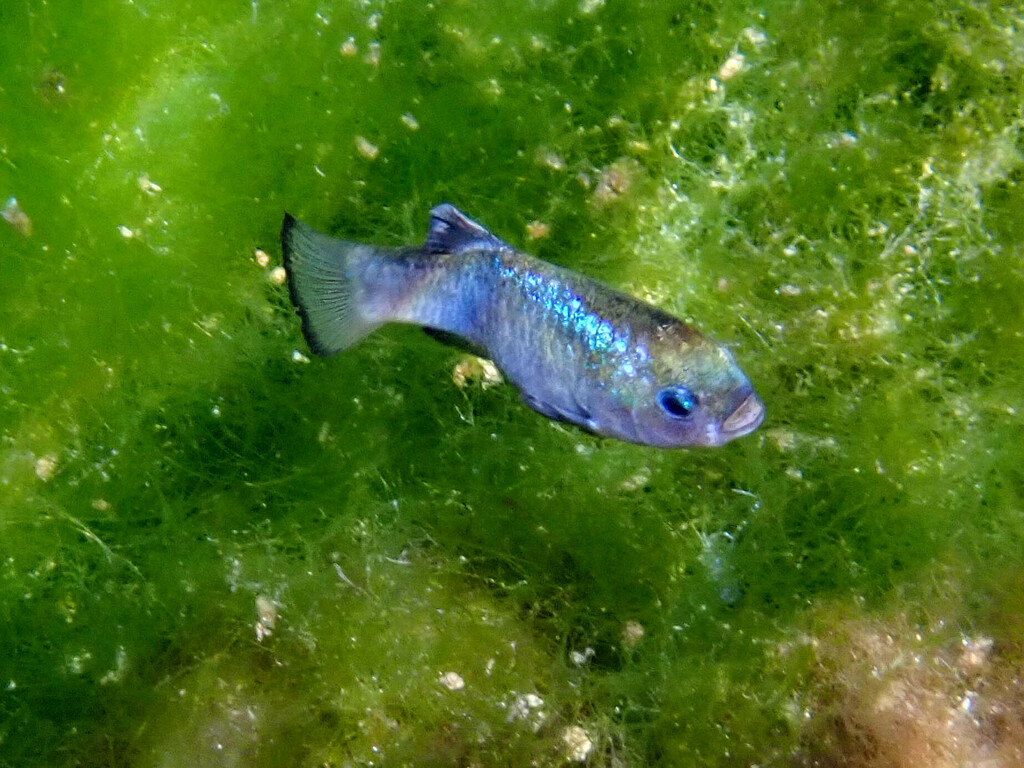
(c) Madeleine Claire, some rights reserved (CC BY) · licence
Family: Cyprinodontidae · Class: Actinopterygii · Order: Cyprinodontiformes
Conservation status: Endangered
Cyprinodon nevadensis mionectes (Ash Meadows Amargosa pupfish) is a California animal in the Cyprinodontidae family.
The Ash Meadows Amargosa pupfish is a small, endemic desert fish measuring approximately 25 to 50 millimeters (1.0 to 2.0 inches) in total length. This subspecies of Cyprinodon nevadensis exhibits the typical pupfish body form with a deep, laterally compressed body, large head, and upturned mouth. Males develop bright blue coloration during breeding season, while females and non-breeding males display more subdued olive-brown tones. The species possesses a single dorsal fin positioned posteriorly and lacks pelvic fins. The Ash Meadows Amargosa pupfish is endemic to the Ash Meadows region of Nye County, Nevada, near the California border. This subspecies occupies ten distinct spring systems within the Ash Meadows valley, including Point of Rocks Springs, Fairbanks Spring, and Big Spring. The total range encompasses less than 20 square kilometers (8 square miles) of aquatic habitat within the Mojave Desert ecosystem. The species inhabits spring-fed pools, outflow channels, and associated marsh areas characterized by constant water temperatures ranging from 28 to 34°C (82 to 93°F). These thermal springs maintain stable water levels and temperatures year-round, creating unique desert oases. The pupfish tolerates high salinity levels and low dissolved oxygen concentrations that would be lethal to most other fish species. Water depths in occupied habitats typically range from 0.3 to 2.0 meters (1 to 6.5 feet), with substrates consisting of sand, gravel, and organic debris. Ash Meadows Amargosa pupfish are omnivorous, feeding primarily on blue-green algae supplemented by small invertebrates including chironomid larvae, ostracods, and copepods. The species exhibits diurnal feeding behavior, actively foraging from sunrise to sunset and remaining inactive during nighttime hours. Spawning occurs year-round in the stable thermal environment, with peak reproductive activity during spring months. Males establish territories in shallow areas and develop intensified breeding coloration to attract females. Females deposit adhesive eggs on submerged vegetation and substrate, with larvae hatching within 7 to 10 days. The U.S. Fish and Wildlife Service listed the Ash Meadows Amargosa pupfish as endangered on September 23, 1982, due to habitat degradation and water diversions. Critical habitat designation encompasses approximately 36 acres across the ten occupied spring systems (USFWS 1990). The total population is estimated in the thousands across all spring systems, with the largest populations occurring in Point of Rocks Springs and Fairbanks Spring. Primary threats include groundwater pumping that reduces spring discharge, habitat modification from agricultural development, and introduction of non-native species such as mosquitofish and bullfrogs. The establishment of Ash Meadows National Wildlife Refuge in 1984 provides federal protection for most occupied habitats. Recent conservation efforts focus on habitat restoration, removal of invasive species, and monitoring of spring discharge rates to ensure adequate water levels for pupfish survival.
Classification
Class: Actinopterygii · Order: Cyprinodontiformes · Family: Cyprinodontidae
Conservation status
Endangered
Frequently asked questions
How is Cyprinodon nevadensis mionectes classified?
Cyprinodon nevadensis mionectes belongs to class Actinopterygii, order Cyprinodontiformes, family Cyprinodontidae.
What family does Cyprinodon nevadensis mionectes belong to?
Cyprinodon nevadensis mionectes is in the Cyprinodontidae family.
Is Cyprinodon nevadensis mionectes protected or of conservation concern?
Cyprinodon nevadensis mionectes carries the following status: Endangered.
What is Cyprinodon nevadensis mionectes?
The Ash Meadows Amargosa pupfish is a small, endemic desert fish measuring approximately 25 to 50 millimeters (1.0 to 2.0 inches) in total length.
Is Cyprinodon nevadensis mionectes found in California?
Yes. Cyprinodon nevadensis mionectes is recorded in California in The California Species Project's catalogue.
Related species
Other California species in the same genus, family, or bioregion.
Data from The California Species Project — 14,000+ California species with verified data from CNPS, CDFW, USFWS, and more.