Cypseloides niger
Black Swift
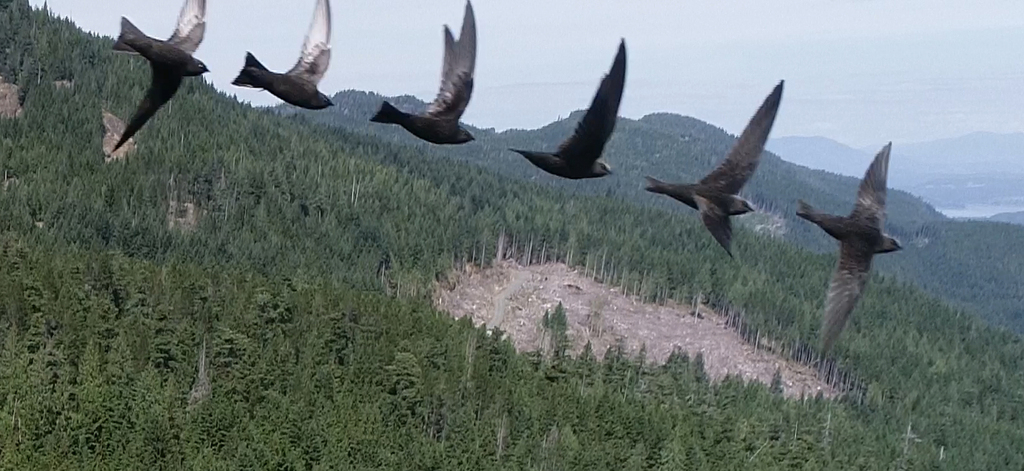
no rights reserved · CC0
Family: Apodidae · Class: Aves · Order: Apodiformes
Conservation status: G4 S3
Cypseloides niger (Black Swift) is a California animal in the Apodidae family.
The Black Swift is North America's largest swift species, measuring 18 to 19 centimeters (7.1 to 7.5 inches) in length with a wingspan reaching 41 centimeters (16 inches). The species exhibits uniformly dark brown to black plumage across its entire body, appearing nearly black in flight. The tail is distinctly notched, though less deeply forked than other swift species. Wings are long, narrow, and curved, characteristic of aerial insectivores adapted for continuous flight. Males and females are similar in appearance, with juveniles showing slightly lighter coloration and more prominent pale feather edges. Black Swifts breed across western North America from southeastern Alaska south through the western United States to Central America. In California, the species occurs primarily in mountainous regions including the Sierra Nevada, Cascade Range, and coastal mountains. The breeding range extends from sea level to elevations exceeding 3,000 meters (9,800 feet). During winter, North American populations migrate to South America, though specific wintering grounds remain poorly documented. The species' secretive nesting habits and remote habitat preferences have made comprehensive range mapping challenging. Breeding habitat consists of steep cliff faces, typically near or behind waterfalls, in rocky canyons, or along sea cliffs where moisture creates suitable microclimatic conditions. Nests are constructed on narrow ledges or in shallow caves where constant moisture from spray or seepage maintains humid conditions necessary for successful reproduction. The species shows strong fidelity to traditional nesting colonies, which may be used for decades. Foraging occurs over diverse habitats including forests, meadows, lakes, and urban areas, often at considerable distances from nesting sites. Black Swifts are aerial specialists, capturing flying insects exclusively on the wing. Their diet consists primarily of flying ants, termites, beetles, flies, and other small insects, with seasonal variation reflecting local insect emergence patterns. The species can remain continuously airborne for extended periods, with individuals capable of flying at altitudes up to 4,000 meters (13,000 feet) and covering distances exceeding 500 kilometers during daily foraging flights. Breeding occurs from late May through August, with pairs typically producing a single white egg. The prolonged incubation period of 24 to 27 days and extended nestling phase of 45 to 49 days represent the longest reproductive cycle among North American swifts. Both parents participate in incubation and chick-rearing duties. The Black Swift currently holds a Global Rank of G4 (apparently secure) but a California State Rank of S3 (vulnerable), reflecting population concerns within the state. Primary conservation challenges include habitat loss from development near nesting sites, water diversions that alter waterfall flows, climate change impacts on insect prey availability, and disturbance at sensitive nesting colonies. The species' dependence on specific microhabitat conditions makes it particularly vulnerable to environmental changes. Population monitoring remains difficult due to the species' remote nesting locations and aerial lifestyle, though citizen science efforts and targeted surveys have improved understanding of distribution patterns. Conservation efforts focus on protecting known nesting sites and maintaining natural hydrological processes that sustain suitable breeding habitat.
Classification
Class: Aves · Order: Apodiformes · Family: Apodidae
Conservation status
G4 S3
Frequently asked questions
How is Cypseloides niger classified?
Cypseloides niger belongs to class Aves, order Apodiformes, family Apodidae.
What family does Cypseloides niger belong to?
Cypseloides niger is in the Apodidae family.
Is Cypseloides niger protected or of conservation concern?
Cypseloides niger carries the following status: G4 S3.
What is Cypseloides niger?
The Black Swift is North America's largest swift species, measuring 18 to 19 centimeters (7.1 to 7.5 inches) in length with a wingspan reaching 41 centimeters (16 inches).
Is Cypseloides niger found in California?
Yes. Cypseloides niger is recorded in California in The California Species Project's catalogue.
Related species
Other California species in the same genus, family, or bioregion.
Data from The California Species Project — 14,000+ California species with verified data from CNPS, CDFW, USFWS, and more.