Dama dama
Fallow Deer
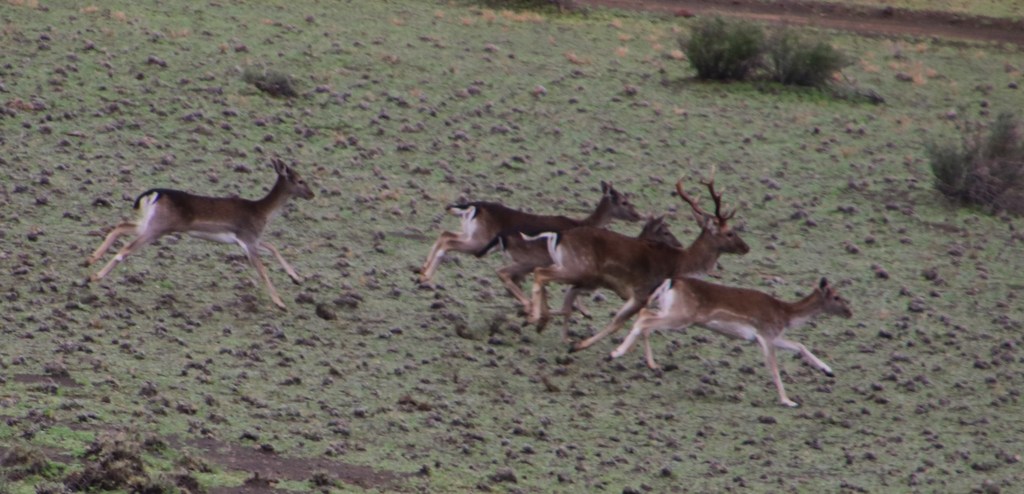
(c) Tony Rebelo, some rights reserved (CC BY-SA) · licence
Family: Cervidae · Class: Mammalia · Order: Artiodactyla
Dama dama (Fallow Deer) is a California animal in the Cervidae family.
The fallow deer is a medium-sized cervid species native to Europe and western Asia that has been introduced to numerous locations worldwide, including California. Adult males (bucks) typically measure 130 to 175 cm (51 to 69 inches) in body length and weigh 35 to 100 kg (77 to 220 pounds), while females (does) are smaller, weighing 25 to 45 kg (55 to 99 pounds). The species exhibits considerable color variation, with four primary coat patterns: common (chestnut-brown with white spots), menil (pale with white spots), melanistic (dark brown to black), and white (leucistic). During summer, most individuals display the characteristic spotted coat with white spots arranged in rows along the flanks and back. Males develop broad, palmate antlers that can span up to 70 cm (28 inches) in width, with the palmation becoming more pronounced with age. In California, fallow deer occur as introduced populations primarily on private ranches and hunting preserves throughout the state. Established populations exist in various counties, with notable concentrations in coastal and interior regions. The California Department of Fish and Wildlife does not maintain specific population estimates for this non-native species, as it is not considered part of the state's native fauna. Fallow deer are highly adaptable and occupy diverse habitat types including oak woodlands, grasslands, chaparral, and mixed coniferous forests. They prefer areas with a mosaic of open grasslands for foraging and wooded areas for cover and thermal regulation. The species tolerates a wide range of elevations from sea level to approximately 1,500 meters (4,900 feet). Unlike some cervid species, fallow deer can persist in relatively arid environments and show considerable flexibility in habitat selection. Fallow deer are primarily grazers and browsers, feeding on grasses, forbs, leaves, twigs, and bark. Their diet varies seasonally, with grasses comprising the majority during spring and summer months, while browse becomes more important during autumn and winter. The species exhibits a polygynous mating system, with breeding occurring from September through November. Males establish territories and engage in ritualized displays and vocalizations to attract females. After a gestation period of approximately 230 days, does typically give birth to a single fawn, occasionally twins, in late spring or early summer. As a non-native species in California, fallow deer are not protected under state or federal endangered species legislation. The species is classified as Least Concern globally by the International Union for Conservation of Nature, with stable populations in its native range and numerous introduced populations worldwide. In California, fallow deer are managed as an exotic game species and may be hunted year-round on private lands with appropriate licenses. While not considered a significant ecological threat compared to some invasive species, fallow deer can compete with native ungulates for forage and may cause localized habitat impacts through browsing and grazing pressure in sensitive ecosystems.
Classification
Class: Mammalia · Order: Artiodactyla · Family: Cervidae
Frequently asked questions
How is Dama dama classified?
Dama dama belongs to class Mammalia, order Artiodactyla, family Cervidae.
What family does Dama dama belong to?
Dama dama is in the Cervidae family.
What is Dama dama?
The fallow deer is a medium-sized cervid species native to Europe and western Asia that has been introduced to numerous locations worldwide, including California.
Is Dama dama found in California?
Yes. Dama dama is recorded in California in The California Species Project's catalogue.
Related species
Other California species in the same genus, family, or bioregion.
Data from The California Species Project — 14,000+ California species with verified data from CNPS, CDFW, USFWS, and more.