Danaus gilippus
Queen
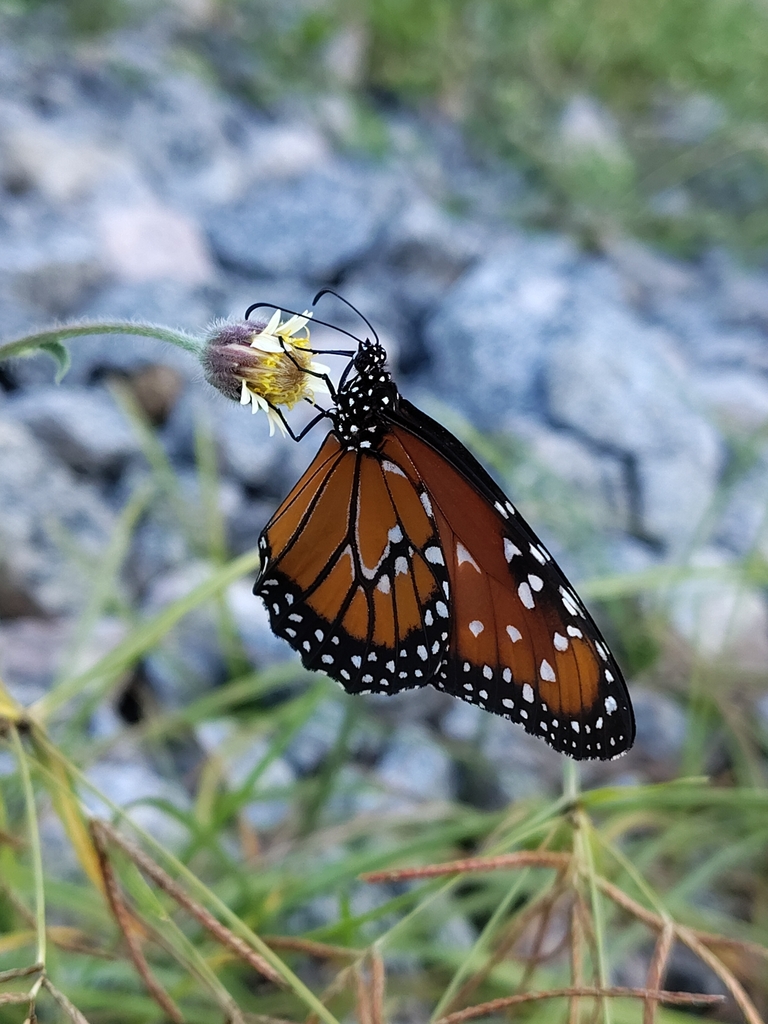
(c) Lucas Kaminski, some rights reserved (CC BY) · licence
Family: Nymphalidae · Class: Insecta · Order: Lepidoptera
Danaus gilippus (Queen) is a California animal in the Nymphalidae family.
The Queen (Danaus gilippus) is a medium-sized butterfly in the family Nymphalidae, closely related to the Monarch butterfly. Adults have a wingspan of 70-88 mm (2.8-3.5 inches). Males are orange-brown with black borders on the forewings and distinctive black scent patches on the hindwings. Females are similar but lack the scent patches and appear slightly duller in coloration. Both sexes display white spots scattered across the wings, with males showing more prominent white spotting. The undersides of the wings are paler orange-brown with more extensive white spotting and black veining. Larvae are distinctive with alternating black, white, and yellow stripes and three pairs of black filaments - one pair at the head, one at the thorax, and one at the rear. The Queen is resident in the extreme southern United States south through tropical lowlands of the West Indies and Central America to Argentina. It occurs as a regular stray and sometime colonist in the plains, rarely reaching the Atlantic coastal plain to Massachusetts and the Great Plains. In California, the species is primarily found in the southern regions, with populations extending northward along the coast and into the Central Valley during favorable conditions. The species exhibits some migratory behavior, though less pronounced than the Monarch butterfly. Queens inhabit a variety of open habitats including desert washes, fields, roadsides, gardens, and scrublands from sea level to approximately 2,100 meters (6,900 feet) elevation. They prefer areas with abundant milkweed plants and are often found in disturbed habitats where these host plants colonize readily. The species shows preference for warmer, drier conditions compared to Monarchs. Adults are active year-round in warmer regions, with peak activity during spring and fall. Males establish territories and use their scent patches to release pheromones during courtship. Females lay single eggs on milkweed host plants, primarily species in the genus Asclepias and related milkweed vines. The species feeds exclusively on milkweeds and milkweed vines during the larval stage. Some of these milkweeds contain cardiac glycosides which are stored in the bodies of both the caterpillar and adult. These compounds are distasteful and emetic to birds and other vertebrate predators. After tasting a Queen, a predator might associate the bright warning colors of the adult or caterpillar with an unpleasant meal and avoid Queens in the future. Adults nectar on a wide variety of flowering plants including milkweeds, lantana, pentas, and various composites. The species completes multiple generations per year in suitable habitat. The Queen is not federally or state listed and appears to maintain stable populations across much of its range. However, like other milkweed-dependent species, it faces threats from habitat loss, pesticide use, and decline of native milkweed populations. The Florida Viceroy (Limenitis archippus floridensis) serves as a Batesian mimic of the Queen, having evolved similar coloration to benefit from the Queen's unpalatability to predators. Conservation efforts focus on milkweed habitat preservation and restoration.
Classification
Class: Insecta · Order: Lepidoptera · Family: Nymphalidae
Frequently asked questions
How is Danaus gilippus classified?
Danaus gilippus belongs to class Insecta, order Lepidoptera, family Nymphalidae.
What family does Danaus gilippus belong to?
Danaus gilippus is in the Nymphalidae family.
What is Danaus gilippus?
The Queen (Danaus gilippus) is a medium-sized butterfly in the family Nymphalidae, closely related to the Monarch butterfly.
Is Danaus gilippus found in California?
Yes. Danaus gilippus is recorded in California in The California Species Project's catalogue.
Related species
Other California species in the same genus, family, or bioregion.
Data from The California Species Project — 14,000+ California species with verified data from CNPS, CDFW, USFWS, and more.