Dasychira sp.
Tussock Moth (genus-level)
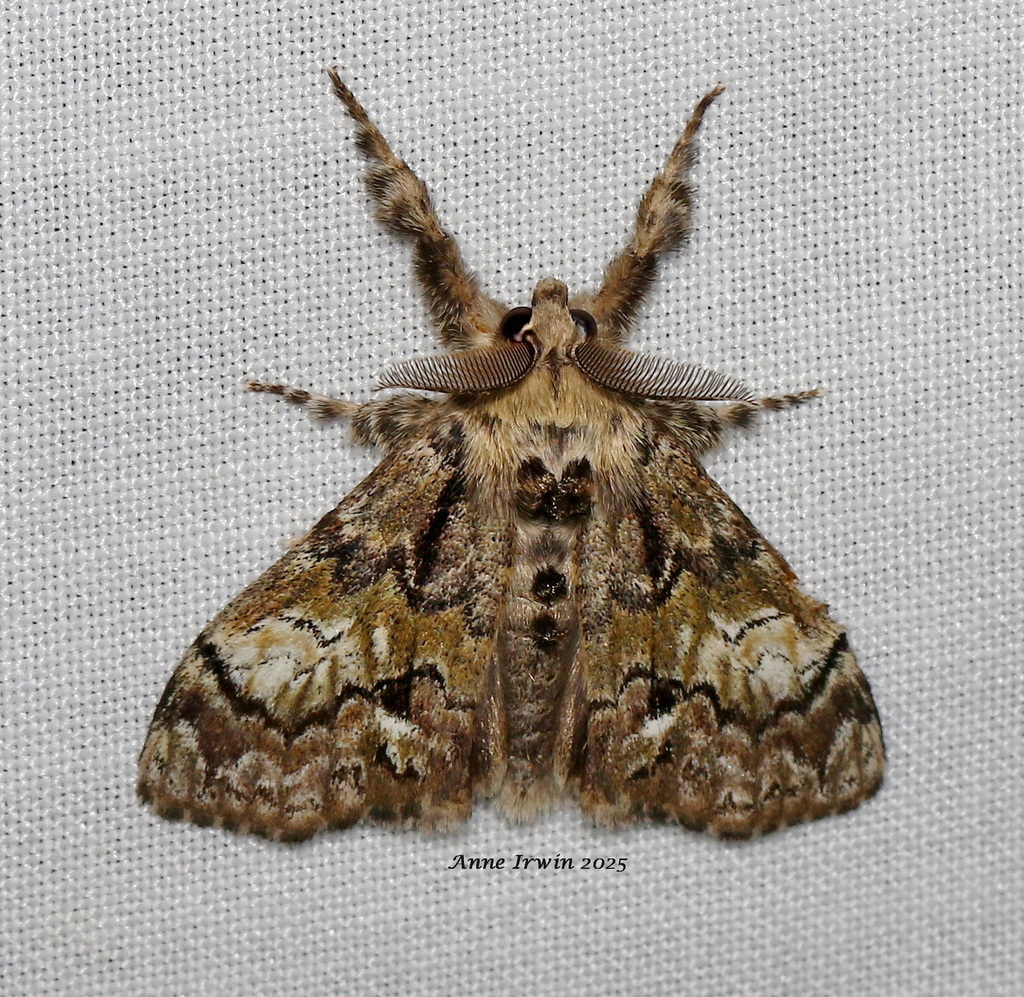
(c) anneirwin, some rights reserved (CC BY) · licence
Family: Erebidae · Class: Insecta · Order: Lepidoptera
Dasychira sp. (Tussock Moth (genus-level)) is a California animal in the Erebidae family.
Tussock moths of the genus Dasychira are medium-sized moths in the family Erebidae, subfamily Lymantriinae. Adults typically display cryptic coloration with mottled brown, gray, and white patterns that provide camouflage against tree bark and lichen. Males are generally smaller and more slender than females, with feathery antennae and functional wings. Females are often larger with reduced wings and may be partially or completely flightless. The larvae are distinctive caterpillars covered in dense tufts of hair, including characteristic pencil-like tufts extending from the head and posterior segments. The genus Dasychira occurs across North America, with several species documented in California. Distribution patterns vary by species, with some occupying coastal regions while others are found in montane forests. The Sharp-lined Tussock Moth (Dasychira dorsipennata) represents one example of the genus found in western North America (BAMONA). Species within this genus typically have localized distributions and may be associated with specific elevation ranges or vegetation communities. Dasychira species inhabit forested environments where their host plants occur. Different species within the genus utilize various deciduous and coniferous trees as larval food sources. Forest edges, woodland openings, and areas with mixed vegetation often provide suitable habitat. Elevation preferences vary among species, with some occurring from sea level to montane zones. The availability of appropriate host plants appears to be a primary factor determining habitat suitability. The larvae are the most conspicuous life stage, feeding on foliage of their host trees during spring and summer months. Caterpillars typically undergo five or six instars before pupating in cocoons constructed within bark crevices or among leaf litter. Adults emerge in late summer or fall, with timing varying by species and geographic location. Females often mate shortly after emergence and deposit eggs in masses on host plant bark or nearby surfaces. The genus exhibits complete metamorphosis typical of Lepidoptera. Many species are univoltine, producing one generation per year. Conservation status varies among Dasychira species. While some maintain stable populations, others face pressures from habitat loss, forest management practices, and climate change. The genus includes at least one species, Dasychira dominickaria, that appears on U.S. Fish and Wildlife Service species lists (USFWS). Forest fragmentation and urbanization can impact local populations by reducing habitat connectivity and eliminating host plants. Climate-driven changes in forest composition may alter suitable habitat ranges for specialist species within the genus. Detailed ecological studies of many Dasychira species remain limited. Host plant relationships, population dynamics, and specific habitat requirements for individual species require further investigation. The inconspicuous nature of adults and the complex taxonomy within tussock moth groups contribute to knowledge gaps. Systematic surveys and molecular genetic studies could help clarify species boundaries and conservation priorities within this genus.
Classification
Class: Insecta · Order: Lepidoptera · Family: Erebidae
Frequently asked questions
How is Dasychira sp. classified?
Dasychira sp. belongs to class Insecta, order Lepidoptera, family Erebidae.
What family does Dasychira sp. belong to?
Dasychira sp. is in the Erebidae family.
What is Dasychira sp.?
Tussock moths of the genus Dasychira are medium-sized moths in the family Erebidae, subfamily Lymantriinae.
Is Dasychira sp. found in California?
Yes. Dasychira sp. is recorded in California in The California Species Project's catalogue.
Related species
Other California species in the same genus, family, or bioregion.
Data from The California Species Project — 14,000+ California species with verified data from CNPS, CDFW, USFWS, and more.